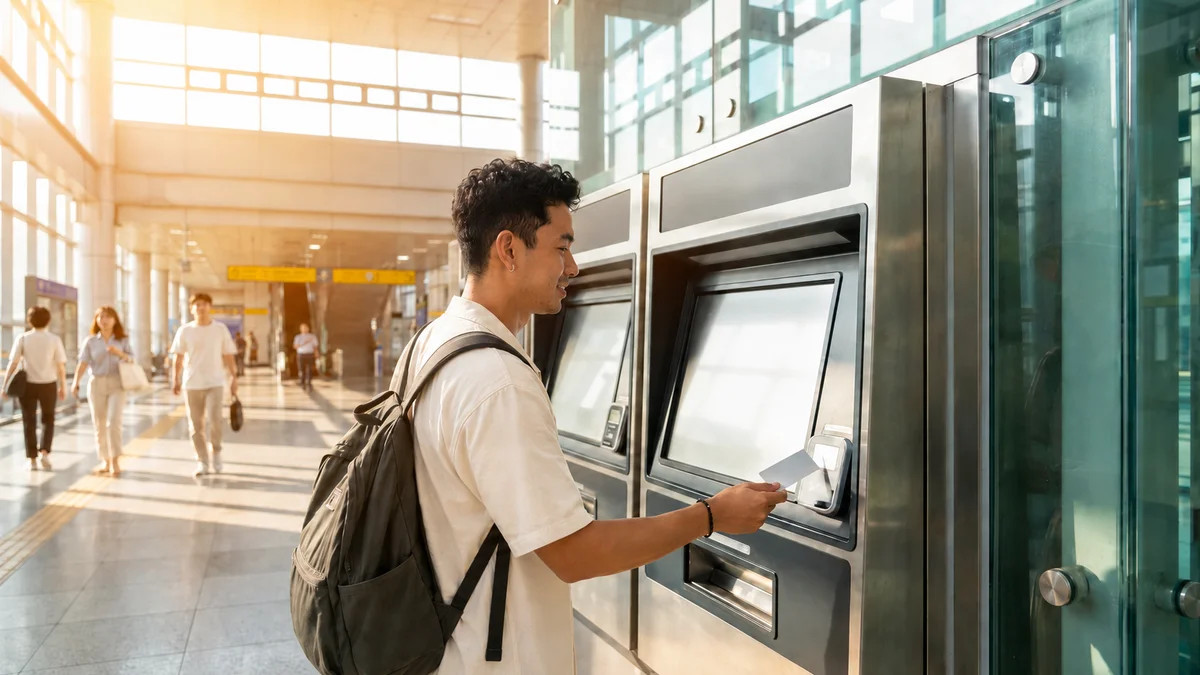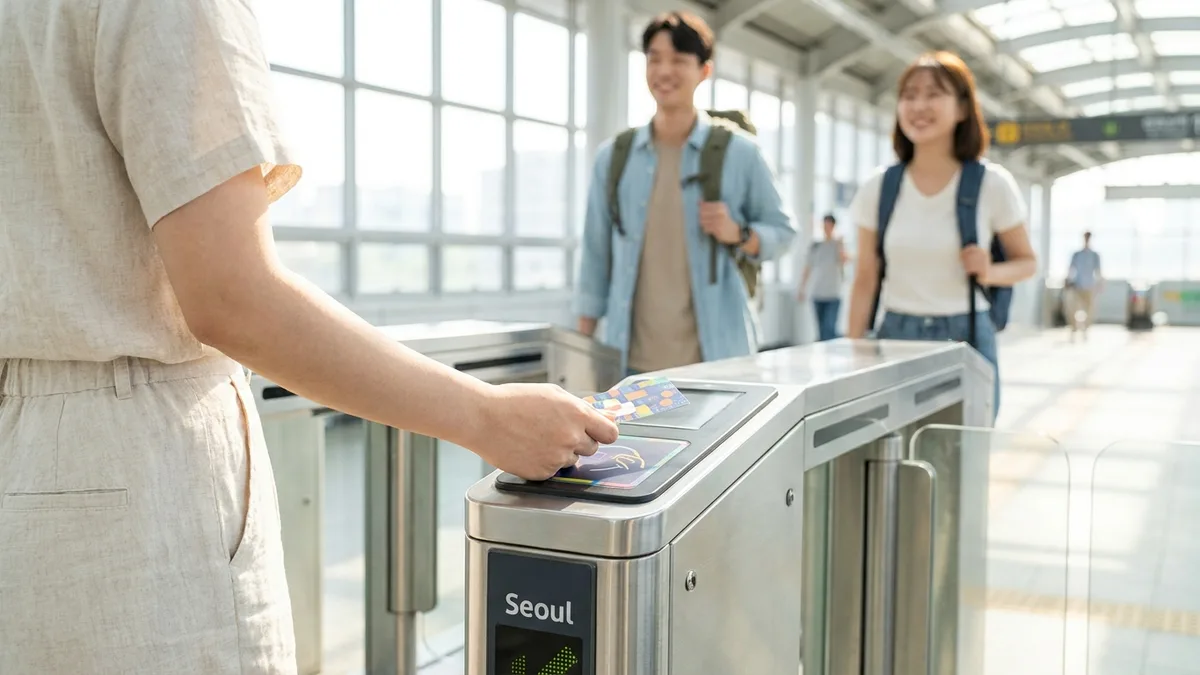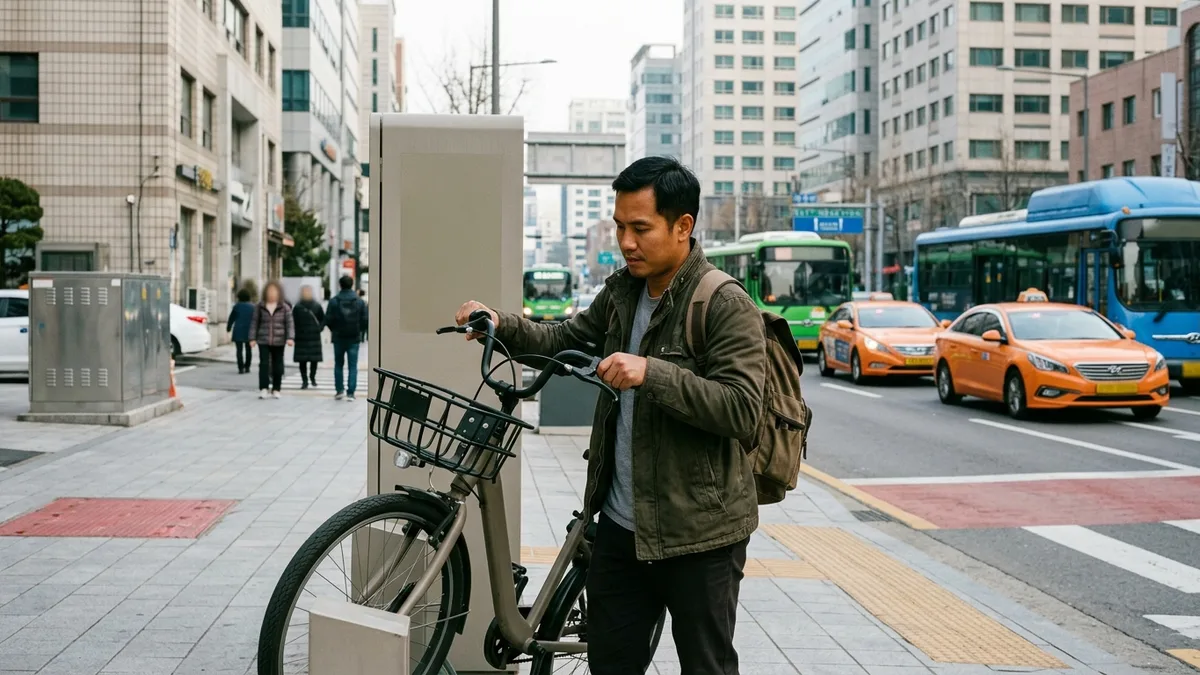
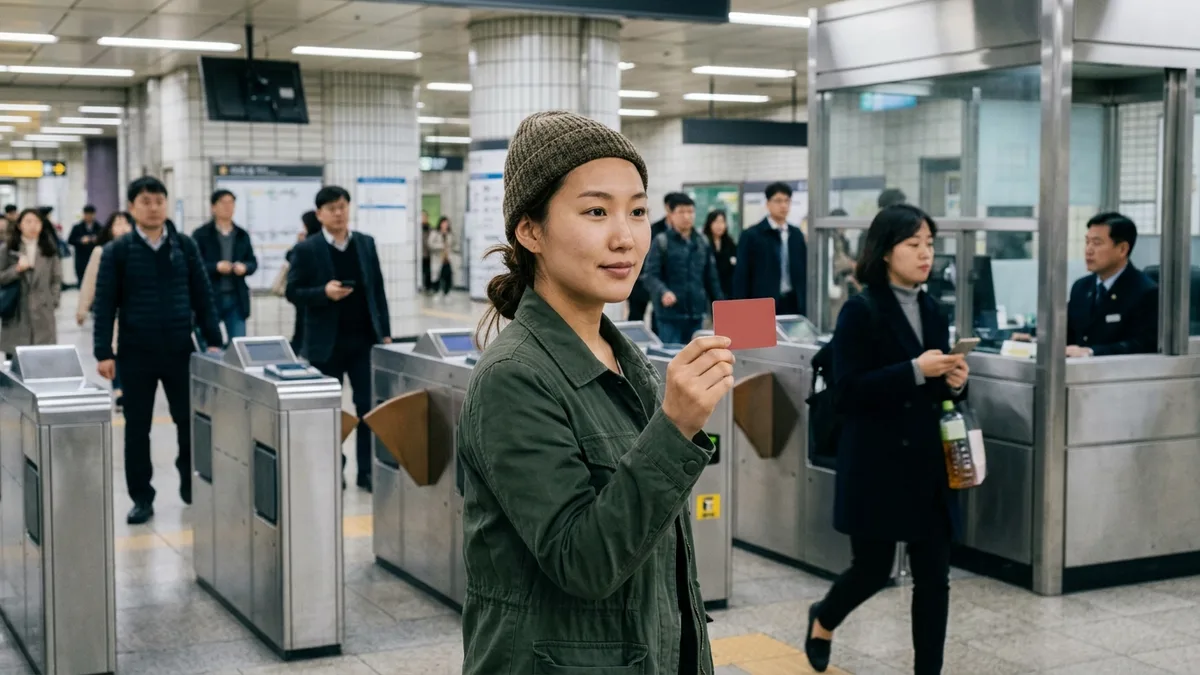
Tap a T-money card you bought in Seoul at a Busan subway fare gate and it just opens. Busan treats Hanaro, Mybi, EB, T-money, Cashbee (EZL), and postpaid transit cards all as eligible for wide-area transfer discounts, and T-money's official list of usable locations includes Busan Lines 1–4 plus the Busan–Gimhae Light Rail and the Donghae Nambu Line. Jeju city buses also accept nationwide-compatible prepaid cards.
The reason this works is that "nationwide compatibility" isn't a card company marketing phrase — it's a certification system operated by the Ministry of Land, Infrastructure and Transport. The legal basis is Article 10-7 (Certification of Nationwide-Compatible Transit Cards, etc.) of the Act on the Promotion of Public Transport, with the Ministry's notices "Guidelines for Certifying Nationwide Compatibility of Transit Card Equipment" and the certification fee notice sitting beneath it (verified 2026-08-25).
But this certification guarantees exactly one thing: that the reader can read your card. Where you can reload it, how you get your balance back, and how far a pass is valid are all decided separately by each city and each issuer. Koreans mostly get around with postpaid transit functions built into their credit or debit cards, so they rarely see this wall — but postpaid cards require a bank account and a credit check, so most foreigners are stuck with prepaid cards. That means every time you change cities, you have to hunt down reload points from scratch.
The timing right now is awkward, too. Seoul's Climate Card 30-day pass stops accepting prepaid top-ups on 2026-08-31, and topped-up amounts can only be used until 2026-09-29 (postpaid until 2026-09-30). From 2026-09-01 it switches to the Modu Card (Climate Pass). Older articles that come up in search results are becoming outright wrong right now, so always check the dates alongside any pass information.
Note: The fares, usable locations, and schedules in this article are as of 2026-08, confirmed from Ministry of Land, Infrastructure and Transport notices, T-money's official list of usable locations, and materials published by Seoul Metropolitan Government, Busan Metropolitan City, Daejeon Metropolitan City, and Jeju Special Self-Governing Province. Transit card coverage and reload rules change often by city and issuer, so please re-check each agency's and issuer's official channels before you travel.
The Bottom Line — Riding Works Nationwide; Reloading and Refunds Are Where You Get Stuck
Here's the one-page summary. Of the actions in the left column, only the first row is truly "nationwide" — everything else splits city by city.
| What you want to do | Does it work nationwide? | Where it actually trips you up |
|---|---|---|
| Riding (boarding) | Mostly yes | The official coverage list is broken down by city/county, so check your specific destination |
| Reloading | Only convenience stores are universal | You can't reload with a card issued overseas |
| Refunds | Tied to issuer and regional rules | Without a Korean bank account, getting your balance out is hard |
| Passes | No | The Climate Card explicitly excludes "subways in other regions," and the 30-day pass ends usage on 2026-09-29 |
| Intercity travel | You can pay, but you can't book | T-money's official guidance lists express and intercity buses as "no online booking, in-person payment only" |
Whether you're a traveler or a resident, the place you actually lose money isn't the first row — it's the second and third. Because the card gets read, people assume "great, this works everywhere," load 30,000 or 50,000 KRW onto it in Seoul, and then can't extract the balance out in the provinces and just leave it there.
What Nationwide Compatibility Actually Is — One Card All Pass and Its Legal Basis
Nationwide compatibility is a system created by law. The Act on the Promotion of Public Transport requires the Minister of Land, Infrastructure and Transport to establish a master plan for nationwide transit card compatibility so that cards used to pay transit fares electronically "can be compatible anywhere in the country" (Article 10-2, Paragraph 1, as of the version effective 2009-01-01). Following that are provisions on regional plans (Article 10-3), sector-specific plans (Article 10-4), and the obligation of public transport operators to install and operate nationwide-compatible transit card systems (Article 10-5).
- Article 10-7 (Certification of Nationwide-Compatible Transit Cards, etc.) is the most important provision for this article. Paragraph 2 of the same article is the basis for the notice on certification fees paid to certification agencies
- The practical certification work is governed by the Ministry's notice "Guidelines for Certifying Nationwide Compatibility of Transit Card Equipment." In other words, both cards and readers must be certified before anything can be called nationwide-compatible
- The government pushed standard technology development and equipment installation support starting in 2007, and named Korail, EB Card Co., Ltd., U-Payment Co., Ltd., and Hanpay Sys Co., Ltd. as issuers of nationwide-compatible cards (per the 2013-07-15 policy briefing)
- Korail's Rail+ (Rail Plus) is also a nationwide-compatible transit card. It's advertised as usable on subways, buses, taxis, trains, expressways, and at convenience stores
Article numbers can change with amendments. Articles 10-2 through 10-5 above are based on the version effective 2009-01-01; the one we cross-checked against a separate notice is Article 10-7, the certification provision. If you need to quote the text exactly, please re-check the current wording on the Korea Law Information Center.
Important: Nationwide compatibility certifies that "the card is read across the country" — it is not a promise that "you get the same service across the country." Reloading, refunds, passes, and transfer discounts all fall outside the certification.
How to Check Whether Your Card Is "Nationwide-Compatible" (Even T-money Cards Come in Different Generations)
Even within one brand, cards differ. T-money's official usable-locations page states under the train (rail) section that "only nationwide-compatible T-money cards can be used to pay at Korail ticket windows." Meaning: not every T-money is the same T-money. The older the item — a card you bought on a previous trip to Korea, a character-design card you got as a gift — the more it needs checking.
Here's the order to check in.
- Look for the nationwide compatibility mark (One Card All Pass) on the front, back, or packaging. The location of the mark varies by card
- Check T-money's official usable-locations page to see whether the city you're heading to is on the list
- If it's ambiguous, the fastest route is to call the issuer's customer center and read them your card number
- If you're still unsure, on your first day in the new city load only a small amount and try a single tap to test it
We couldn't find city-by-city official usable-location pages for EZL (Cashbee). We did confirm that EZL qualifies for wide-area transfer discounts in Busan, but for other cities you'll need to check with EZL's customer center (1644-0006). We also couldn't confirm the 2026 issuance and acceptance status of regional brand cards — Daegu's One Pass and Top Pass, Daejeon's Hankkumi, Gwangju's Hanpay — from primary agency sources in this round of research. If you plan to buy a regional card, ask that city's public transport department first.
Tip: Don't load a large balance before moving to another city. It's safer to top up after you've confirmed it works in the next city. The bigger the balance, the bigger the refund headache. Convenience store refunds come with limits and fees, and as we'll see below, the Climate Card only refunds to a Korean bank account.
How Far Coverage Goes by City — How to Read the Official List Yourself
The most accurate source is T-money's official usable-locations page. The address is t-money.co.kr/ncs/pct/ugd/ReadUsepTrns.dev, and on the site you navigate via 이용안내 (User Guide) > 사용처안내 (Usable Locations) > 교통 (Transit). As viewed on 2026-08-25, here's the scope listed under subway/rail.
| City | Subway/rail listed in T-money's guide | Also worth knowing |
|---|---|---|
| Seoul·Gyeonggi | Lines 1–9, Suin Line, Gyeongchun Line, Gyeongui-Jungang Line, Uijeongbu LRT, Bundang Line, Shinbundang Line, AREX, Seohae Line, Gimpo Goldline, Sillim Line, EverLine, Gyeonggang Line, Ui-Sinseol Line | This is different again from the Climate Card's coverage |
| Incheon | Lines 1–2 | Connected to Seoul, so in practice it feels like one zone |
| Busan | Lines 1–4, Busan–Gimhae Light Rail, Donghae Nambu Line | Hanaro, Mybi, EB, T-money, EZL, and postpaid cards all qualify for wide-area transfer discounts |
| Daegu | Lines 1–3 | We couldn't confirm the current status of regional brand cards |
| Daejeon | Line 1 | City buses are 1,500 KRW by transit card / 1,700 KRW cash; urban railway Zone 1 is 1,550 KRW by transit card |
| Gwangju | Line 1 | For city buses, check the city/county names directly using the method below |
| Jeju | No urban railway | Nationwide-compatible prepaid cards work on city buses; buy and reload cards at nearby convenience stores |
City buses are hard to put in a table. On the same page, the city bus section is listed not by metropolitan city but by individual city and county. For example, in Jeollanam-do, Yeosu, Mokpo, Gwangyang, Naju, Hwasun, Haenam, Jangseong, Muan, Hampyeong, Damyang, Gurye, Gangjin, Goheung, Boseong, Yeongam, Suncheon, Gokseong, Jangheung, and Yeonggwang are each listed one by one. So the question isn't "does it work in Jeollanam-do" but "is the specific city or county I'm going to on the list."
Two problems here hit only foreigners. One is that this list is written out in Korean city and county names. If you don't know your destination's name in Hangul, it's hard to find it on the list. The practical workaround is to look up your destination's Korean name in a map app and compare.
The other is how current the list is. This page still contains names like "Yeongi-gun," which was abolished in 2012, so we can't confirm when it was last updated. That means you shouldn't conclude "that area doesn't work" just because it isn't on the list. Use it in one direction only: trust it when something is listed, and check with the local city hall or bus company when it isn't.
Wall One — Reloading: Convenience Stores Are Nationwide, Everything Else Varies by City
Koreans don't need this section at all. If your credit or debit card has a postpaid transit function, the problem of "reloading" simply disappears. Conversely, foreigners who can't get a postpaid card run into this wall again in every city.
| Reload point | How far it works | Cards issued overseas | Worth knowing |
|---|---|---|---|
| Convenience stores | Nationwide | No (cash only) | Works at any CU, GS25, or 7-Eleven — the surest method |
| Subway station self-service machines | Only cards that city supports | Varies by city | T-money can be reloaded at self-service machines in Busan Metro stations |
| Foreigner-focused card kiosks | Concentrated in the capital region | Check with the card company's guidance | Per 2026-06 reporting, WOWPASS has roughly 430 kiosks nationwide, about 60 of them in Busan |
| Smartphone apps | Depends on device and card specs | Often requires a domestic payment method | Methods for Android NFC phones are covered separately |
In short, the further you go from the capital region, the more your options converge on a single convenience store. Foreigner-focused card kiosks are reportedly expanding to Jeju, Daegu, Gyeongju, Yeosu, Jeonju, Cheongju, and more, but even by 2026-06 reporting Busan had only about 60, so density drops sharply outside the capital region. Two outlets published the same figure on the same day, so they may be drawing on the same source — treat the counts as a rough reference only.
And whichever method you use, you'll ultimately need cash. Credit cards issued overseas can't reload T-money or EZL, and Busan Metro station ticket machines don't accept credit cards at all. How to reload with an Android phone is covered in Mobile T-money for Foreigners: How to Use It, and workarounds for reloading with an overseas card are in Reloading a Transit Card with a Foreign Card.
Caution: On days you're taking the KTX or an express bus to a regional city, withdraw a little cash in Seoul before you leave. The smaller the destination city, the more likely the only reload point open late at night is a convenience store — and if your card balance is 0 KRW, you can't even board the bus.
Wall Two — Refunds: Why It's Hard to Cash Out a Seoul-Bought Card in the Provinces
Refunds are far more region-locked than reloading. The most extreme example is the Climate Card. Per T-money customer center guidance, the process goes like this.
- First, suspend the card. Do this at self-service machines inside Seoul Metro stations on Lines 1–8 within the Seoul city limits, Phases 2–3 of Line 9, the Ui-Sinseol Line, and the Sillim Line, or through the Mobile T-money app
- Then the refund application is accepted only via the website. Stations don't process refunds on the spot
- Amounts topped up with cash are deposited to the bank account you specify
All three steps trip up foreigners. Step 1 can only be started if you're physically at a designated Seoul station, so in Busan or Jeju the process never even opens. Step 2 runs on a Korean-language website. Step 3 means there's nowhere for the money to go if you don't have a Korean bank account. For a short-term traveler, the structure effectively tells you to write off your balance.
Balance refunds for ordinary prepaid T-money cards also follow issuer and retailer rules. Convenience store refunds come with balance caps and fees, and cards issued by regional operators have different rules again. For refund conditions and fees by card type, see T-money Reloading and Refunds: The Complete Guide.
Here are the practical rules to follow. Seoul-only passes like the Climate Card should be wrapped up before you leave Seoul. Ordinary prepaid T-money and EZL balances can be refunded at convenience stores nationwide, but as noted above there are brand-specific caps and fees, and cards issued by regional operators have different rules — so it's safer to handle those in the city where you bought them. Many people try to sort everything out at the airport on departure day and run short of time, so take care of it a day ahead.
Wall Three — Passes and Regional Discounts Are Not Nationwide-Compatible
Passes are a completely different world. Per Seoul Metropolitan Government, the Climate Card covers all Seoul subway lines, certain Gyeonggi-do sections, city and village buses licensed by Seoul, plus Ttareungi bikes and the Hangang Bus. And the exclusion list explicitly includes "subways in other regions." That covers Busan Line 1 and Daegu Line 2 alike.
- The Shinbundang Line, GTX, wide-area buses, and airport buses are also excluded. Even within Seoul, these lines charge separate fares
- If you board within the covered area but get off at a station outside it, the pass doesn't apply. You'll pay a separate fare at the exit station
- Short-term pass prices: 1-day 5,000 KRW · 2-day 8,000 KRW · 3-day 10,000 KRW · 5-day 15,000 KRW · 7-day 20,000 KRW
- For the 30-day pass: prepaid top-ups end 2026-08-31 · topped-up amounts usable through 2026-09-29 · postpaid ends 2026-09-30, and from 2026-09-01 it converts to the Modu Card (Climate Pass)
Two things here remain unconfirmed. One is how far the Modu Card (Climate Pass) applies outside Seoul. Seoul's press release only uses the phrase "Seoul-specific benefits" and doesn't state whether it can be used nationwide. The other is whether the short-term passes (1–7 day) will continue to be sold after the 30-day pass ends. That's directly relevant to short-stay travelers, but the announcement doesn't mention it, so please re-check with a sales counter or Seoul's official guidance before buying. A comparison of the three cards' characteristics is laid out in T-money vs. WOWPASS vs. Climate Card.
Regional discount programs also operate independently of card compatibility. Rebate programs like Busan's Dongbaek Pass or K-Pass require a foreign resident registration number to sign up, so short-term visitors without an Alien Registration Card end up in a situation where the card works perfectly but the discount is off-limits. If you're staying in Busan for a few days, the Busan Metro app's 1-day pass at 6,000 KRW and 3-day pass at 13,000 KRW (as of 2026-08) are an alternative. Note, though, that these passes are valid on the urban railway only — they can't be used on city buses, the Busan–Gimhae Light Rail, or the Donghae Line. That means the day you come in from the airport on the light rail, that leg isn't covered. Getting around within Busan is covered in more detail in Busan Transportation Guide for Foreigners.
Caution: If a sales counter tells you "it works nationwide," ask back whether they mean the card or the pass. If a Seoul-only pass is loaded onto a nationwide-compatible card, the card will be read in Busan, but the pass benefit won't apply — your balance will be drawn down or a separate fare will be charged.
Segments Cards Can't Cover — Crossing Between Cities
The last wall is between cities. T-money's official guidance states that for trains (rail), only nationwide-compatible T-money cards can be used to pay at Korail ticket windows. Express and intercity buses can be paid for at major bus operators and terminals nationwide, but "no online booking, in-person payment only."
Read those two sentences together and the conclusion is clear: to pay for intercity travel with a transit card, you have to stand at a counter in person. That means discussing seat selection, departure time changes, and refunds in Korean — and during holidays or weekends the lines are long. This is where you get segments you can pay for but can't book.
| Segment | Payment by transit card | Online booking | Where foreigners get stuck |
|---|---|---|---|
| Subways and city buses within a city | Just tap | Not needed | Finding a reload point is the remaining task |
| KTX and other trains | With a nationwide-compatible T-money card at Korail ticket windows | Separately via the Korail app or website | Counter service is in Korean |
| Express buses | In-person payment at major operators and terminals | Not possible with a transit card | In-person, face-to-face payment is the default |
| Intercity buses | In-person payment at major operators and terminals | Not possible with a transit card | Terminals are often far from the city center |
| LACHA | Transit card reloading not confirmed as of 2026-08 | KTX and express bus booking, taxi hailing, airport railroad | Doesn't handle intercity buses, ferries, or rental cars |
Getting to the terminal is another variable. Regional terminals are often away from the city center, so after arriving you'll need one more taxi or city bus ride. City-by-city access methods are laid out in Guide to Reaching Regional Cities by Train and Bus.
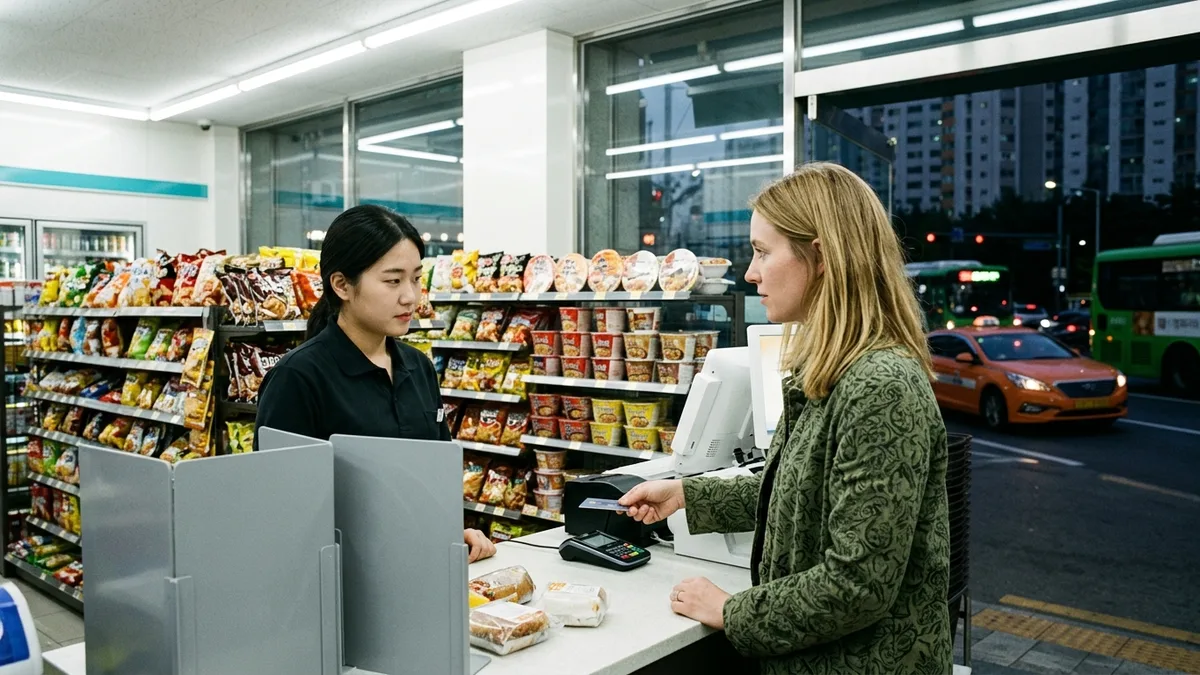
So a transit card covers "within a city" but not "between cities." Since these are segments you can pay for but can't book, if your itinerary runs Seoul to Busan to Jeju, it's easier to lock in your intercity legs in advance. LACHA is a transport and payment super app for foreigners that you can use right away without identity verification. You can start with just your passport — no Korean bank account or phone number — and pay with overseas simple-payment services like Alipay and WeChat Pay, or with an overseas card. KTX and express bus booking, taxi hailing after you arrive, and the airport railroad back to the airport all connect in one place. That said, transit card reloading wasn't confirmed in the app's guidance as of 2026-08, so keep cash on hand for convenience store top-ups.
Want to search and book KTX and express buses in one app? Check out LACHA.
Built to work without a Korean phone number or bank account, with overseas payment methods like Alipay, WeChat Pay, and Apple Pay. Taxi hailing plus KTX, express bus, and airport railroad (AREX) booking — all in one app.
Up to 60% off Korea transit with a coupon (max ₩3,000): enter code at sign-up. KTX gets up to 18% off on top
Download now


Frequently Asked Questions (FAQ)
Q1. Can I use a T-money card bought in Seoul on the Busan subway as-is? Yes, you can. Busan treats Hanaro, Mybi, EB, T-money, Cashbee (EZL), and postpaid transit cards all as eligible for wide-area transfer discounts, and T-money's official usable-locations page includes Busan Lines 1–4 plus the Busan–Gimhae Light Rail and the Donghae Nambu Line. Reloading is a separate matter, though. Cash top-ups at convenience stores are the surest option, and you can also reload T-money at self-service machines in Busan Metro stations. Cards issued overseas can't be used to reload, so keep a little cash on hand.
Q2. Do transit cards work in Jeju? Where do I reload? Jeju city buses accept nationwide-compatible prepaid transit cards, including T-money. You can buy and reload cards at nearby convenience stores. Jeju has no urban railway, so it's bus- and taxi-centric and you need to keep your balance from running out — but refunds are a hassle before you leave, so it's safer to top up roughly a day's worth at a time. Note that rental cars and ferries have to be booked separately, unrelated to transit cards.
Q3. Can I use the Climate Card in Busan or Daegu? No. Seoul's stated coverage explicitly lists "subways in other regions" as excluded. The Shinbundang Line, GTX, wide-area buses, and airport buses are also excluded, and if you board within the covered area but exit at a station outside it, the pass doesn't apply. On top of that, prepaid top-ups for the 30-day pass end 2026-08-31, topped-up amounts are usable only through 2026-09-29, and postpaid only through 2026-09-30. From 2026-09-01 it switches to the Modu Card (Climate Pass), so check Seoul's official guidance before buying.
Q4. I don't have a Korean bank account — can I get my card balance refunded in the provinces? For the Climate Card, it's difficult. Suspension has to be done at self-service machines in Seoul Metro stations on Lines 1–8 within the Seoul city limits, Phases 2–3 of Line 9, the Ui-Sinseol Line, or the Sillim Line, or through the Mobile T-money app; the refund application is accepted only via the website; and cash top-ups are deposited to the bank account you specify. If you're outside Seoul, you're blocked at step one. Ordinary prepaid cards can be refunded at convenience stores nationwide, but with brand-specific caps and fees — so sort it out before you leave.
Q5. Can I book an express bus ticket with a transit card? You can pay, but you can't book. T-money's official guidance says express and intercity buses accept the card at major operators and terminals nationwide, but "no online booking, in-person payment only." Same for trains: nationwide-compatible T-money cards can only be used at Korail ticket windows. If you want to lock in a seat in advance, you'll need a booking app or website rather than a transit card.
Note: This article is intended as general information. The usable locations, fares, schedules, and procedures in the text are as of 2026-08, confirmed from the Act on the Promotion of Public Transport and Ministry of Land, Infrastructure and Transport notices, T-money's official usable-locations page (t-money.co.kr), and materials published by Seoul Metropolitan Government, Busan Metropolitan City, Daejeon Metropolitan City, and Jeju Special Self-Governing Province. Some items (the current status of regional brand cards, EZL's city-by-city coverage, the Modu Card's coverage outside Seoul, whether Climate Card short-term passes will continue, and legal article numbers) could not be pinned down from primary sources and are flagged as needing verification. Transit card systems change frequently by city and issuer, so please re-check each agency's and issuer's official channels before buying, reloading, or refunding a card. LACHA does not issue transit cards and does not handle intercity buses, ferries, or rental cars.