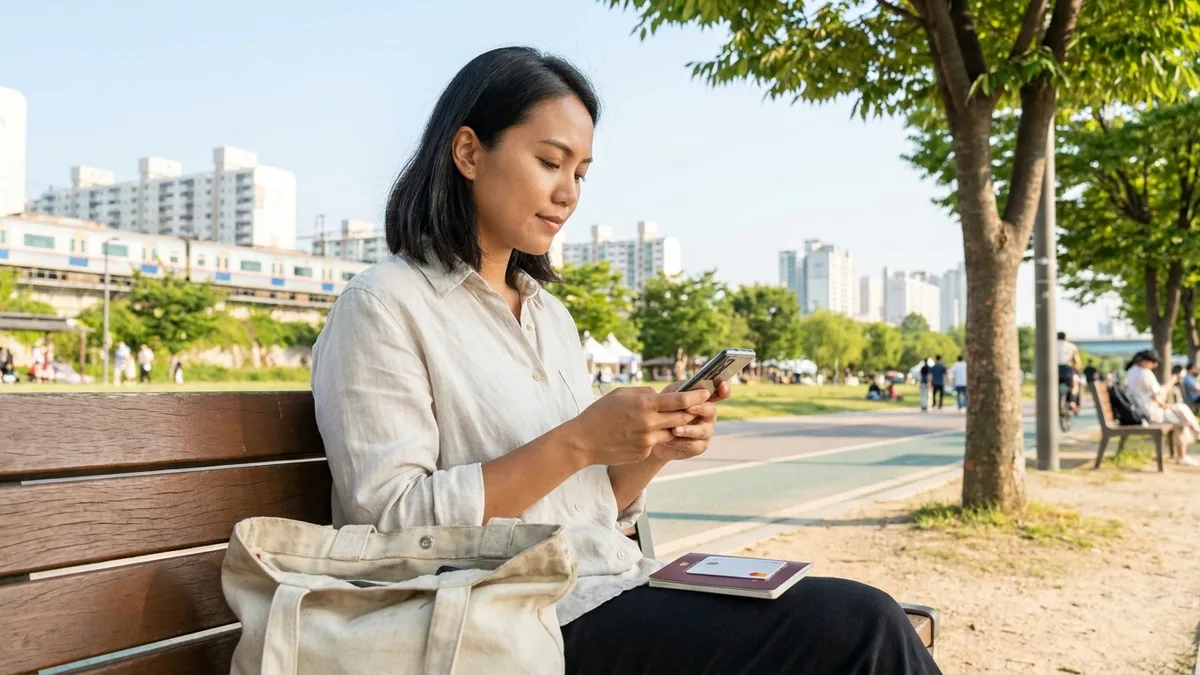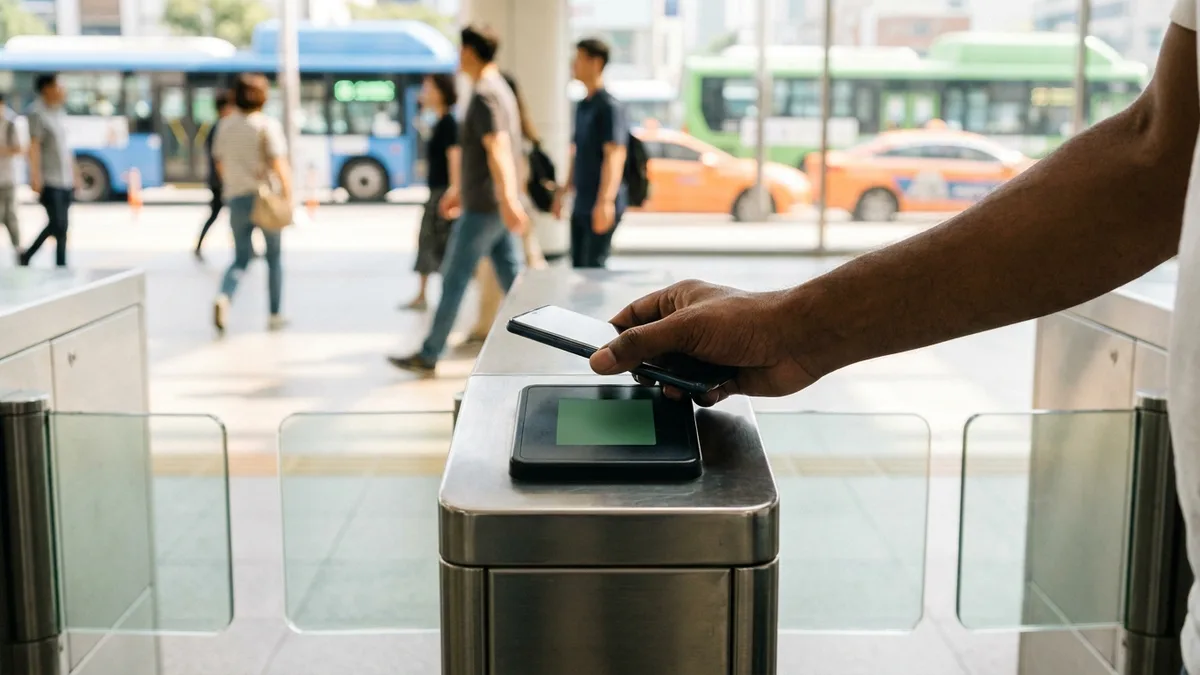
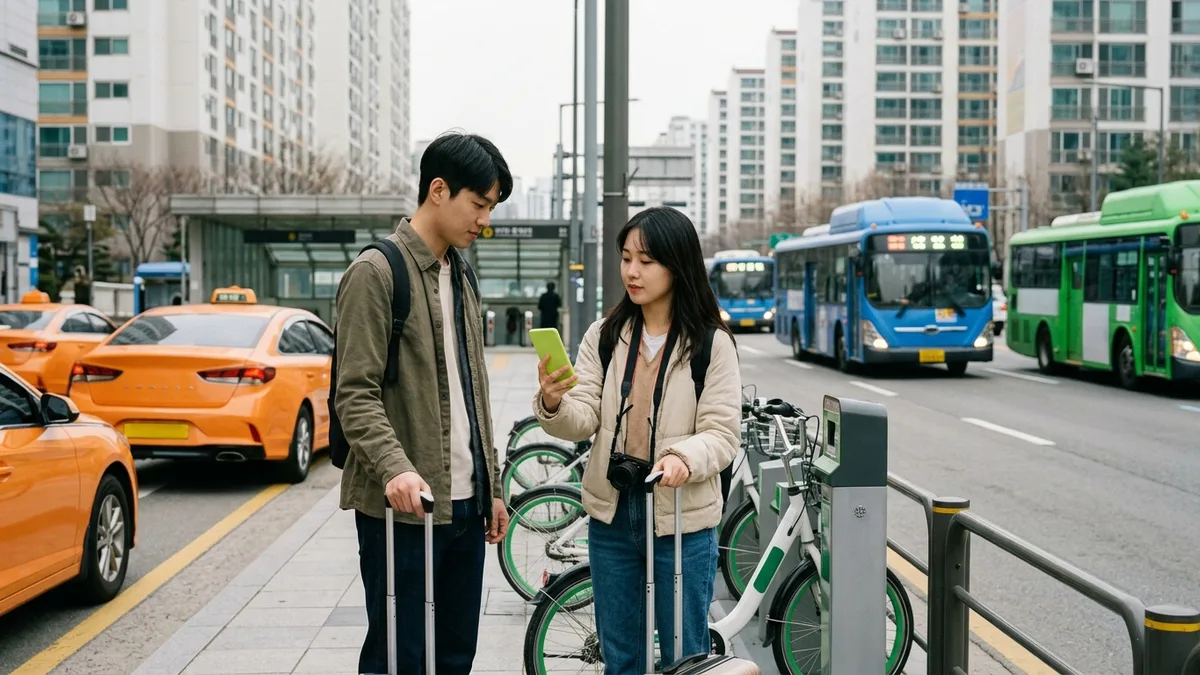
A Ttareungi day pass costs 1,000 KRW for one hour. No membership, no alien registration card, no real-name verification — just pick "non-member" in the app and buy it on the spot (as of 2026-08). Up to this point, it's the same whether you're Korean or not.
Where it splits is payment. If you select "Foreigner" in the app or on the website and then buy a pass, credit card payment on that screen works only with cards issued outside Korea. Most Korean services require you to have a Korean card — the Ttareungi foreigner screen is the one place where the rule is reversed. So a foreign resident who got a card in Korea taps "Foreigner" simply because English is easier, watches their card get declined, and finds no explanation anywhere on the screen.
The other door has a wall too. The payment methods on the Korean-language "non-member" screen are mobile phone billing, KakaoPay, PAYCO, and ZeroPay — all tied to a Korean carrier line or a Korean account. For a visitor who just landed, that effectively means there's nothing to choose but a credit card. Residents and short-term visitors need to walk through different doors, and the app doesn't tell you which.
If you're traveling in a group, there's one more catch. Foreigner passes are limited to one pass per card, so three people riding together need three cards. Having one person pay for everyone is blocked.
Note: The fares, terms, and legal provisions below are as of 2026-08, verified against the official Seoul Bike Ttareungi guidance, the terms of use, and the Korea Law Information Center. September 2026 in particular has a terms revision and a transit card transition landing at the same time, so this is a period of heavy change. Check the notices at bikeseoul.com once more before you ride.
You can rent without signing up — "non-member" vs. "Foreigner," two different doors
There are three ways into Ttareungi. Non-members ride immediately without signing up, but can only buy day passes. "Foreigner" (overseas tourist) is the path where you select a language or "Foreigner" in the app or on the website and buy a pass. Members have to sign up in the app, but season passes open up.
There's only one age restriction. Children age 12 and under cannot use the service, and 13-year-olds must sign up as members before riding. In that case, consent from a legal guardian is required under Article 22-2 of the Personal Information Protection Act.
Rental stations operate 24 hours. Even if you land on a red-eye flight, drop your bags at your lodging, and head back out, renting itself isn't blocked.
The scale is worth knowing too. The official FAQ lists 45,000 bikes, 2,762 rental stations, and 11 regional centers — but the reference date is December 31, 2023, so current figures may differ. Just take it as a sign that finding a station in central Seoul won't be much of a struggle.
Which door should you use — the real reason your card gets declined
This table is the heart of this article. Find the row that matches your situation first.
| Type | Membership | Passes you can buy | Payment condition that trips you up |
|---|---|---|---|
| Non-member | Not required | Day pass | Mobile phone billing, KakaoPay, PAYCO, and ZeroPay all require a Korean carrier line or Korean account |
| Foreigner (overseas tourist) | Not required | One pass | Credit cards must be issued outside Korea; one pass per card |
| Member | Sign up in the app | Day passes and season passes | Signing up requires a Korean mobile phone number |
The payment methods Ttareungi officially lists are six: mobile phone billing, credit card, PAYCO, KakaoPay, ZeroPay, and the foreigner-only Discover Seoul Pass. Anything not on that list has no official basis, no matter how many people say "it usually works" — so don't head to a station relying on that alone.
That leads to a practical rule of thumb. If you're a foreign resident with a card issued in Korea or a Korean-account mobile payment, go in through the non-member or member path, not "Foreigner." If you're a short-term visitor with no Korean payment method at all, the standard move is to pay with your home-country card through the Foreigner path. For how far overseas cards get you with Korean transit payments, see Using an overseas credit card for transit in Korea.
Caution: The usage guide also states that if you choose Discover Seoul Pass, you can only buy one specific type of pass. However, we couldn't verify with primary sources whether this tie-in is still valid in 2026 or which pass type it covers. Check directly with the seller before building plans around the pass.
Fare table — day passes, season passes, and 200 KRW per 5 minutes of overage
Day passes are the pass type non-members can buy. That said, official pages disagree on whether non-members can choose the 3-hour pass, so check which options actually appear on the payment screen.
| Day pass | Fare | Good to know |
|---|---|---|
| 1-hour pass | 1,000 KRW | The most basic option |
| 2-hour pass | 2,000 KRW | For when you need breathing room, like a round trip along the Han River |
| 3-hour pass | 3,000 KRW | Launched on November 13, 2025 |
The terms of use mention one more pass type. Article 2, Item 20 defines an "all-day pass" that foreign users can ride for up to 24 hours without an interim return, but no official fare table anywhere posts a price for it. Travel reviews quoting an amount aren't confirmed by primary sources, so judge by the pass types and prices that actually appear on your payment screen.
Season passes are members-only and have a two-dimensional structure where duration multiplies with the time limit. Read it as a single line and the numbers get scrambled, leading to odd conclusions like "the 30-day pass costs more than the 180-day pass." Read the rows as duration and the columns as how long you can ride per rental.
| Season pass duration | 1-hour pass | 2-hour pass |
|---|---|---|
| 7-day pass | 3,000 KRW | 4,000 KRW |
| 30-day pass | 5,000 KRW | 7,000 KRW |
| 180-day pass | 15,000 KRW | 20,000 KRW |
| 365-day pass | 30,000 KRW | 40,000 KRW |
Here, "1-hour pass" doesn't mean you only get one hour a day — it means the base rental time per checkout is one hour. Return the bike and rent again, and the clock starts fresh.
Go over the base time and you're charged 200 KRW per 5 minutes of overage (Terms of Use Article 14, Paragraph 1). The cap is 30,000 KRW per rental (Article 14, Paragraph 2), and that amount lines up exactly with the maximum overage time of 12 hours 30 minutes set in the terms. Divide 750 minutes by 5 and you get 150; multiply by 200 KRW and you get 30,000 KRW. The official FAQ states that going beyond that time is treated as theft and reported to the police.
Caution: The non-return threshold differs by document. The precautions on the fare page say 4 hours, while the terms and the FAQ say 12 hours 30 minutes. Either way, if the bike breaks down or your return is going to be late, don't make the call yourself — contact the Ttareungi call center at 1599-0120 (24 hours, 365 days) first.
What you need for membership — and what you don't
This is where the misunderstandings pile up. Ttareungi membership does not require an alien registration number. Here are the collected items straight from the privacy policy.
- Required items: mobile number, ID, password, email address, birth year, gender
- Optional items: weight, postpaid transit card info, rental card info, refund account info
- Not collected at all: resident registration number, alien registration number
Identity verification is the same story. The only real-name verification Ttareungi outsources is NICE I-PIN real-name verification, used to confirm legal guardian consent for 13-year-old members. There is no separate identity verification procedure prescribed for adult members.
In short, there's exactly one wall: a Korean mobile phone number. With just a number, you can become a season pass member even before your alien registration card arrives. What works and what doesn't during that waiting period is collected in What you can and can't do without identity verification.
Sign-ups happen in the app. Press the membership button on the website and you get a message telling you to "download the app to proceed with sign-up." To sort out all the apps you'll need in Korea at once, see Essential apps for traveling in Korea.
Family passes are hard for foreigners to use. Family relationships are verified through resident registration data in the administrative information sharing system, and the parent must be the head of household or the spouse of the head of household, living in the same household as the child. Foreign resident families hoping to ride with their kids get stuck here.
If you use a 365-day pass, transfer mileage is worth collecting. Register a T-money or postpaid transit card and you earn 100 points per ride, up to 200 points a day and up to 15,000 points a year, deducted from the price when you buy another 365-day pass.
Renting and returning — a temporary lock is not a return
The rental sequence is simple.
- Tap "Rent" in the app and scan the QR code on the bike's terminal.
- If the QR won't read, type in the 5-digit bike number next to the right pedal.
- Your phone's Bluetooth and GPS must be on. If you're outdoors and the rental won't go through, check these two first.
Caution: On September 23, 2025, Ttareungi posted a warning about "qishing" scams targeting the QR codes on the bikes. If you scan and an unfamiliar web page opens instead of the Ttareungi app, asking for payment or an installation, close it right there. Rentals only happen inside the Ttareungi app.
Returning is much more flexible. You can return the bike to any nearby Ttareungi station, regardless of where you rented it. But the process only counts as complete after three steps: dock the bike in the rack, pull the rear wheel lock to lock it, and confirm the return notification (app notification, KakaoTalk alert, or text message).
That third step matters especially for foreigners. Of the three channels, KakaoTalk alerts and text messages only go to Korean mobile numbers. Without a number, you're relying on the app notification alone — so check the screen yourself to confirm it actually appeared before you leave the station.
A temporary lock is not a return. Parking the bike somewhere other than a station and pulling the rear wheel lock leaves it in "in use" status, and leaving it that way keeps the overage clock running and the extra charges piling up. Even during a quick coffee stop, the meter is still ticking.
There's also a boundary on where you can ride. Article 16, Paragraph 10, Item 12 of the terms requires you to ride within Seoul's administrative jurisdiction and return the bike to a station. Follow the Han River bike paths and it's easy to cross into Gyeonggi-do, where there are no Ttareungi stations to return to. Pick your turnaround point on the map in advance. Outside Seoul, Ttareungi simply doesn't exist, so you'll need to look into each city's own system — like Tashu in Daejeon or Eoulling in Sejong. City-by-city fares and sign-up requirements are covered in Public bikes outside Seoul.
Tip: Terminal designs at stations differ depending on the bike type. We couldn't confirm on official pages whether the type-specific return restrictions in older guidance still apply. Safer bet: check the station markers on the app map and head to a place where bikes are actually docked.
Where money leaks — automatic overage billing and refunds
The spots where foreigners actually lose money on Ttareungi are predictable.
First, overage charges are billed automatically to the payment method you used originally. If you paid with an overseas card, you'll discover it belatedly on your card statement after you've flown home — and the inquiry channel is a Korean-language call center. Email inquiries go to seoulbike@sisul.or.kr.
Second, unpaid balances block your next ride. A notice pops up when you try to rent, and even non-members must pay off the outstanding amount before renting again.
Third, day passes aren't refundable once you start using them. For an unused pass, the validity period for starting a rental is one year (365 days) from the purchase date. If today's ride falls through, your only option is to leave it unstarted.
Fourth, the one-pass-per-card rule mentioned earlier breaks group planning. Either everyone brings their own card, or the people who have Korean payment methods buy separately through the non-member path.
Laws and insurance — where foreigners get burned most often
Many visitors come from countries where cycling under the influence isn't a crime, or isn't enforced in practice. Korea is different. Read the actual provisions before you go.
| Item | Legal basis | Content | Penalty / consequence |
|---|---|---|---|
| Riding under the influence | Road Traffic Act Article 44, Paragraphs 1 and 4 | Riding a bicycle with a blood alcohol concentration of 0.03% or higher is prohibited | Under Article 156, Item 11: a criminal fine of up to 200,000 KRW, detention, or a minor fine (과료) |
| Refusing a breath test | Road Traffic Act Article 156, Item 12 | You must comply with a police officer's request for a test | A criminal fine of up to 200,000 KRW, detention, or a minor fine (과료) |
| Wearing a helmet | Road Traffic Act Article 50, Paragraph 4 | Protective gear must be worn when riding on bike paths and roads | Article 156, Item 6 excludes bicycle riders from punishment |
| Lights at night | Road Traffic Act Article 50, Paragraph 9 | A headlight, tail light, or reflective band/other light-emitting device when riding on roads at night | Article 156, Item 1 excludes bicycle riders from punishment |
| Intentional damage to facilities | Ttareungi Terms Article 12, Paragraph 2, Item 2 | Intentionally damaging Ttareungi facilities | 6-month suspension for a first offense, 1 year for a second |
Read the third and fourth rows carefully. Helmets and night lighting are legal obligations with no penalty attached for bicycle riders. No penalty doesn't mean no accidents, though — if you're planning to ride the Han River paths at night, bring lights.
Drinking carries one extra consequence beyond the penalty. Using Ttareungi with a blood alcohol concentration of 0.03% or higher means your Ttareungi service access is suspended for one year under Article 12, Paragraph 2, Item 1 of the terms. Making a habit of riding a Ttareungi home after a work dinner can be the most expensive choice you make in Korea.
Insurance also looks at whose account it is. The insured parties under Ttareungi's comprehensive public bike insurance are Ttareungi users age 13 and older and users registered on a family pass — and the guidance states that "coverage may be excluded when using an account under another person's name." Borrowing a Korean friend's account is the most common way to get around the membership wall, and the most expensive way when something goes wrong.
Coverage limits are as follows: 20 million KRW for accidental death (excluding those under 15), up to 20 million KRW for permanent disability, up to 3 million KRW for medical treatment (100,000 KRW deductible), and up to 2 million KRW for accident liability (100,000 KRW deductible). Claims are filed with DB Insurance at 02-1899-7751.
📌 Important: The common documents for insurance claims include a resident registration certificate (abstract or full), but the insurance guidance doesn't specify whether foreigners can substitute something like a certificate of alien registration facts. If you've had an accident, call DB Insurance at 02-1899-7751 to confirm what substitutes are accepted before you start gathering documents.
What changes in 2026 — transit card transition, breach compensation, terms revision
Right now is an unusually crowded stretch of changes. Three things to watch together.
First, the Climate Card is ending. Prepaid versions can be used through September 29, 2026, postpaid through September 30, and the last recharge date is August 31. Its successor, the Modu Card (Climate Companion Pass), launches on September 1, 2026. But the Seoul city press release only says the Modu Card's Ttareungi discount tie-in "will be applied at a later date." The discount amount, the mechanism, and the start date have all yet to be announced.
Here's where one mistake happens: choosing a transit card because you saw the phrase "includes Ttareungi." At this point, it's safer to hold off on buying a specific transit card for Ttareungi's sake. The end-of-service and transition schedule is laid out in the Climate Card guide for foreigners.
Second, compensation passes for the member data breach are being issued. On June 28–29, 2024, through a server security vulnerability, some information (IDs, mobile numbers, dates of birth, gender, weight, email, postal codes, addresses, etc.) belonging to 4.62 million members who signed up before June 30, 2024 was collected without authorization. The Seoul Metropolitan Police Agency's Cyber Investigation Division notified on January 27, 2026; the app and website notice went up January 30; individual notifications went out July 21.
Compensation is one pass, either a 1-hour 30-day pass or a 2-hour 15-day pass, issued starting August 26, 2026 at 10:00. The usage deadline is November 27, 2026, 23:59, and the path to claim it is: app login → My Info → Personal Data Breach Compensation Coupon → My Coupons → Use. That said, the notice doesn't specify whether foreign members were among those affected, or whether foreign members can get through the lookup page, so it needs confirmation.
Third, the terms of use are being revised. Advance notice says it takes effect sometime in September 2026, removing the "website sign-up" clause in Article 5, Paragraph 2 and dropping name, month/day of birth, gender, and email address from the required sign-up fields (notice period August 25–31, 2026). The full revised text hasn't been published yet, so if you're signing up after September, the accurate move is to check which fields the sign-up screen actually asks for.
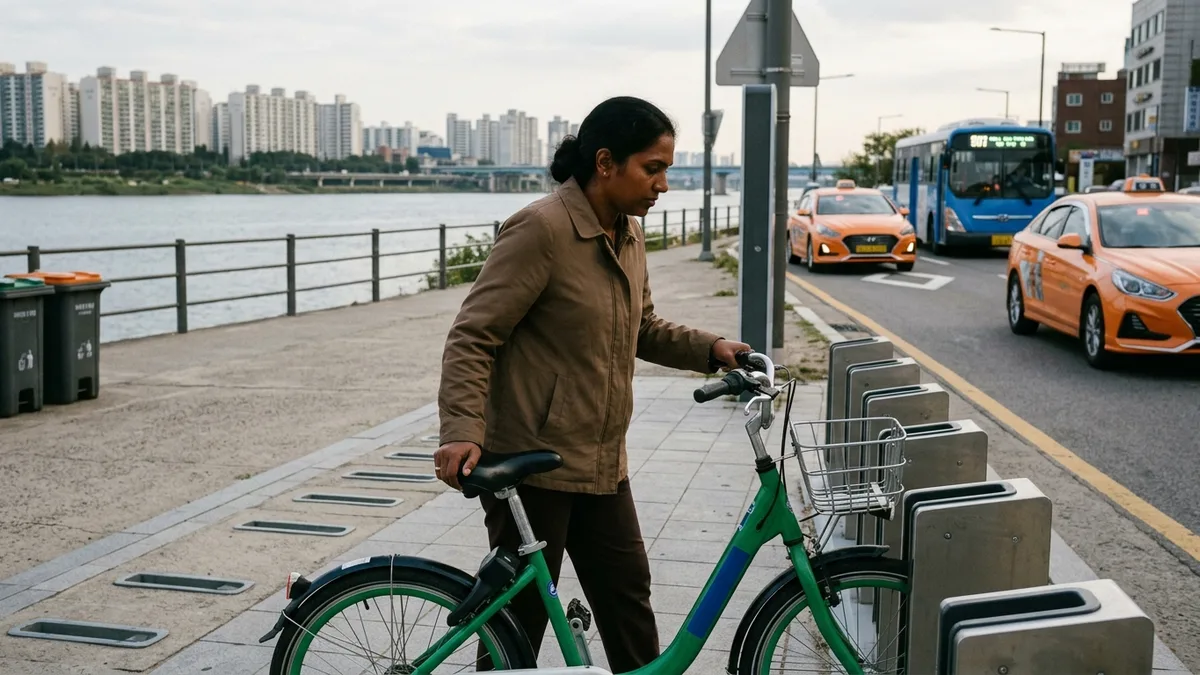
Ttareungi is, in the end, a way to get around within Seoul. The terms require riding within Seoul's administrative jurisdiction and returning to a station, so it's safer to plan any travel outside Seoul around a different mode from the start. LACHA is a transit and payment super app for foreigners that works right away without identity verification. You can start with just your passport — no Korean bank account or phone number — and handle KTX, express buses, taxis, the Airport Railroad, and transit cards all in one place. We don't handle bike rentals, so rent your Ttareungi in the Ttareungi app and just lock in your intercity trips and airport runs in advance.
Want to search and book KTX and express buses in one app? Check out LACHA.
Built to work without a Korean phone number or bank account, with overseas payment methods like Alipay, WeChat Pay, and Apple Pay. Taxi hailing plus KTX, express bus, and airport railroad (AREX) booking — all in one app.
Up to 60% off Korea transit with a coupon (max ₩3,000): enter code at sign-up. KTX gets up to 18% off on top
Download now


Frequently Asked Questions (FAQ)
Q1. Can I ride Ttareungi without signing up for membership? Yes — select "non-member" and you can ride without signing up. Non-members can only buy day passes, though; season passes are members-only. Day passes are 1,000 KRW for 1 hour, 2,000 KRW for 2 hours, and 3,000 KRW for 3 hours (as of 2026-08). Children age 12 and under cannot use the service, and 13-year-olds must sign up as members and obtain legal guardian consent (Personal Information Protection Act Article 22-2). For reference, official pages disagree on whether non-members can buy the 3-hour pass, so check which options appear on the payment screen.
Q2. I paid with a card issued in Korea — why was it declined? There's a good chance you went in through the "Foreigner (overseas tourist)" screen. Credit card payment on that path only works with cards issued outside Korea. If you have a Korean card or a Korean-account mobile payment, buy through the non-member or member path instead of Foreigner. Conversely, if you're a short-term visitor with no Korean payment method at all, paying with your home-country card via the Foreigner path is the right call.
Q3. Can I sign up for a season pass without an alien registration card? The required items for member information are mobile number, ID, password, email address, birth year, and gender — resident registration numbers and alien registration numbers aren't on the collection list. The outsourced real-name verification is only for confirming legal guardian consent for 13-year-old members. So the real requirement is a single thing: a Korean mobile phone number. Note that a terms revision in September 2026 is set to change the required fields, so check the sign-up screen again.
Q4. Can I pay for my friends with one card? Foreigner passes are limited to one pass per card. Three people means three cards. If someone in your group has a Korean payment method, that person can buy separately through the non-member path. We don't recommend borrowing a Korean friend's account — the insurance guidance explicitly states coverage may be excluded when using an account under another person's name.
Q5. I returned the bike but I'm still being charged. You may have confused a temporary lock with a return. Pulling the rear wheel lock somewhere other than a station leaves the bike in "in use" status, so 200 KRW keeps accruing every 5 minutes of overage. A return is only complete once you've docked the bike in a station rack, pulled the lock, and confirmed the return notification via the app or a text message. Overage charges can climb to 30,000 KRW per rental, and any unpaid balance blocks future rentals — so if something seems off, call the center at 1599-0120 right away.
Note: This article is for general informational purposes. The fares, terms provisions, statutory penalties, and schedules in the text are as of 2026-08, verified against the official Seoul Bike Ttareungi guidance, terms of use, and privacy policy, Seoul city press releases, and the Korea Law Information Center. The price of the foreigner-only "all-day pass," whether the Discover Seoul Pass tie-in is currently active, the Modu Card's Ttareungi benefits, and the final text of the September terms revision have not yet been published in official materials, so we've hedged them in the text. September 2026 in particular has a terms revision overlapping with a transit card transition, so details may change — check the notices at bikeseoul.com and the call center at 1599-0120 again before you ride. LACHA does not rent bicycles or operate Ttareungi.