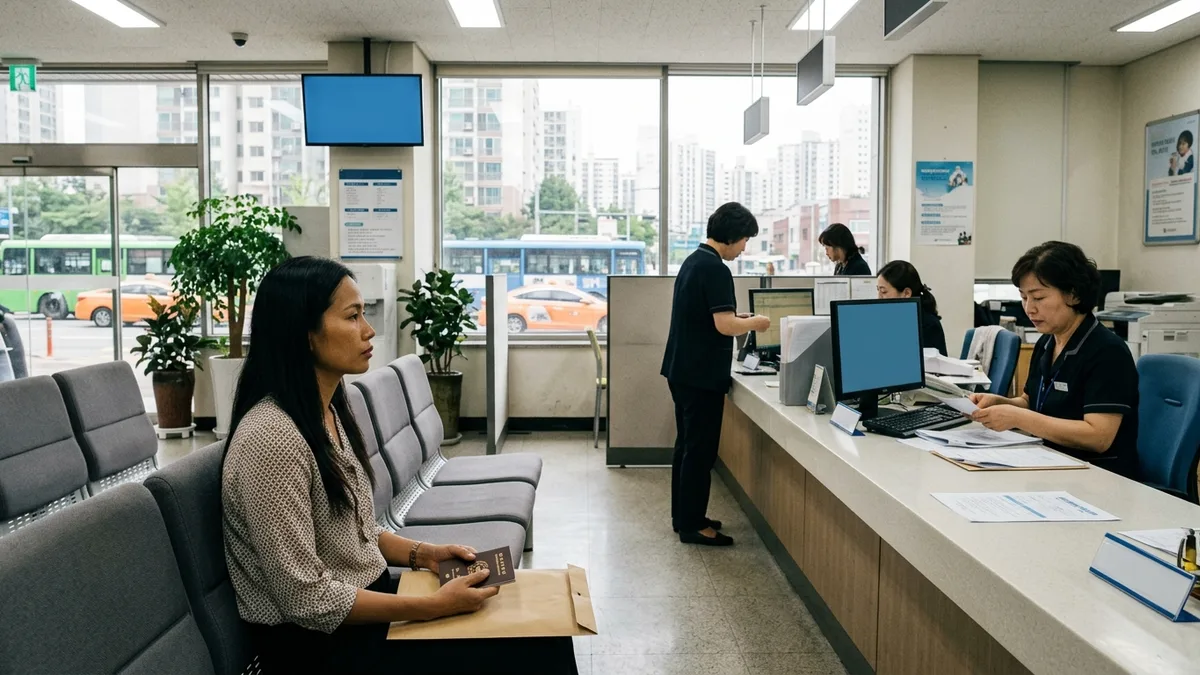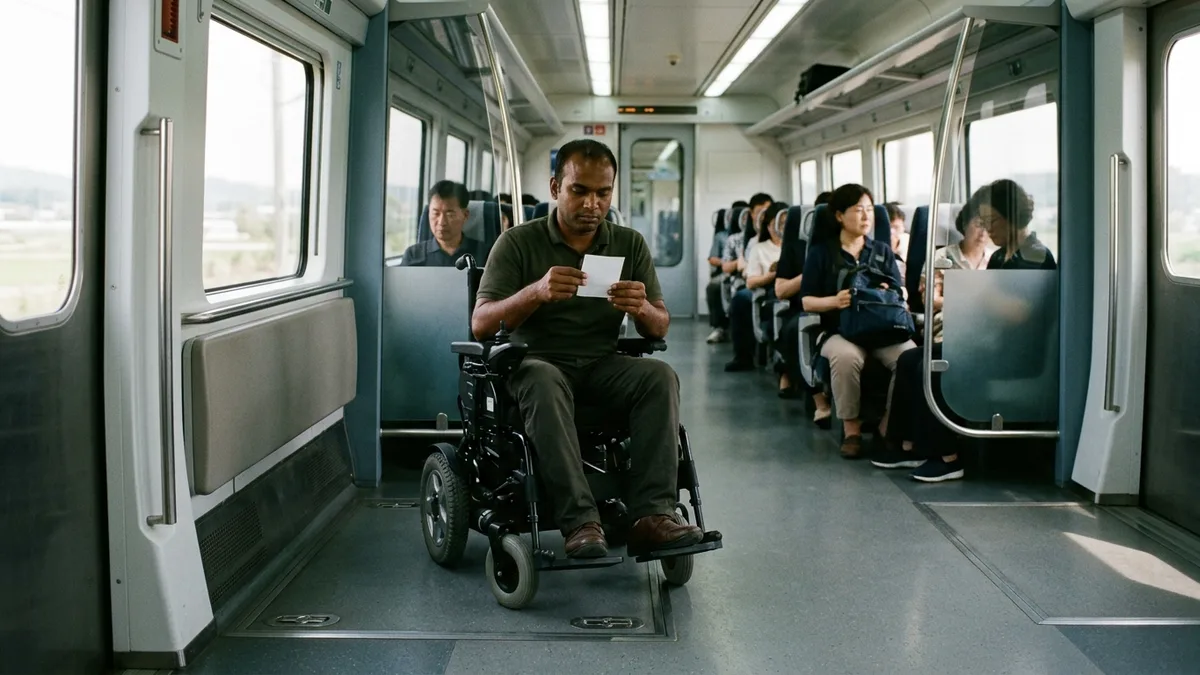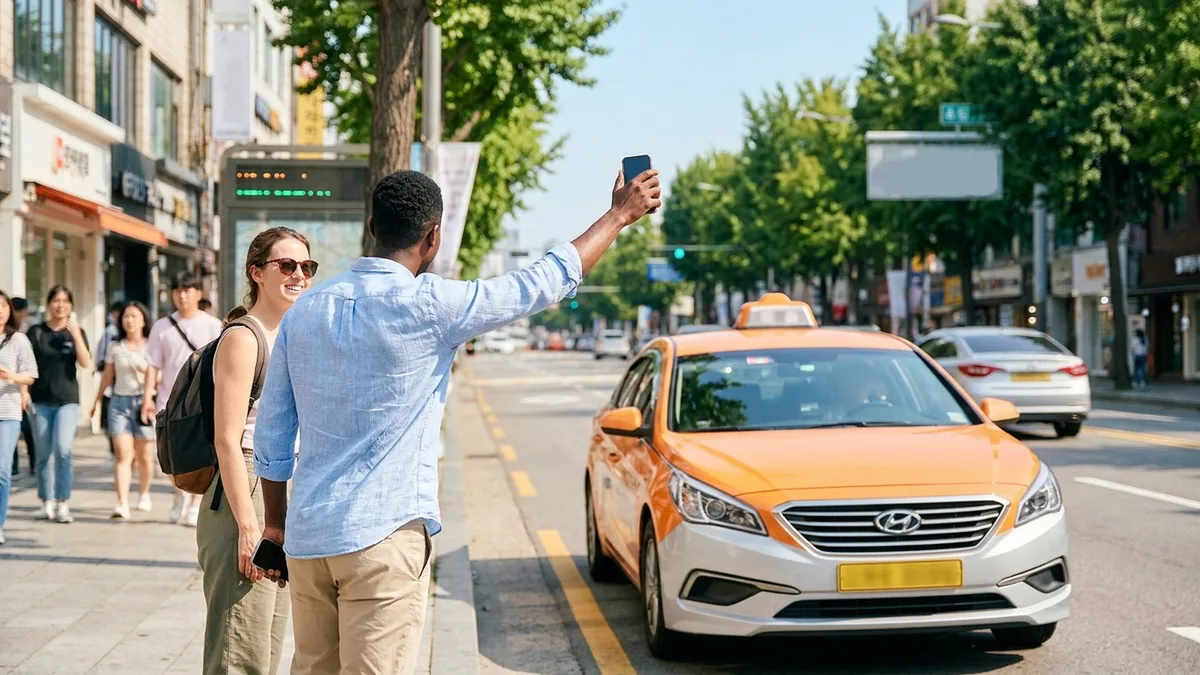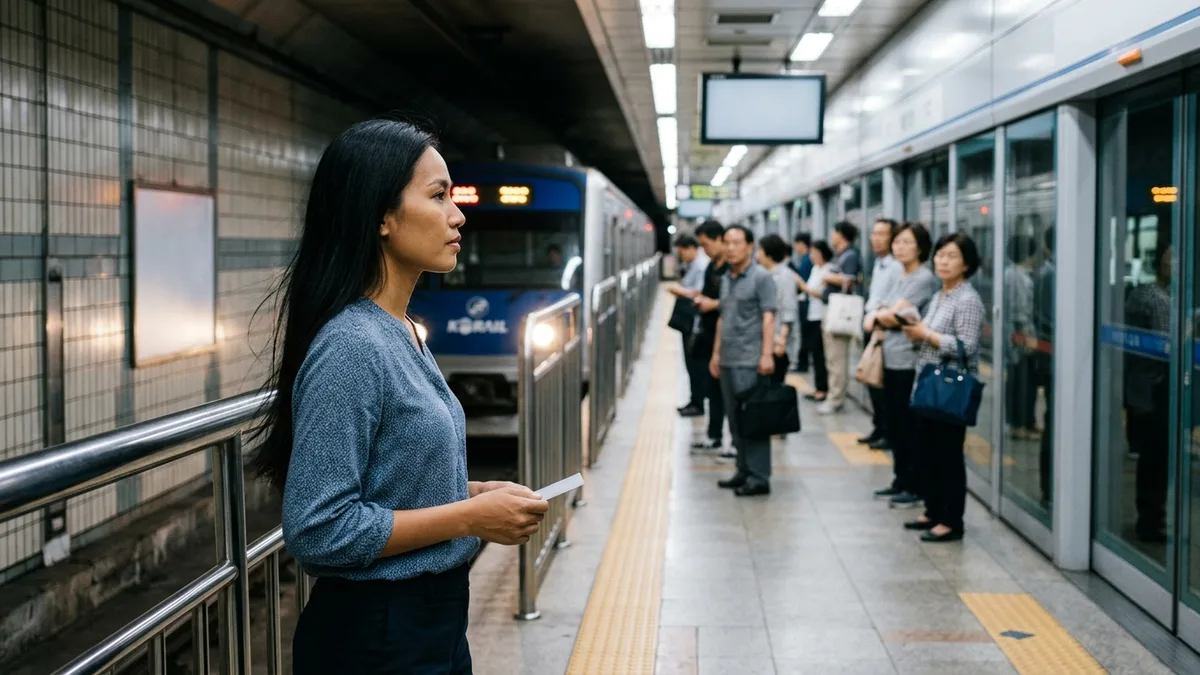
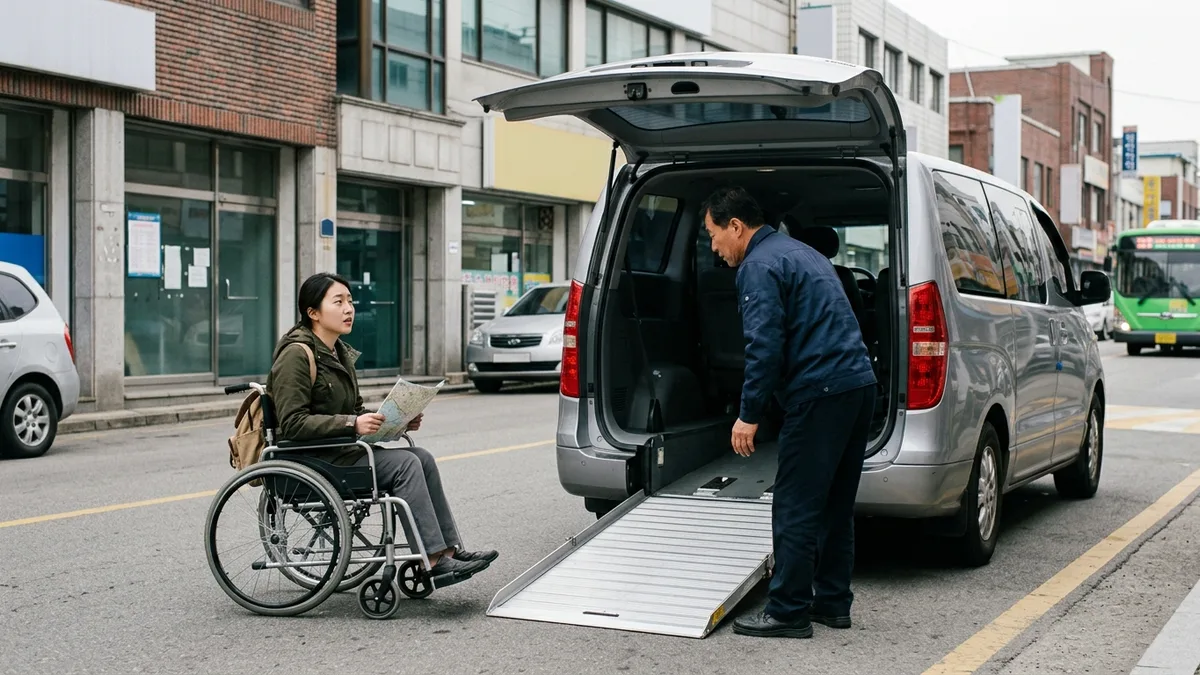
Seoul Facilities Corporation's disabled call taxi eligibility rules list six categories of eligible riders, and the third one is "foreigners with a disability who use a wheelchair." In parentheses it adds: "boarding permitted after verification of foreign national documentation (passport, etc.)." Not a welfare card, not an alien registration card — the rules spell out, in writing, a path to riding with just your passport (as of 2026-08).
The fares work differently from regular taxis, too. The base fare covers up to 5 km for 1,500 KRW, and even a 10 km trip runs 2,900 KRW. Costs incurred during the trip, such as parking and tolls, are paid separately by the passenger.
But the rules being open and actually being able to book a ride are two different things. The same notice carries a catch: "However, new customers must first register their information by phone before use." App and internet booking aren't available to first-time users at all. And about that phone line — Seoul Tourism Organization's official English page states flatly: "The Call Taxi for the Disabled is serviced in Korean." Korean only.
Seoul City's official English tourism guidance goes one step further: "it is not recommended to rely on accessible call vans as your primary mode of transportation." Since accessible taxi service isn't always guaranteed, they explicitly tell you not to depend on it as your main way of getting around. The fact that you can ride and this warning deserve equal weight.
Of the six eligibility categories, only one — ③ — mentions foreigners at all.
Note: This article covers Seoul. Special transportation services are run separately by each local government, so eligibility, fares, and phone numbers differ everywhere. In Busan it's called "Durybal," and even the main phone number is different: 1555-1114. The fares, hours, and operating conditions in this article were verified as of 2026-08 from Seoul Facilities Corporation and Seoul City's official guidance.
The Bottom Line — Foreigners Are Eligible, But Only With a "Wheelchair" and a "Passport Check"
Here are the six categories exactly as written in the eligibility rules.
| Eligible rider | What the notice says | For foreigners |
|---|---|---|
| ① Persons with severe mobility disabilities | Persons with a severe disability who also have a walking impairment | Disability registration is a prerequisite, so it depends on your visa status |
| ② National merit recipients, grades 1–2 | Wounded veterans, injured police/soldiers, injured public officials, combat-wounded veterans | Doesn't apply |
| ③ Foreigners with a disability who use a wheelchair | Boarding permitted after verification of foreign national documentation (passport, etc.) | This is the path a passport opens |
| ④ Users from before the grading system was abolished | Those who had been using the service continuously since before July 1, 2019 | Effectively doesn't apply |
| ⑤ Caregivers | Family members, personal assistants, etc., only when riding along | You can ride as a companion |
| ⑥ Persons with a temporary disability | Those submitting a specialist's medical certificate from a tertiary medical institution | The notice contains no nationality restriction, but whether it applies to foreigners is unconfirmed |
Read the table vertically and you can see how differently the door opens depending on nationality. Korean nationals qualify under ① even if they don't use a wheelchair. For foreigners, though, the rules open exactly one door — ③ — and it comes with the condition "who use a wheelchair." Foreign travelers with visual or hearing disabilities who don't use a wheelchair, or older travelers with limited mobility, aren't covered by this path.
If you get injured during your trip and temporarily need a wheelchair, category ⑥ does exist. But the conditions are strict. You must submit a specialist's certificate from a tertiary medical institution (a top-tier general hospital), and the certificate must state both that you are "unable to move without the use of a wheelchair" and the "treatment period." And this path can only be used for medical appointments and treatment. Not for sightseeing trips. The absence of a nationality restriction in ⑥ doesn't mean it applies to foreigners, either. In the rules, the only door explicitly open to foreigners is ③, so you'll need to confirm whether ⑥ applies by calling the call center (1588-4388) before booking. If it's your first time using a Korean hospital, also read How Foreigners Use Hospitals in Korea.
Caution: Reading this as "any foreigner with a passport can ride" will trip you up on the ground. The rule says, strictly, "foreigners with a disability who use a wheelchair." Always tell them whether you use a wheelchair before dispatch.
The Real First Hurdle Is a Korean-Language Phone Call — New Customers Must Register by Phone First
Booking is offered through four channels: phone and text message (1588-4388), plus the website and the mobile app. The main numbers are 1588-4388 and 02-2024-4200, and the English guidance lists the international format as +82-2-1588-4388.
But the fine print underneath is decisive: "However, new customers must first register their information by phone before use." Even if you download the app and create an account, your first ride won't open up unless you go through a phone call. The plan of prepping everything through the app before you land in Korea simply doesn't work.
And Seoul City–affiliated official pages state outright that this phone line operates in Korean. Seoul Danurim Tourism's English guidance says "The Call Taxi for the Disabled is serviced in Korean," and recommends asking your hotel or a nearby tourist information center for help when you need to call. The same page describes the service scope as "travel within Seoul or a return trip to the airport."
In short, the first wall here isn't eligibility — it's language. You end up in a situation where you're allowed to ride but can't book. Whether the booking app and website support English wasn't something we could confirm this time, so it's worth asking the call center about that too.
Tip: Prepare a note in advance to hand to whoever makes the call for you. ① Pickup address written in Korean ② Destination address written in Korean ③ Wheelchair type (manual or electric) ④ Number of companions ⑤ A phone number where you can be reached. Five lines makes the call dramatically shorter.
Fares and Service Area — From 1,500 KRW for 5 km, Plus Metro-Area and Incheon Airport Conditions
Fares break down into three brackets.
| Bracket | Fare |
|---|---|
| Up to 5 km | Base fare 1,500 KRW |
| Over 5 km – 10 km | +280 KRW per km (2,900 KRW at the 10 km mark) |
| Over 10 km | +70 KRW per km |
| Rounding | Amounts under 100 KRW are rounded down |
| Parking & tolls | Costs incurred during the trip are paid by the passenger |
Past 10 km it's only 70 KRW per km, so the fare climbs gently as distance grows. That said, toll road charges and parking fees are separate — if your destination has paid parking, you cover that yourself.
Trips outside Seoul follow different rules. Wider metro-area travel covers all of Incheon and Gyeonggi Province, and the 12 districts bordering Seoul plus Incheon International Airport are treated under the same conditions as trips within Seoul. For other destinations in the metro area, you must submit documents in advance, such as a same-day medical appointment confirmation or hospital admission certificate.
The airport condition is a particularly common source of confusion. Use of Incheon International Airport carries the caveat "limited to holders of a same-day flight ticket." You can use it to get from the airport into the city on your arrival day, or to the airport on your departure day, but not to go pick someone up at the airport mid-trip or for airport round trips. For the support available inside the airport (free wheelchair rental, electric cart transport, priority lanes), see Incheon Airport Services for Passengers With Reduced Mobility.
Caution: Plenty of English-language travel write-ups just say "you can use it at the airport too" and leave out the same-day ticket condition. If an airport trip is part of your plan, check the ticket requirement first. Also, whether the metro-area fare matches the in-city fare was hard to pin down — outdated wording remains on the corporation's guidance page — so confirm that with the call center when you book.
Booking Hours — Immediate Calls, Advance Calls, and Separate Rules for Late Night
Same service, but booking hours and channels differ depending on how you call.
| Type | How to book | Hours |
|---|---|---|
| Immediate call | Book on the spot when you need it | First vehicle at 07:00 |
| Advance call | Call center phone booking (first-come, first-served) | 10:00–18:00 the day before use |
| Late night | Advance phone booking with the call center the day before | Operates 01:00–05:00 (until 03:59 outside Seoul) |
| Metro-area travel | Phone booking only (1588-4388 / 02-2024-4200) | Operates daily 07:00–22:00, applications 07:00–17:00, one one-way trip per day |
Metro-area travel is also described as an advance booking system running 07:00–22:00 the day before your trip. Since the notice lists the application window (07:00–17:00) and the advance booking window (07:00–22:00 the previous day) side by side, it's safest to confirm by phone how late they actually take calls.
The dispatch method is public, too. It's scored out of booking order (15 points), waiting time (35 points), and pickup distance (40 points), and if a wait exceeds 60 minutes, the mobility support center steps in to adjust dispatch directly. From the scoring you can infer that nearby vehicles get priority — meaning the farther out you are, the longer you wait.
There's one more problem that hits foreigners specifically: advance calls and late-night rides both require a first-come, first-served phone booking between 10:00 and 18:00 the previous day. You have to call in Korean, on Korean time, within an eight-hour competitive window. That window overlaps exactly with the operating hours of the foreign-language help line covered in the next section — so you end up having to clear the language barrier twice in a single day.
Wait Times and the Official Warning — Seoul City Itself Wrote "Don't Rely on It as Your Primary Transportation"
You can't quote just one number for wait times. Official Seoul City–affiliated pages don't agree with each other.
- Seoul Facilities Corporation (Korean) — if a wait exceeds 60 minutes, the mobility support center adjusts dispatch directly
- Seoul Danurim Tourism (English) — waits of up to 90 minutes are possible; typically dispatched within 20–30 minutes of a request
- Visit Seoul (English) and the Seoul Danurim accessibility page — average wait of 30–60 minutes
Line all three up and it becomes clear that neither "it'll come in 20–30 minutes" nor "brace for 90 minutes" is accurate on its own. This is exactly where foreigners planning from English-only pages get burned worst. Practically speaking, the safe approach is to block out a generous 60 minutes and decide in advance the exact time you'll switch to a backup option if it doesn't show.
Which is why the sentence in Seoul City's official English tourism guidance matters: "it is not recommended to rely on accessible call vans as your primary mode of transportation." In other words, since accessible taxi service isn't always guaranteed, they don't recommend depending on it as your main transportation. Don't brush past the fact that a tourism page whose job is to promote services wrote that itself.
Important: For anything you absolutely can't miss — a flight departure, a KTX departure, a hospital appointment — don't make this service your only option. Build in at least two layers, and set a specific clock time at which you'll switch to option two if option one is running late.
Workarounds for Booking Without Korean — Hotels, Tourist Information Centers, and the 120 Dasan Call Foreign-Language Line
There are three realistic routes.
First, your hotel front desk or a nearby tourist information center. This is the method Seoul Danurim Tourism's English page recommends directly, so the people you ask won't find the request unusual. Just show them the five-line note you prepared earlier.
Second, the 120 Dasan Call Foundation's foreign-language service. It operates in five languages: English, Chinese, Japanese, Vietnamese, and Mongolian. From inside Korea, dial (02)120, press 9 on the automated menu, then select your language; from overseas, call +82-2-731-2120. Hours are Monday–Friday, 09:00–18:00, closed weekends and public holidays. Three-way interpretation is available during the call if needed.
Third, help from a Korean friend or personal care assistant who's already a member. Since information registration itself only opens by phone, once you get past that first call, the text-message booking route becomes relatively easy afterward.
But do the time math once. Advance call bookings run 10:00–18:00 the day before, and the Dasan Call foreign-language line runs weekdays 09:00–18:00. The overlapping window is only weekdays from 10:00 to 18:00. An advance call for a Sunday ride has to be made between 10:00 and 18:00 on Saturday — when Dasan Call is closed. For weekend trips, sort things out by Friday, or go the hotel / tourist information center route to be safe.
📌 Note: Whether 120 Dasan Call will actually place a disabled call taxi booking on your behalf isn't stated in their guidance. Only "three-way interpretation during consultations" is confirmed, so ask first when you call whether proxy booking is possible. The 1330 tourist interpretation hotline is also mentioned as an alternative, but we couldn't confirm its hours, supported languages, or whether three-way interpretation is available — please verify with official sources.
If You're a Resident Foreigner — Membership and Disability Registration Come Down to Visa Status
If you live in Korea, you're probably wondering about formal membership — and here's where the paperwork wall appears. The signup guidance requires a welfare card (showing name, date of birth, disability type, disability level, and validity period), a disability level determination notice, and the supplementary notice on the disability level review results. You submit by fax (02-2290-6518), text message (1588-4388), or app upload, and if you don't submit documents within two weeks of registering, your membership may be canceled.
The problem is that nowhere in this guidance is there any mention of a signup procedure for foreigners. The eligibility rules include a passport-verification path, but the signup guidance is written entirely on the assumption of a welfare card. Whether the passport path ends at "on-the-spot boarding verification," or extends to advance information registration and full membership, can't be confirmed. Don't assume you can sign up — check with the call center first.
To get that welfare card, you need disability registration, and here visa status is the dividing line. Article 32-2, Paragraph 1 of the Act on Welfare of Persons with Disabilities limits registration to five categories of overseas Koreans and foreigners.
- Item 1 — Those who have filed a domestic residence report under Article 6 of the Overseas Koreans Act
- Item 2 — Those registered as overseas nationals under Article 6 of the Resident Registration Act
- Item 3 — Those registered as foreign nationals under Article 31 of the Immigration Act who hold, among the statuses of stay under Article 10(1) of the same Act, a status of stay permitting permanent residence in Korea
- Item 4 — Marriage immigrants as defined in Article 2, Item 3 of the Framework Act on Treatment of Foreigners Residing in Korea
- Item 5 — Recognized refugees under Article 2, Item 2 of the Refugee Act
Anyone outside this list — E-9 workers, D-2 students, D-4 language trainees, and so on — can't become a registered person with a disability in the first place. They're structurally excluded from any benefit that presumes registered status. Exactly how far each visa status gets you is broken down article by article in Disability Registration for Foreigners and Transit Fare Discount Eligibility.
Even registration isn't the end of it. Paragraph 2 of the same article states that "the State and local governments may limit support under disability welfare programs, taking budgets and other factors into account, for persons with disabilities registered under Paragraph 1." Meaning registration alone doesn't automatically get you the same support as a Korean registered person with a disability.
The discounted transit card used for free subway rides is yet another separate system. Seoul City's guidance defines eligible recipients as "those eligible for free rides on metropolitan-area urban rail who reside in Seoul according to their resident registration," with no mention of foreigners. Free rides apply only to metropolitan-area urban rail; buses are still paid. Since the guidance says nothing about how cases like permanent residents or marriage immigrants — who can register a disability but have no resident registration — are handled, we can't write that it works or that it doesn't. Please check directly with 120 Dasan Call or your local community service center.
Caution: Every system has different eligibility criteria. Riding the call taxi opens with a passport check; disability registration turns on visa status; free subway rides look at resident registration. Assuming that qualifying for one means qualifying for the rest will send you on a wasted trip to the counter.
When the Call Taxi Isn't an Option, and Outside Seoul — UD Taxis, Regular Taxis, Danurim, and Busan's Different Number
Seoul launched UD (Universal Design) taxis on July 1, 2026. These are vehicles built so that wheelchair users, people with disabilities who don't use wheelchairs, and non-disabled passengers can all ride. It's a pilot program running July–December 2026 with 12 vehicles, using the Kia PV5 WAV.
Dispatch works a bit unusually. Each vehicle gives priority dispatch to persons with severe mobility disabilities (disabled call taxi members) for up to 100 trips per month; once a vehicle hits that quota, it converts to a regular taxi that anyone can use via app hailing or street pickup. At that point, standard mid-size taxi fares apply. That said, whether hailing apps let you specifically request a UD taxi is unconfirmed. Wheelchair users are directed to the disabled call taxi call center (1588-4388) for inquiries.
Seoul Tourism Organization's "Danurim" also comes up often. What's confirmed in the English accessibility guidance is an airport pickup service (Danurim Minivan), which is limited to wheelchair users, requires advance online reservation through the website, and comes with the explicit note "This service is not available continuously." There's a separate Danurim vehicle rental service too, but the press release includes the phrase "limited to organizations located in Seoul," so we couldn't confirm whether individual foreigners can rent one. Inquiries go to the Seoul Danurim Tourism Center (1670-0880). For elevator routes and low-floor bus realities when you're moving by subway and bus instead of call taxi, see Riding the Seoul Subway and Buses in a Wheelchair.
Leave Seoul and the whole system changes. Busan's disabled call taxi is called "Durybal," and its main number is 1555-1114. Beyond the disabled call taxi, it's a separate system with dedicated services for expectant mothers, multi-passenger Durybal vans, and vehicles for bedridden passengers. No wording about foreigners was found in the Durybal usage guidance — but the absence of a statement doesn't mean it's a no. Don't carry Seoul's information with you; check directly with each region's mobility support center.
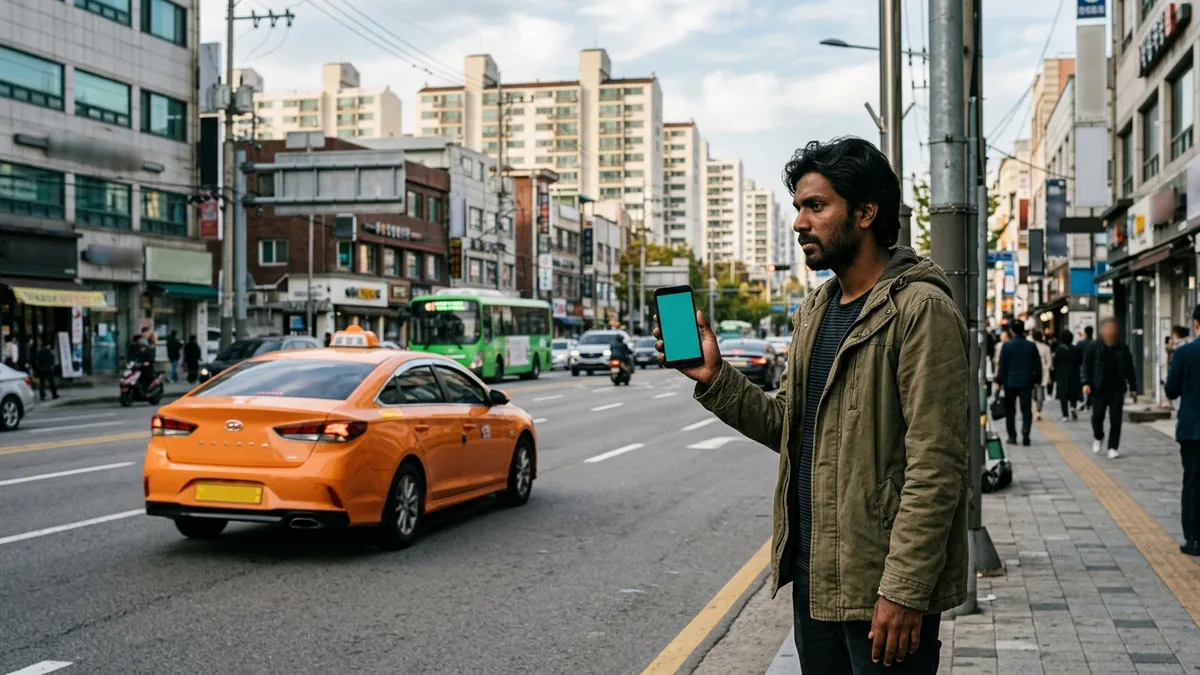
Some trips don't actually require a lift-equipped vehicle. Cases where a folding manual wheelchair fits in the trunk, legs where only your companion heads to the accommodation first, or trips just to move luggage. Line up your options for those situations and it looks like this.
| Option | What it does | Where foreigners get stuck |
|---|---|---|
| Seoul disabled call taxi | Board while seated in your wheelchair, 1,500 KRW for 5 km | New customers must first register by phone in Korean |
| UD taxi | Both wheelchair users and non-users can ride | 12-vehicle pilot stage; whether you can specifically request one is unconfirmed |
| Kakao T | Hail regular and large taxis | Requires Korean phone number verification |
| LACHA | Taxis, VANs (5–6 seats), KTX, express buses, airport railroad, transit cards | Doesn't handle lift-equipped vehicle dispatch |
LACHA is a transportation and payment super app for foreigners that you can use immediately without identity verification. It's designed so you can start with just your passport — no Korean bank account or phone number — and it takes overseas payment methods like Alipay and WeChat Pay. When the Korean-language phone line is a dead end, you can still use it to call a regular taxi or a 5–6 seat VAN, and you can bundle airport railroad, KTX, and express bus reservations into the same app.
One thing to be clear about, though: LACHA does not book disabled call taxis or dispatch wheelchair lift vehicles. Wheelchair spaces on trains and buses, as well as boarding assistance, are set separately by each operator. If you need to board without folding your wheelchair, look into the disabled call taxi or UD taxi first, and for train seating see How to Book a KTX Wheelchair Seat.
Want to get a taxi without a Korean phone number? Check out LACHA.
Built to work without a Korean phone number or bank account, with overseas payment methods like Alipay, WeChat Pay, and Apple Pay. Taxi hailing plus KTX, express bus, and airport railroad (AREX) booking — all in one app.
Up to 60% off Korea transit with a coupon (max ₩3,000): enter code at sign-up. KTX gets up to 18% off on top
Download now


Frequently Asked Questions (FAQ)
Q1. Can I ride Seoul's disabled call taxi with just my passport? There's one condition attached. The third eligibility category in Seoul Facilities Corporation's rules is "foreigners with a disability who use a wheelchair," with the parenthetical "boarding permitted after verification of foreign national documentation (passport, etc.)." So it's a path where, if you use a wheelchair, a passport check gets you on board. People with disabilities who don't use a wheelchair, or older travelers with limited mobility, aren't covered by this category. If you're injured during your trip and temporarily need a wheelchair, there's a separate category requiring a specialist's certificate from a tertiary medical institution — but that can only be used for medical appointments and treatment.
Q2. I don't speak Korean. How do I call one? You can't avoid the phone for your first ride. The guidance states that "new customers must first register their information by phone before use," so app and internet booking aren't available from the start. Seoul City's official English guidance also states that this call center is serviced in Korean and recommends asking your hotel or a nearby tourist information center for help. Another option is the 120 Dasan Call Foundation's foreign-language service (English, Chinese, Japanese, Vietnamese, Mongolian; dial (02)120 and press 9 on the automated menu, or +82-2-731-2120 from overseas), but it runs Monday–Friday 09:00–18:00 and is closed on weekends. Whether they'll book on your behalf isn't stated in the guidance, so ask first when you call.
Q3. Can I use it at Incheon Airport? Conditionally, yes. Incheon International Airport falls within the metro-area travel zone treated under the same conditions as Seoul, but with the caveat "limited to holders of a same-day flight ticket." You can use it on your arrival day or departure day, but not to travel to and from the airport mid-trip to meet or see off someone else. Metro-area travel is phone-booking only, limited to one one-way trip per day, and requires advance booking — so plan on it being difficult to summon one on the spot the day you land.
Q4. How long is the wait? Official sources give different numbers. Seoul Facilities Corporation says the mobility support center adjusts dispatch directly when a wait exceeds 60 minutes; Seoul Danurim Tourism's English page says waits of up to 90 minutes are possible but dispatch typically happens within 20–30 minutes of a request. Visit Seoul's English page and the Seoul Danurim accessibility page say the average is 30–60 minutes. Dispatch is determined by a combined score of booking order (15 points), waiting time (35 points), and pickup distance (40 points), so it varies widely by location and time of day. Seoul City's own official English guidance recommends not relying on this service as your primary transportation, so for any time-sensitive schedule, prepare a backup option alongside it.
Q5. Can I use the same number in Busan or other cities? No. Everything in this article is Seoul-specific, and special transportation services are operated separately by each local government. Busan's is called "Durybal," its main number is different at 1555-1114, and beyond the disabled call taxi it has separate services for expectant mothers, multi-passenger Durybal vans, and vehicles for bedridden passengers. No wording about foreigners was found in the Durybal guidance, but the absence of a statement doesn't mean it's a no — check directly with that region's mobility support center before you ride. Generalizing from "it works in Seoul" to "it works nationwide" is risky.
Note: This article is intended as general information. The eligibility categories, fares, booking hours, and operating conditions described here were verified as of 2026-08 from Seoul Facilities Corporation's disabled call taxi eligibility rules and metro-area travel guidance, the Seoul Metropolitan Government's 120 Dasan Call Foundation, the Visit Seoul and Seoul Danurim Tourism English pages, and Article 32-2 of the Act on Welfare of Persons with Disabilities. Some items (whether foreigners can register as members, whether foreigners can get the discounted transit card, whether individuals can apply for Danurim vehicle rental, metro-area travel fares, foreign-language support in the booking app, and 1330's operating conditions) aren't specified in official guidance and couldn't be confirmed — they're flagged as such in the text. Systems and fares can change, so please re-confirm with Seoul Facilities Corporation (1588-4388) and each region's mobility support center before you ride. LACHA does not book disabled call taxis or dispatch wheelchair lift vehicles.