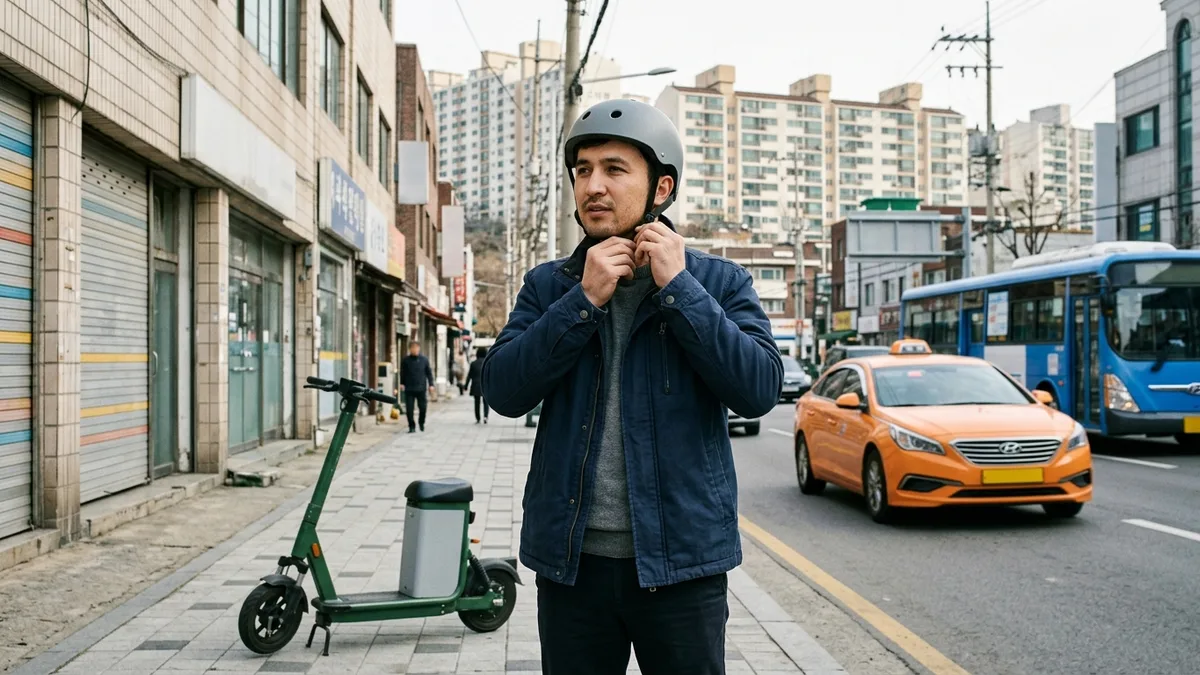
To ride a shared electric scooter on the road in Korea, you need at least a motorized bicycle (원동기장치자전거) license. That's set out in Article 80(1) and Article 80(2)2(c) of the Road Traffic Act, and if you're caught riding without one, it's a 100,000 KRW summary fine (notice disposition) (Article 156(13), Enforcement Decree Article 93(1) and Annex Table 8 item 1-4).
And it's rarely just one charge. No helmet is 20,000 KRW (Annex Table 8 item 38-2), two people on one scooter is 40,000 KRW (Annex Table 8 item 3-4), riding on the sidewalk is 30,000 KRW (Annex Table 8 item 5), and riding at night without lights is 10,000 KRW (Annex Table 8 item 57-2) — each calculated separately. When the violations stack, so do the amounts.
The app blocks none of this. Cards issued overseas sometimes go through and the scooter unlocks, which makes it easy to read the situation as "the app let me, so I'm allowed." But payment going through and being legal on the road are two different things. The person police stop on the road isn't the rental operator — it's whoever was riding at that moment.
Don't count on the rules loosening any time soon, either. On December 18, 2025, the Constitutional Court unanimously dismissed a constitutional complaint challenging both the license requirement and the helmet mandate (2021Hun-Ma946). It was the first ruling on whether personal mobility device regulations are constitutional, and the answer was: they stand.
That said, you're not out of options. Pedal-assist (PAS) e-bikes are classified as electric bicycles under the Act on the Promotion of Bicycle Use, are treated like bicycles, and require no driver's license. They can look nearly identical to throttle-type models, but their legal status is completely different.
Note: The statutes and amounts in this article were verified as of 2026-08 against the Korea Ministry of Government Legislation's Easy-to-Find Practical Law portal and public materials from Incheon Metropolitan City and the Ministry of Land, Infrastructure and Transport. This article is not legal advice, and the Road Traffic Act is amended often. Before you actually ride, double-check with the Korea Road Traffic Authority (1577-1120) or your local police station.
A Shared Scooter Isn't a "Bicycle" — It's a "Motorized Bicycle," and 25km/h and 30kg Draw the Line
The legal term is "personal mobility device (PM)." Article 2(19)-2 of the Road Traffic Act defines it as a device that meets certain requirements among motorized bicycles. It's not a type of bicycle but a type of motorized bicycle — and that's the starting point for every rule that follows.
Article 2-3 of the Enforcement Rule sets three requirements:
- The motor must not operate at speeds of 25 km/h or above. People usually shorten this to "top speed under 25 km/h," but that's the actual statutory wording.
- Vehicle body weight must be under 30 kg.
- It must have a safety confirmation declaration under the Electrical Appliances and Consumer Products Safety Control Act.
Meet all three and it's a personal mobility device; exceed them and it's simply treated as a motorized bicycle or a two-wheeled motor vehicle. Either way, you still need a license. If anything, the faster it goes, the stricter the rules get.
What's in and what's out is easy to mix up.
| Vehicle | Legal classification | Driver's license |
|---|---|---|
| Electric kickboard (scooter) | Personal mobility device | At least a motorized bicycle license required |
| Self-balancing two-wheeler | Personal mobility device | At least a motorized bicycle license required |
| Throttle-type e-bike | Personal mobility device | At least a motorized bicycle license required |
| Pedal-assist (PAS) e-bike | Electric bicycle under the Act on the Promotion of Bicycle Use | Not required |
| Electric unicycle (one-wheel), electric two-wheel board, electric skateboard | Excluded from personal mobility devices | See explanation below |
Don't misread that last row. "Excluded" doesn't mean "you can ride it without a license" — it means the rules written for personal mobility devices don't automatically apply. What legal standing one-wheels and electric skateboards have on the road is outside the scope of this article, so check separately before you ride.
The License You Need Is a Motorized Bicycle License or Higher — Under 16 Can't Ride at All
Article 80(1) of the Road Traffic Act says anyone who wants to drive a motor vehicle or the like must obtain a driver's license from the commissioner of the city/provincial police agency, and Article 80(2)2(c) places personal mobility devices under the motorized bicycle license category. So a motorized bicycle license, or any higher car license, works. If you already hold a car license — Class 2 Ordinary or Class 1 Large, it doesn't matter — you don't need to get a separate motorized bicycle license.
Age matters too. Under Article 82(1)1, you must be at least 16 to get a motorized bicycle license. So there is simply no legal way for anyone under 16 to ride an electric scooter. If a guardian lets a child ride one on the road, the guardian faces a 100,000 KRW administrative fine (Article 11(4), Enforcement Decree Annex Table 6 item 1-3).
For foreigners, the real question is "does the license I already have count?" Here it splits three ways.
- A license issued in Korea is the cleanest case. Motorized bicycle license or car license, either works.
- An International Driving Permit (IDP) leaves the question open. We could not confirm from primary sources how personal mobility devices fit into the scope of foreign licenses recognized under Article 96 of the Road Traffic Act, or how Korea treats IDP subcategories like A, A1, and AM as qualification to ride a scooter. Being able to drive a rental car on an IDP with only the car (B) category does not mean scooters are covered. Call the Korea Road Traffic Authority (1577-1120) and ask about your specific license type. We've covered recognized countries and validity periods in How to Tell Whether Your International License Works in Korea.
- Some countries have no IDP route at all. China, Indonesia, and Nepal have no international driving permit pathway, so unless you get a Korean license, there's no option. A large share of foreign residents in Korea fall into this group.
Caution: If the app never showed you a license verification screen, that doesn't mean no license is needed. Some shared scooter apps design their license checks around Korean-issued licenses only, so there may be no path at all for registering a foreign license or an IDP. Whether a verification screen appears is the app's business — the Road Traffic Act's license requirement stands regardless.
Payment Going Through in the App and Being Legal on the Road Are Two Different Things
With some shared scooter apps, you can complete signup and payment entirely with an overseas card. Once the lock releases and the wheels roll, it feels like you've been given permission — but what the app just verified is whether your payment method is valid, not whether you're qualified to ride.
The responsibility sits in a different place. The rental operator lent you a device; the Road Traffic Act places duties on the rider. That's why the fine notice goes to the person who was riding, not to the app. Regardless of nationality or visa status, on the road you're treated the same as any other rider.
Helmets work the same way. Even if the rental scooter doesn't have a helmet attached, the duty to wear one doesn't disappear. Article 50(4) requires riders to wear protective gear, and going without carries a 20,000 KRW summary fine. Travelers don't carry helmets around, which means you're already in violation the moment you rent.
Important: What the app verified is payment. What the law requires is a license, a helmet, the right place to ride, and the passenger limit. Those two lists don't overlap.
The contrast makes it clear. With a rental car or a scooter rental, staff check your license with their own eyes at the counter, so if you're not qualified you're stopped right there. With shared scooters that gate has just moved behind a screen — the requirement hasn't gone away. Rental conditions for two-wheelers are covered separately in Scooter and Motorcycle Rental Requirements.
What It Costs If You're Caught — One Table of Fines by Violation
A single ride can trigger several violations at once, and each amount is calculated separately.
| Violation | Amount | Legal basis |
|---|---|---|
| Riding without a license (including during license suspension) | Summary fine 100,000 KRW | Articles 43 and 80, Article 156(13), Enforcement Decree Annex Table 8 item 1-4 |
| Riding under the influence (BAC 0.03% or higher) | Summary fine 100,000 KRW | Article 44, Article 156(11), Enforcement Decree Annex Table 8 item 64-2 |
| Refusing a breath test | Summary fine 130,000 KRW | Article 44, Article 156(12), Enforcement Decree Annex Table 8 item 64-3 |
| Riding while possibly unable to drive normally due to drugs, etc. | Summary fine 100,000 KRW | Article 50(8), Article 156(1), Enforcement Decree Annex Table 8 item 1-5 |
| Two or more riders | Summary fine 40,000 KRW | Article 50(10), Enforcement Rule Article 33-3, Enforcement Decree Annex Table 8 item 3-4 |
| Riding on the sidewalk | Summary fine 30,000 KRW | Enforcement Decree Annex Table 8 item 5 |
| No helmet (rider) | Summary fine 20,000 KRW | Article 50(4), Enforcement Decree Annex Table 8 item 38-2 |
| Failing to have a passenger wear a helmet | Administrative fine 20,000 KRW | Article 50(4), Enforcement Rule Article 32(2), Enforcement Decree Annex Table 6 item 10 |
| No lights or reflective device at night | Summary fine 10,000 KRW | Article 50(9), Enforcement Decree Annex Table 8 item 57-2 |
| Guardian who let a child ride on the road | Administrative fine 100,000 KRW | Article 11(4), Enforcement Decree Annex Table 6 item 1-3 |
The row people miss is the passenger limit. The seating capacity of an electric scooter is one person (Enforcement Rule Article 33-3); the two-person capacity applies to throttle-type e-bikes. Sharing one scooter with a friend turns into 40,000 KRW on the spot, so when there are two of you, rent two scooters or take something else.
Drinking and riding a scooter is treated on the same footing as driving a car. BAC of 0.03% or higher is a 100,000 KRW summary fine, and refusing a police breath test is 130,000 KRW. On top of that, it triggers administrative action against your driver's license. Per the Easy-to-Find Practical Law portal, 0.03% or higher but under 0.08% means license suspension (100 penalty points), and 0.08% or higher means license revocation. In other words, your car license can be suspended or revoked even though you weren't driving a car.
Tip: The most dangerous combination is leaving a night out and grabbing a scooter "just to the station." Drinking 100,000 + no helmet 20,000 + no night lights 10,000 + no license 100,000 KRW can all apply at once, and if you crash on top of that, you move into the criminal process described below.
Where You're Supposed to Ride — Bike Lanes as the Rule, Sidewalks Cost 30,000 KRW
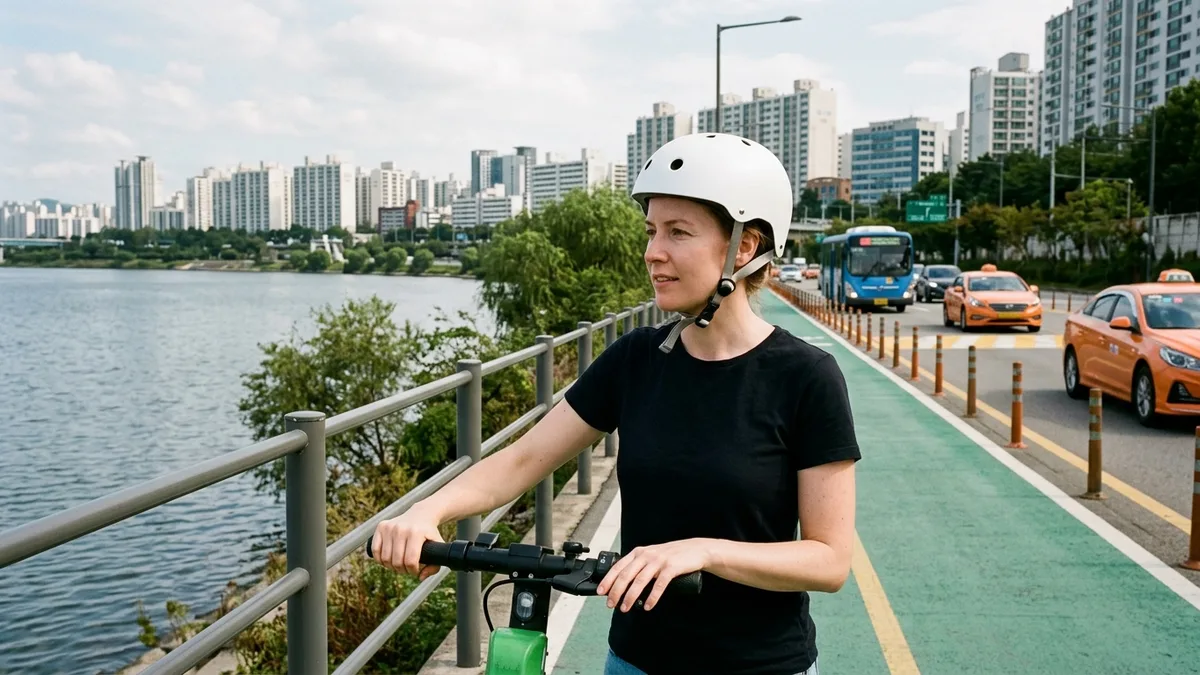
Where you can ride is set by Article 13-2 of the Road Traffic Act. Paragraph 1 says that where a bicycle lane exists, you must ride in the bicycle lane; paragraph 2 says that where there is no bicycle lane, you must ride along the right edge of the road, and where sidewalk and roadway are separated, you must use the roadway.
| Situation | Where to ride | Basis / amount |
|---|---|---|
| Street with a bike lane | Bike lane | Article 13-2(1) |
| Street with no bike lane | Right edge of the road | Article 13-2(2) |
| Street where sidewalk and roadway are separated | Roadway (sidewalk not allowed) | Article 13-2(2) |
| If you ride on the sidewalk | — | Summary fine 30,000 KRW (Enforcement Decree Annex Table 8 item 5) |
This is the trap foreigners fall into most. Sidewalks in Korean city centers are wide and flat, so they look safer than a roadway with cars whipping past. The instinct is to choose the sidewalk — and the law says exactly the opposite. On top of that, this rule is mostly written only on Korean-language signs and in Korean-language app notices, so there's barely a chance to learn it.
When you're actually moving, check in this order:
- If the pavement has blue surfacing or a bicycle pictogram, that's a bike lane. Stay on it.
- If you don't see a bike lane, hug the far right edge of the roadway. If cars are parked along the shoulder, that means the right edge of the lane outside them.
- If a stretch of roadway feels like too much, get off and walk it. When you're pushing it on foot, you're a pedestrian.
- Whether you're legally required to dismount and push across a crosswalk isn't spelled out in the Ministry of Government Legislation's guidance on riding rules (needs verification). Still, riding through a crowd of pedestrians raises both crash risk and pedestrian-protection issues, so dismounting and pushing is the safer call.
Parking it anywhere when you're done is also a problem. A personal mobility device left in a way that obstructs traffic can be towed, and towing and storage fees are set by each local government. Amounts and the retrieval process are covered in If You Get a Parking Ticket or Towed.
If You Crash, It Doesn't End With a Fine — Criminal Proceedings and Insurance Gaps
From here the scale changes. If a personal mobility device rider's occupational negligence or gross negligence injures or kills someone, Article 3 of the Act on Special Cases Concerning the Settlement of Traffic Accidents makes it punishable by imprisonment without labor for up to 5 years or a criminal fine of up to 20,000,000 KRW. Even damaging property rather than injuring a person is punishable under Article 151 of the Road Traffic Act by imprisonment without labor for up to 2 years or a criminal fine of up to 5,000,000 KRW.
Most cases are resolved by settling with the victim, but there's a separate list of items where prosecution can proceed even after a settlement: running a signal, crossing the center line, exceeding the speed limit by more than 20 km/h, drunk riding, drug-impaired riding, riding onto the sidewalk, violating the duty to protect pedestrians at a crosswalk, and violating safety duties in a school zone.
The one to watch on that list is riding onto the sidewalk. Normally it's a 30,000 KRW fine item — but hit a pedestrian while doing it and it becomes a matter where criminal proceedings can go forward regardless of any settlement. That's the point where a choice made because "the sidewalk looked safer" leads to the heaviest outcome.
Insurance isn't like cars either. In 2020 the Financial Supervisory Service amended the standard auto insurance policy terms to include personal mobility devices in the definition of an "uninsured motor vehicle." That means victims gained a route to claim under the uninsured-motorist coverage of their own auto policy — it does not mean scooter riders carry mandatory insurance. Sources disagree on whether personal mobility devices are subject to mandatory insurance, so in this article we'll only state the fact that "there is a mandatory insurance gap" (needs verification).
This phase is especially heavy for foreigners because the entire process runs in Korean. You can request interpretation support during a police investigation, but interpretation doesn't necessarily follow you into settlement negotiations or damage calculations. If the rental app offers insurance, check the coverage scope and deductible before you ride.
Caution: Leaving the scene afterward is the worst possible choice. We couldn't verify from primary sources which statute and sentencing range apply to failure to take measures (needs verification), but in an accident with personal injury, leaving the scene makes matters far more serious. If someone is hurt, call 112 and 119 first.
What You Can Legally Ride Without a License — Pedal-Assist (PAS) E-Bikes and Public Bikes
There's exactly one dividing line: how the power is delivered. Pedal-assist (PAS) systems, where the motor only helps while you pedal, are classified as electric bicycles under the Act on the Promotion of Bicycle Use, treated like ordinary bicycles, and require no driver's license. Throttle types, which move on lever input alone without pedaling, are personal mobility devices and require a license.
The problem is that you can't tell them apart by looking. In stores and on shared-mobility app screens alike, they look like the same bicycle. When buying or renting, just check these two things:
- Does it have pedals? No pedals, not a bicycle.
- Does it move forward when you pull the lever without pedaling? If it does, it's a throttle type and you need a license.
Here's a single table of your options when you can't meet the license requirement.
| Option | Driver's license | Where foreigners get stuck |
|---|---|---|
| Public bike share (Ttareungi, etc.) | Not required | App signup and overseas card payment can block you |
| Pedal-assist (PAS) e-bike | Not required | Looks like a throttle type, so it's hard to tell them apart when choosing |
| Throttle-type e-bike | Required | Capacity is two, but the license requirement is the same as for scooters |
| Electric scooter | Required | Even if app payment goes through, license and helmet rules still apply |
Municipal public bike systems need no license, so they're the safest starting point. That said, foreigners hit specific snags at the signup and payment stages, and we've written up how to handle Seoul's Ttareungi in How Foreigners Can Use Ttareungi.
The Rules Aren't Loosening — The Constitutional Court's 2025 Answer
There have long been arguments that personal mobility device regulations go too far. The dispute reached the Constitutional Court, and on December 18, 2025 it was unanimously dismissed (2021Hun-Ma946). Two provisions were at issue: the parts of Articles 43 and 80 of the Road Traffic Act requiring at least a motorized bicycle license to ride a personal mobility device, and the part of Article 50(4) mandating helmet use.
The meaning is clear. In the first ruling to squarely address whether the license and protective-gear rules are constitutional, the rules were upheld. The calculation "they'll be relaxed soon, so it's fine until then" doesn't hold.
That said, what we verified about this decision comes from reporting by two legal media outlets. The case number, ruling date, and disposition match, but we were not able to read the full text of the decision (provisional). To see the reasoning precisely, look it up by case number in the Constitutional Court's precedent search.
There's also talk in the other direction — bills introducing new regulations such as a registration system for rental businesses. However, a similar bill discussed in the 21st National Assembly lapsed at the end of the term, and we could not confirm the status of any bill currently pending (needs verification). Don't make decisions based on rules that haven't been confirmed to take effect. The Road Traffic Act often has amendments queued up with future effective dates, so for the latest text it's most accurate to check the Korean Law Information Center along with the enforcement date.
Not meeting the license requirement doesn't mean you have to stop moving. That "last 1–2 km from the subway station to your destination" the scooter was meant to fill is easily covered by city buses and taxis — and with luggage or late at night, those are actually safer. LACHA is a transport-and-payment super app for foreigners that you can use right away with no Korean identity verification. You can start with just your passport, without a Korean bank account or phone number, and pay for taxis, KTX, express buses, the Airport Railroad, and transit cards with overseas easy-pay services like Alipay and WeChat Pay, or with an overseas card. LACHA doesn't handle electric scooters, bicycles, or two-wheelers, so think of it not as a substitute for the vehicles in this article but as a way to cover the stretches you can travel without a license. If you're getting around Seoul mainly by public transit, How Foreigners Can Use the Climate Card is worth reading too.
Want to search and book KTX and express buses in one app? Check out LACHA.
Built to work without a Korean phone number or bank account, with overseas payment methods like Alipay, WeChat Pay, and Apple Pay. Taxi hailing plus KTX, express bus, and airport railroad (AREX) booking — all in one app.
Up to 60% off Korea transit with a coupon (max ₩3,000): enter code at sign-up. KTX gets up to 18% off on top
Download now


Frequently Asked Questions (FAQ)
Q1. Can I ride an electric scooter in Korea if I have an International Driving Permit? We can't give you a definitive answer. We could not verify from primary sources how personal mobility devices fit into the scope of foreign licenses recognized under Article 96 of the Road Traffic Act, or whether Korea recognizes IDP categories A, A1, and AM as qualification to ride a scooter. Being able to drive a rental car on an IDP with only the car (B) category doesn't mean scooters are included. Call the Korea Road Traffic Authority (1577-1120) with your specific license type, and see our article on international license recognition for the country list. Note that some countries — China, Indonesia, Nepal — have no IDP route at all.
Q2. If payment goes through in the app and the scooter unlocks, doesn't that mean I don't need a license? No. What the app verified is your payment method, not your riding qualification. Riding without a license is a 100,000 KRW summary fine (Road Traffic Act Article 156(13), Enforcement Decree Annex Table 8 item 1-4), and the notice goes to you, the person who was riding — not to the rental operator. If no license verification screen appears, that's the app's setup, not an exemption from the requirement.
Q3. The rental scooter has no helmet — is it still a fine if I don't wear one? Yes. Article 50(4) of the Road Traffic Act imposes the duty to wear protective gear on the rider, and going without is a 20,000 KRW summary fine (Enforcement Decree Annex Table 8 item 38-2). It doesn't matter whether the device came with a helmet. Failing to have a passenger wear one carries a separate 20,000 KRW administrative fine (Enforcement Decree Annex Table 6 item 10) — and since an electric scooter's capacity is one person to begin with, carrying a passenger is itself a 40,000 KRW violation (Enforcement Rule Article 33-3, Enforcement Decree Annex Table 8 item 3-4).
Q4. The roadway scares me — can't I ride on the sidewalk? No. If there's a bike lane, use the bike lane; if there isn't, ride along the right edge of the road (Article 13-2(1) and (2)). Riding on the sidewalk is a 30,000 KRW summary fine (Enforcement Decree Annex Table 8 item 5). Worse, riding onto the sidewalk is on the list of items where prosecution can proceed even if you settle with the victim after a crash — so the choice that looks safest can produce the heaviest outcome. On stretches that feel like too much, get off and push.
Q5. I don't have a license — is there anything I can ride as easily as a bicycle? Pedal-assist (PAS) e-bikes are the answer. They're classified as electric bicycles under the Act on the Promotion of Bicycle Use, treated like bicycles, and require no driver's license. The motor only helps while you pedal; throttle types, which roll on lever input alone without pedaling, are personal mobility devices and require a license. Municipal public bike systems can also be ridden without a license, making them the simplest option for short trips.
Note: This article is for general information purposes and is not legal advice. The statutes, summary fines, and administrative fines cited here were verified as of 2026-08 against the Ministry of Government Legislation's Easy-to-Find Practical Law portal, Incheon Metropolitan City's guidance on personal mobility device laws, and Ministry of Land, Infrastructure and Transport press releases. Some items (whether an International Driving Permit covers personal mobility devices, whether personal mobility devices are subject to mandatory insurance, the statute on failure to take measures after an accident, crosswalk riding rules, the full text of the Constitutional Court decision, and the status of pending bills) could not be confirmed from primary sources and are flagged in the text as needing verification. The Road Traffic Act is amended often and amounts and article numbers can change, so before you actually ride, double-check with the Korean Law Information Center, the Korea Road Traffic Authority (1577-1120), or your local police station.