On Seoul Subway Lines 1–8, the only days you can bring a regular bicycle on board are Saturdays and legal public holidays. That's spelled out in Article 38(1) of the passenger transport terms and conditions. Folding bikes can ride any day of the week under Article 36 of the same terms — but a rental bike doesn't fold. So the plan of "bike to the Han River, take the subway back" simply doesn't work on a weekday.
There's another hurdle at the rental stage. According to Seoul Facilities Corporation, payment for the foreigner-only Ttareungi pass is possible only with a credit card issued overseas, and one card can buy only one pass. Foreigners living in Korea often have nothing but Korean cards, so they can't buy this pass; short-term travelers have no Korean card, so the regular route is blocked. It's the odd point where residents and travelers — both foreigners — run into opposite walls.
The course itself isn't short. Per the Ministry of the Interior and Safety's Bike Happy Sharing portal, the Seoul section of the Hangang Cross-Country Bike Path runs from the Ara Hangang Lock to Paldang Bridge for a total of 56 km, with a listed riding time of about 3 hours 40 minutes and a difficulty of level 2 (lower-intermediate). If you don't decide in advance which station you'll return the bike to, which bridge you can cross, and how you'll get home, you'll end up pushing a bike along a dark riverside after sunset.
Note: The fares and rules in this article are compiled from the official Seoul Bike Ttareungi fare guide, Seoul Facilities Corporation, the Seoul Metropolitan Government, the Ministry of the Interior and Safety, and the Korea Ministry of Government Legislation's Easy-to-Find Practical Laws, as of 2026-08. Rail transport terms and rental fares are revised often, so please re-check each organization's official channels before you head out.
Where does the Hangang bike path start and end — the 56 km Seoul section and its subway access points
People call it the Hangang bike path, but its official name is the Hangang Cross-Country Bike Path. It's one section of the national cross-country bike route managed by the Ministry of the Interior and Safety, and the Seoul section runs 56 km from the Ara Hangang Lock to Paldang Bridge. It follows the river in a single line from the western end to the eastern end.
Along the way there are three unmanned certification centers: Yeouido Marina, Ttukseom Observatory Complex, and Gwangnaru Bicycle Park. They're where you stamp a cross-country passport book, but even without the book they work well as markers for gauging where you are on the course. Yeouido is on the west and Gwangnaru on the east, so if you've passed all three, you're well past the halfway point.
Access is covered in the official guidance too. The closest subway station to the western entry point is Banghwa Station on Line 5, and the eastern terminus at Paldang Bridge sits next to Paldang Station on the Jungang Line. That said, the same official guidance lists the Seoul section's starting point as the "Ara Hangang Lock" while giving the distance to Banghwa Station based on the "Ara West Sea Lock," so the two similarly named locks get mixed up across sources. Pin the lock's name and location yourself in a map app before you go. Unless you plan to ride all 56 km, it's more realistic to enter near Yeouido, Ttukseom, or Gwangnaru by subway and ride a shorter stretch.
Tip: If you're squeezing the Han River into a single day, pick a stretch between two of the three certification centers. For how to budget a day in Seoul, see our 3-day Seoul itinerary.
Where to rent a bike — Ttareungi and Hangang Park rental shops are two different systems
There are basically two ways to rent a bike at the Han River, and a lot of people show up assuming they're the same thing and get confused.
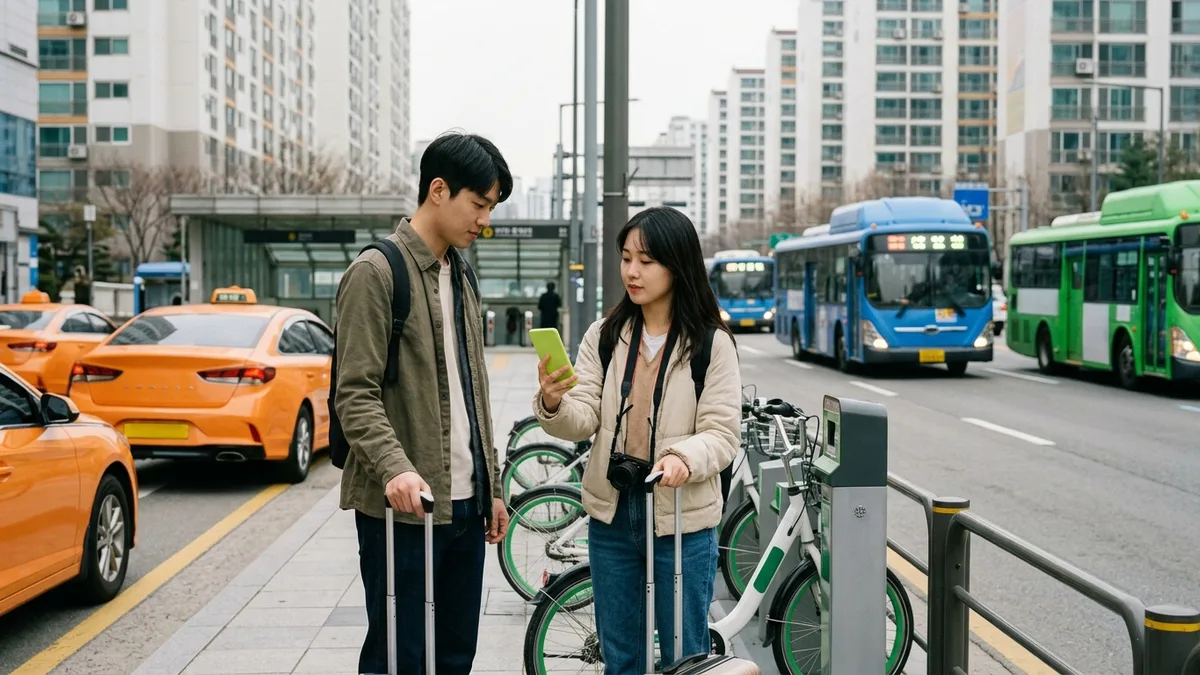
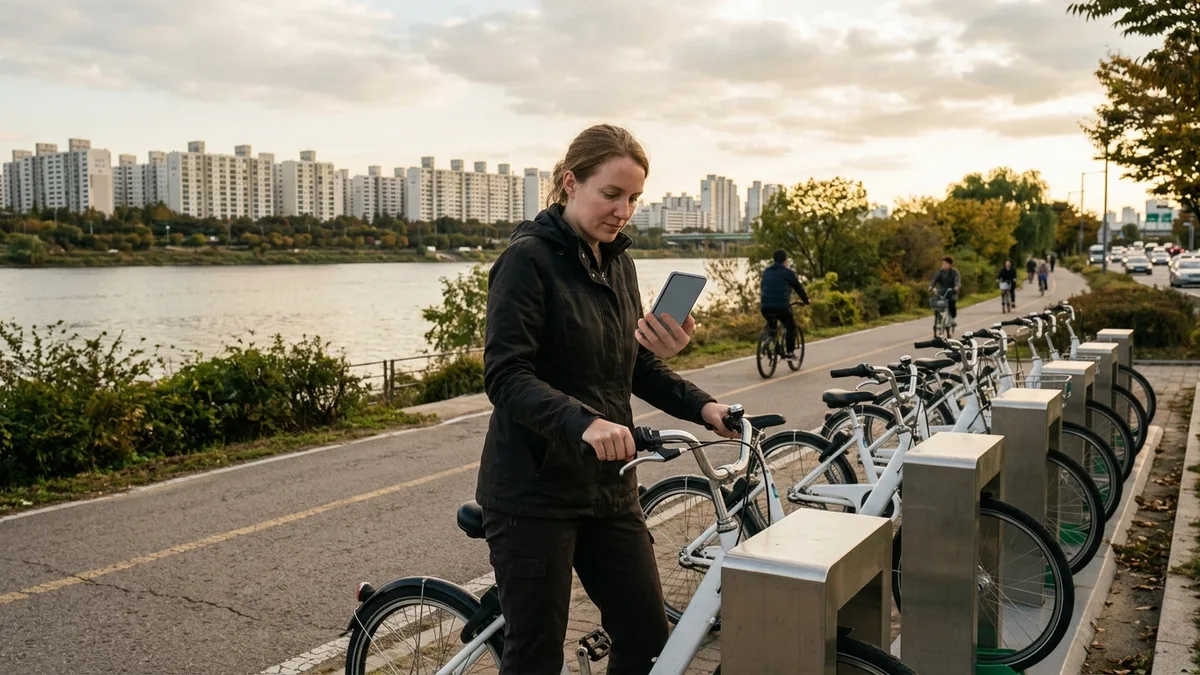
The first is Ttareungi (Seoul Bike). It's the public bike-share run by Seoul Facilities Corporation: rent at any station across Seoul and return at any station across Seoul. The fare table is public and payment is completed online.
The second is the bicycle rental shops inside Hangang Park. Per the facility guide of Seoul's Future Han River Headquarters, on the south side there are Gwangnaru, Jamsil, Jamwon, Banpo, Yeouido, Yanghwa, and Gangseo; on the north side, Ttukseom, Ichon, Mangwon, and Nanji — and Yeouido has multiple outlets, such as the Wonhyo Bridge location. You rent inside the park and return inside the park, so it's a different animal.
We couldn't confirm the 2026 fares, operating hours, or whether ID such as a passport is required at the Hangang Park rental shops from an official source. Please check on-site signage or the Seoul city Hangang Park pages directly.
Ttareungi fares break down like this.
| Pass | 1-hour | 2-hour |
|---|---|---|
| 1-day | 1,000 KRW | 2,000 KRW |
| 7-day | 3,000 KRW | 4,000 KRW |
| 30-day | 5,000 KRW | 7,000 KRW |
| 180-day | 15,000 KRW | 20,000 KRW |
| 365-day | 30,000 KRW | 40,000 KRW |
The 1-day pass also comes in a 3-hour version for 3,000 KRW.
And here's one thing you absolutely need to remember. If you exceed the base riding time, you're charged 200 KRW per 5 minutes for the overage. Rent a 1-hour pass and ride for two hours, and extra fees pile up for the full 60 extra minutes.
Caution: Period passes like the 7-day and 30-day are members only. But Ttareungi membership requires Korean-style identity verification, which is hard to clear without a phone registered in your name in Korea. If the period-pass prices look cheap and you try that route first, you'll get stuck at the sign-up screen.
The catch with the foreigner pass — payment only with an overseas-issued card
This is the most important part of the article. Seoul Facilities Corporation explains the foreigner method like this: on the website, choose your language (English, Chinese, or Japanese), or in the app select foreigner use, and purchase the foreigner-only pass.
The problem is the payment condition. Passes can be paid for only with a credit card issued overseas.
And one card can buy only one pass. You can also use the Discover Seoul Pass.
This condition splits foreigners into three groups.
- Foreigners living in Korea: If all you have are Korean-issued cards, you can't buy the foreigner-only pass. If you still hold a card from your home country, bring it along.
- Short-term travelers: You have an overseas card, but with no Korean phone number the membership and period-pass routes are closed. The foreigner pass is effectively the only way in.
- Groups traveling together: One card can't rent two bikes. Everyone needs to show up at the station with their own overseas card.
The payment methods Ttareungi lists are mobile phone billing, credit card, PAYCO, KakaoPay, ZeroPay, and the foreigner-only Discover Pass. Of these, phone billing and the domestic simple-pay services presuppose a Korean number or a Korean account, so in practice only two are truly open to foreigners: an overseas credit card and the Discover Pass. For how the non-member, Foreigner, and member routes diverge in payment methods — right through checking the return notification — see our separate Ttareungi guide for foreigners.
There's an age limit too. Ttareungi membership is available from age 13 and up, and children aged 12 and under can't use it. If you're with young kids, you'll need another option for them.
Important: The Ttareungi terms define a foreigner all-day pass allowing up to 24 hours of use without an interim return, but the official fare table doesn't list a price for it. Explanations also differ across sources on whether the foreigner pass can be bought in the app or only on the PC website. It's safest to confirm both with the Ttareungi call center (1599-0120).
Returning is the real problem — Ttareungi isn't dockless
If you're used to services like Lime or Citi Bike where you park anywhere and lock up, you'll lose money here. Ttareungi is not dockless.
You can return the bike at any station anywhere in Seoul — no need to come back to where you rented it. But the return itself is only processed when you place it in a dock or chain-lock it to the bike in front (linked return). If you just stand the bike next to a riverside bench and snap on the lock, the system still considers it rented, and once you pass the base riding time, 200 KRW accrues every 5 minutes.
Miss the clock by enough and the situation changes entirely. If the bike isn't returned within 4 hours of rental, it's treated as stolen. We couldn't confirm from the official fare table what amount you'd be liable for in that case, so if you want to know the compensation standard, ask the call center in advance.
It's also worth knowing the pass validity period. An unused pass is valid for one year from the date of payment. So if your plans change and you can't ride that day, the pass you paid for doesn't vanish immediately.
- Check whether there's a station near your destination before you set off. If there's nowhere to return the bike, you'll have to ride back.
- If the dock is full, use a linked return, and confirm the completed-return indicator on the app screen with your own eyes.
- A one-way route only works if there's a station at both your start and your finish. For example, we couldn't confirm from the station list whether a route renting at Yeouido and returning near Sangam actually works, so pin your destination station on the Ttareungi app map ahead of time.
Crossing to the other side — you can count the bike-friendly Han River bridges on one hand
There are 31 crossings over the Han River: 27 road bridges and 4 rail bridges. But the number the Seoul Metropolitan Government lists as passable by bicycle is limited to five. For the rest, no bicycle route across is provided.
| Bridge | Access per Seoul city guidance | Check before you go |
|---|---|---|
| Mapo Bridge | Ride up the ramp on the south side | The ramp entrance may sit away from the bridge approach, so pin the entry point in advance |
| Hangang Bridge | Use the elevator underneath the bridge | If the elevator is out of service you'll need a detour, so pick a backup route |
| Banpo Bridge (Jamsu Bridge) | Connects directly to the bike path | As the name suggests, it can be closed when the water level rises |
| Jamsil Railway Bridge | Connects directly to the bike path | A solid choice for crossing in the eastern section |
| Gwangjin Bridge | Connects directly to the bike path | Farther east than Jamsil Railway Bridge |
Here's the trap foreigners fall into most often: map apps. When a map routes you as a pedestrian, a bridge can look like one you can cross by bike. Bridges you can walk across and bridges you can bike across are not the same, and if you take the wrong one you'll backtrack several kilometers to the other riverbank. If your accommodation or your return station is across the river, decide which bridge you'll cross before you set out.
Caution: Those five are per Seoul Metropolitan Government guidance. Ministry of the Interior and Safety materials and secondary sources also list bridges like Sinhaengju Bridge, Guri-Amsa Bridge, and Paldang Bridge, but those appear to include sections outside Seoul's jurisdiction. If your route goes beyond Seoul, check with the managing authority for that section or contact Seoul's Pedestrian & Bicycle Division (02-2133-2751).
The way back — can you take a bike on the subway?
If you ride one-way and want to return by subway, the rules differ by line. Even within the Seoul subway, different operators mean different terms.
| Line | Regular bicycle | Folding bicycle | Basis |
|---|---|---|---|
| Lines 1–8 (Seoul Metro) | Saturdays and legal public holidays only | Any day, no restrictions | Passenger transport terms, Art. 38(1) and Art. 36 |
| Line 9 (Eonju–Jungang Bohun Hospital) | Not allowed | Allowed | Line 9 passenger transport terms, Art. 35 |
| Sinbundang Line | Not allowed | Only when folded | Sinbundang Line passenger transport terms, Art. 32(2) |
| KORAIL metropolitan railways (Lines 1·3·4, Gyeongui-Jungang, Suin-Bundang, Gyeonggang, Donghae) | Weekends and holidays only | Not separately mentioned in the notice | KORAIL notice of 2023-03-22 |
| Gyeongchun Line (Sangbong–Chuncheon) | Weekends/holidays + weekdays 10:00–16:00 | Not separately mentioned in the notice | KORAIL notice of 2023-03-22 |
| Seohae Line (Sosa–Wonsi) | Completely prohibited | Not separately mentioned in the notice | KORAIL notice of 2023-03-22 |
The KORAIL metropolitan railway portion is based on a March 2023 notice, and we couldn't verify against the current terms whether it still holds in 2026. The Gyeongui-Jungang Line in particular has conflicting sources on weekday permission, so if you plan to board with a bike, ask the KORAIL customer center (1544-7788) about that specific day.
Even on days when bikes are allowed, there's a prescribed way to board. Passengers carrying a bicycle must board only the very first or very last car of the train, and you can't ride the bike inside the station or on the train (Art. 39(1)).
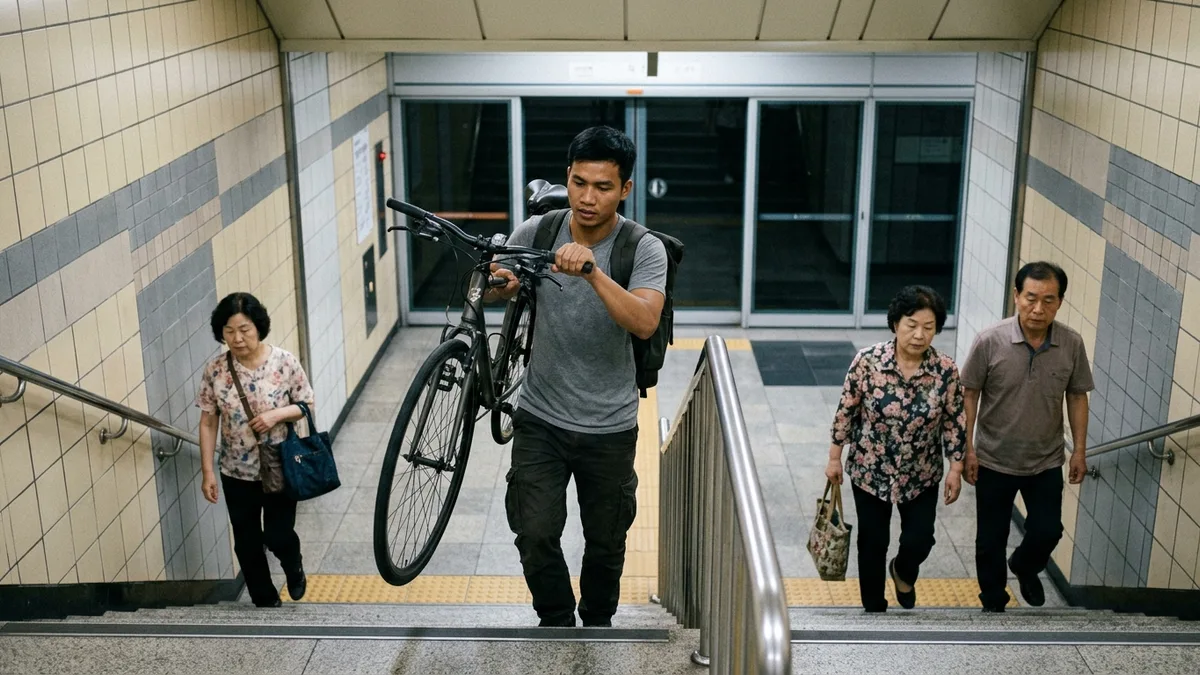
And here's the clause that catches people most off guard on the ground. When carrying a bicycle, you may not use elevators, escalators, or wheelchair lifts. That means hauling the bike up and down stairs from the fare gates to the platform. If you're also carrying a backpack or luggage, even a single transfer station can eat up a lot of time. For transfer routes by line, our complete Seoul subway guide will help you picture it.
Caution: If you're found carrying a bicycle on a day when it isn't permitted, a surcharge of 5,000 KRW per item is imposed and you may be required to get off at the nearest station and exit (Art. 37, Art. 38(3), and Appended Table 5). Walking through the fare gates with a bike on a weekday evening is, in practice, a round trip back out.
Buses aren't much of an alternative either. City buses may restrict items that could block aisles or doors, so bicycle boarding can be refused (City Bus Transport Business Terms, Art. 10(5)). Express and intercity buses can carry bikes in the luggage hold, but that's far removed from getting back across town within Seoul.
How you get in trouble at Hangang Park — drinking and riding, helmets, and lights at night
Under Korea's Road Traffic Act, a bicycle is treated as a vehicle. So if you think of it the same way you think of walking, you'll end up with a summary fine (notice disposition).
The biggest misunderstanding is about drinking. Enjoying chicken and beer at Hangang Park and then hopping back on a bike is famous as a quintessential Seoul experience — but bicycles are subject to the drunk-driving ban in Article 44(1) of the Road Traffic Act.
- Riding a bicycle while intoxicated: a violation of Art. 44(1), summary fine (notice disposition) of 30,000 KRW (Enforcement Decree, Appended Table 8, item 64-2).
- Refusing a police breath test: summary fine (notice disposition) of 100,000 KRW (same table, item 64-3).
- No lights at night or in bad weather: summary fine (notice disposition) of 10,000 KRW (Road Traffic Act Art. 37(1) and Art. 50(9); Enforcement Decree, Appended Table 8, item 61).
- Not wearing protective gear (a helmet): there is a duty to wear one (Art. 50(4) and Enforcement Rule Art. 32), but no summary fine provision is attached.
- Riding on the sidewalk: prohibited in principle, allowed only under specific exceptions (Art. 13-2(4)).
Don't misread the helmet item. The duty to wear one does exist. There's simply no separate summary fine for not wearing it. Rental bikes often don't come with a helmet, so if you're planning a long ride, bringing your own is the safer bet.
Lights are something riders actually get caught on. When riding on the road at night, in fog, rain, or snow, or through a tunnel, you must turn on a headlight and a rear light. Parts of the Hangang bike path get quite dark after sunset. If you set out late in the afternoon, factor in that your ride home will be at night.
Sorting out your entry and return transport
Bottom line: planning a Han River ride should start not with the bike but with how you're getting back. Here's the order.
- If you plan to take the subway with a bike, check that the day is a Saturday or a legal public holiday. With a rental bike like a Ttareungi you just return it at a station near your destination, so the day of the week doesn't matter — but if there's no station at your destination, switch to a round trip.
- Pin whether there's a station to return to at your destination on the Ttareungi app map.
- If you plan to cross the river, decide in advance which of the five bridges you'll take.
- Lock in how you'll get back to your accommodation after returning the bike — the last subway train or a taxi.
Getting to the course is simplest by subway. For the western end, Banghwa Station on Line 5 is your reference point; for the eastern end, Paldang Station on the Jungang Line. Starting near the Yeouido, Ttukseom, or Gwangnaru certification centers is great for a shorter ride. If you haven't settled on which transit card to use, compare the conditions of each type in our Climate Card guide. You can also check there whether any card type includes Ttareungi use.
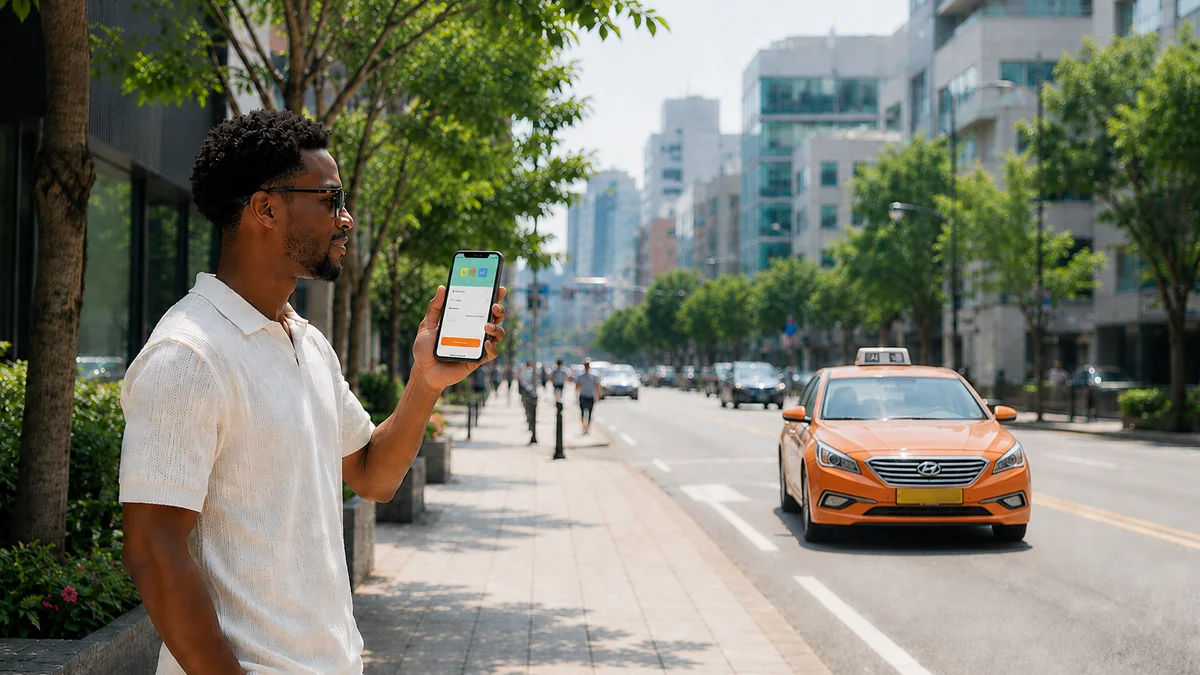
On the way back, a taxi is often the realistic choice — once you've returned the bike, it's just you and your bag. That said, Kakao T requires verification with a Korean phone number, which tends to be the first hurdle for travelers. Ways to use it without a Korean number are covered in our Kakao T guide for foreigners.
| Option | What it solves | Where foreigners get stuck |
|---|---|---|
| Ttareungi website/app | Renting and returning bikes | Foreigner pass takes overseas-issued cards only; one pass per card |
| Hangang Park bike rental shops | Rent and return inside the park | Fares and whether ID is required aren't confirmed in official sources |
| Subway (transit card) | Getting to the course and back home | To bring a bike, it has to be a Saturday or legal public holiday |
| Kakao T | Hailing a taxi | Requires Korean phone number verification |
| LACHA | Taxi, KTX, express bus, Airport Railroad, transit cards | Doesn't handle bike rentals or returns |
Renting and returning a bike is something no transport app can do for you. What you can bundle in one place is the trip out to the Han River and the taxi home when your ride runs late. LACHA is a transport-and-payment super app for foreigners that you can use right away without identity verification. It's designed so that formal identity verification isn't required, so you can start with just your passport — no Korean bank account or phone number — and pay with overseas simple-pay services like Alipay and WeChat Pay or with an overseas card. Once the sun sets along the river, matching a ride can take a while, so having your way home lined up in advance is a real comfort.
Want to search and book KTX and express buses in one app? Check out LACHA.
Built to work without a Korean phone number or bank account, with overseas payment methods like Alipay, WeChat Pay, and Apple Pay. Taxi hailing plus KTX, express bus, and airport railroad (AREX) booking — all in one app.
Up to 60% off Korea transit with a coupon (max ₩3,000): enter code at sign-up. KTX gets up to 18% off on top
Download now


Frequently Asked Questions (FAQ)
Q1. I only have a card issued in Korea — can I buy the Ttareungi foreigner pass? It's difficult. Per Seoul Facilities Corporation guidance, payment for the foreigner-only pass is possible only with a credit card issued overseas. If you live in Korea and have closed out your home-country cards, this route is blocked. The alternatives are using the Discover Seoul Pass, or — if you have a phone registered in your name in Korea — signing up as a regular member and buying a 1-day or period pass. Also keep in mind the limit of one pass per card.
Q2. Can I bring my bike back on the subway? It depends on the day. On Lines 1–8, regular bicycles are allowed only on Saturdays and legal public holidays (passenger transport terms, Art. 38(1)), while folding bikes are allowed any day. Line 9 and the Sinbundang Line allow only folding bikes — regular bicycles aren't allowed even on weekends. Even on permitted days, you must board only the first or last car, and you can't use elevators or escalators, so you'll have to take the stairs (Art. 39(1)). If you're caught on a non-permitted day, a surcharge of 5,000 KRW per item applies.
Q3. If I park a Ttareungi at my destination and lock it, does that count as returning it? No. Ttareungi isn't a dockless service, so a return is only processed when you place the bike in a dock at a station or do a linked return. If you just leave it standing, it stays in rented status, and once you pass the base time, 200 KRW accrues every 5 minutes. If it isn't returned within 4 hours of rental, it's treated as stolen — so check for a station near your destination on the app map before you set off.
Q4. Which bridge should I take to get to the other side of the Han River? The bridges Seoul lists as passable by bicycle are Mapo Bridge (ramp on the south side), Hangang Bridge (elevator beneath the bridge), Banpo Bridge (Jamsu Bridge), Jamsil Railway Bridge, and Gwangjin Bridge. There are 31 Han River crossings in total — 27 road bridges and 4 rail bridges — but most have no designated bicycle route. Just because a map app gives you a pedestrian route doesn't mean you can cross by bike, so decide on your bridge before you set out. For sections outside Seoul, you'll need to check separately with that area's managing authority.
Q5. Can I have a beer at Hangang Park and then ride a bike? No. Bicycles are subject to the drunk-driving ban in Article 44(1) of the Road Traffic Act, so a violation carries a summary fine (notice disposition) of 30,000 KRW (Enforcement Decree, Appended Table 8, item 64-2), and refusing a police breath test carries a summary fine (notice disposition) of 100,000 KRW (same table, item 64-3). Many visitors come from countries where cycling after drinking is fine — Korea isn't one of them. If you've been drinking at Hangang Park, return the bike to a station and head back by subway or taxi.
Note: The fares, rules, and legal provisions in this article are compiled from the official Seoul Bike Ttareungi fare guide, Seoul Facilities Corporation guidance, the Seoul Metropolitan Government's guidance on bicycle lanes over Han River bridges, the Ministry of the Interior and Safety's Bike Happy Sharing portal, and the Korea Ministry of Government Legislation's Easy-to-Find Practical Laws, as of August 2026. Rental fares, rail passenger transport terms, and the Road Traffic Act Enforcement Decree can be revised and may change over time. In particular, the current bicycle-carriage rules for KORAIL metropolitan railways (based on a March 2023 notice), the price of the foreigner all-day pass, the compensation amount for a non-returned bike, and the fares and ID requirements at Hangang Park bike rental shops are items this article could not confirm — please check directly with the relevant organization, such as the Ttareungi call center (1599-0120) or the KORAIL customer center (1544-7788), before you ride. LACHA does not rent bicycles or handle returns on your behalf.