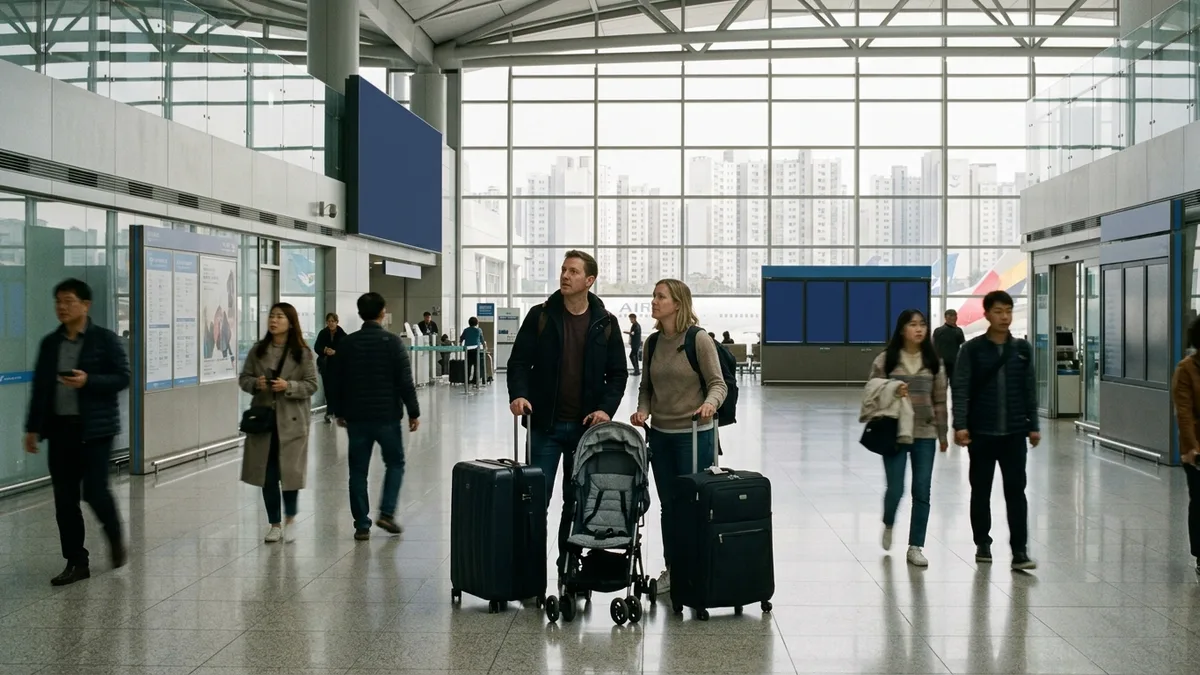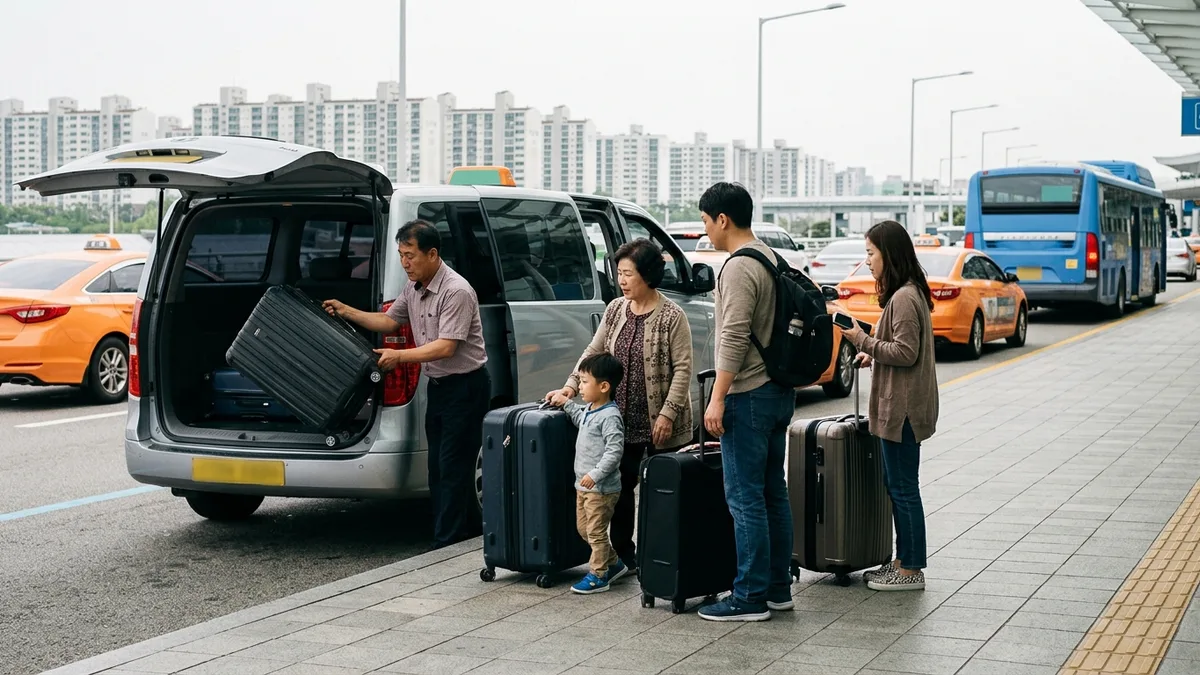
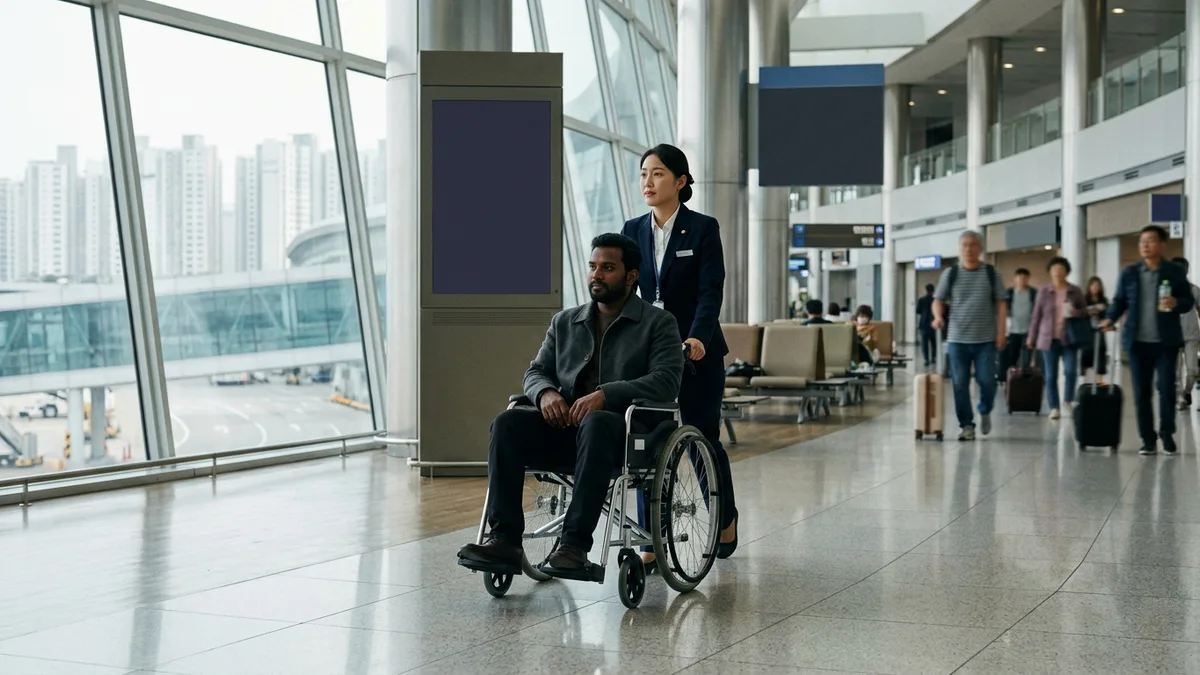
Incheon Airport's priority lane is a departure convenience service. The Korean-language notice says it "operates a priority departure lane to facilitate the departure of the mobility impaired, social contributors, and multi-child families," and the English notice likewise describes "a priority lane to facilitate the departure of the mobility impaired and social contributors" — both limited to departures (confirmed 2026-08). In other words, it's not a door you can walk through even if you head up to the 3rd-floor departures hall right after getting off your flight.
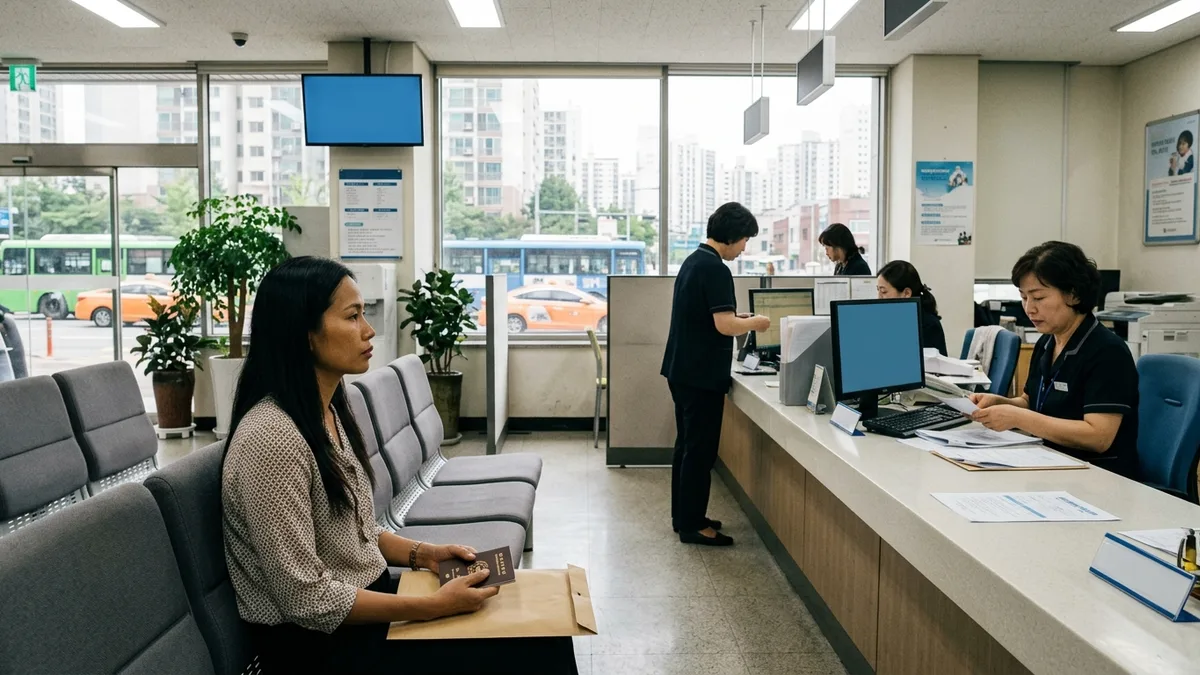
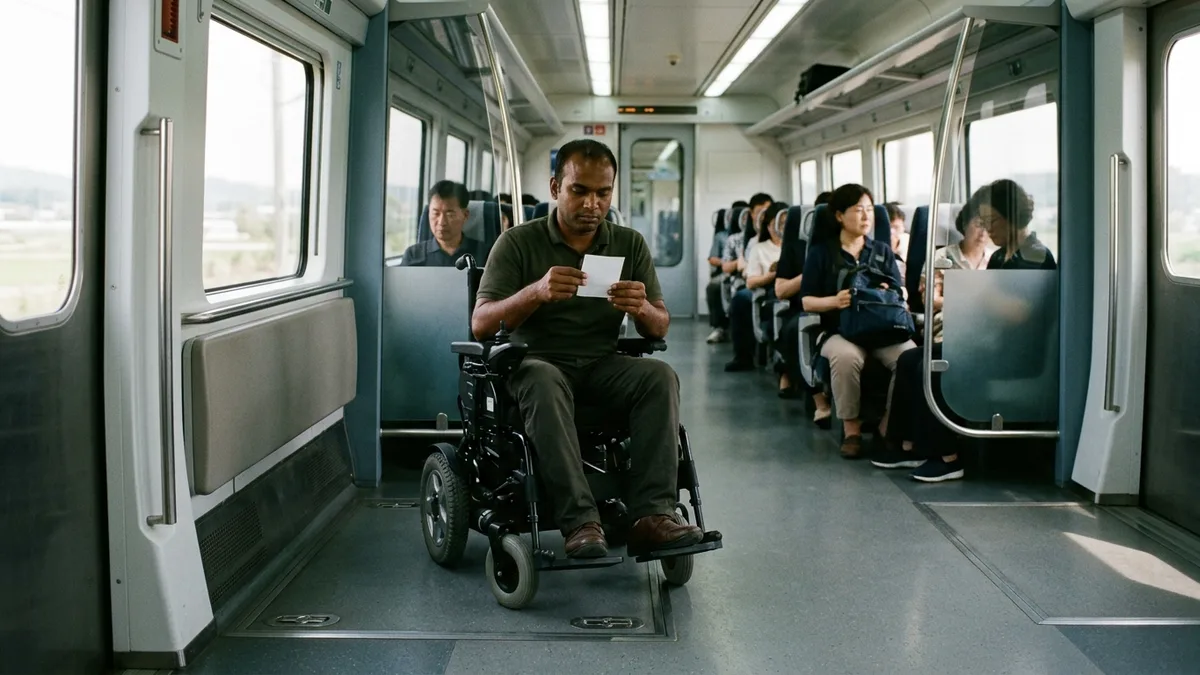
If you're planning to rent a power wheelchair, there's one more condition. Incheon International Airport Corporation's notice only says the service is "for both Korean and international users," but the actual operator, WheelShare, states: "Users arriving in Korea: a Korean-national guarantor must sign up and use the service," and "a Korean guarantor must make the rental reservation and accompany you." A Korean-national guarantor has to create an account, come with you on the rental day, and rent the equipment under their own name. If you go alone based only on the airport's notice, you'll come back empty-handed.
The priority lane's "mobility impaired" track has another hurdle for foreigners. The only accepted proof is a disability welfare card, and that card is available only to the five categories specified in Article 32-2(1) of the Act on Welfare of Persons with Disabilities. So tourists — and even E-9, D-2, and D-10 visa holders — can't use this track. Instead, the "airline passenger requiring medical assistance" track is open without a welfare card, and the proof there isn't a document but "being accompanied by airline staff."
To sum up, the realistic route for foreign wheelchair users isn't the welfare card but requesting assistance from your airline in advance. And after you land, the one counter you can really use on the spot is the free wheelchair and stroller rental at the information desk in front of the 1st-floor arrivals hall. Below, let's start by separating what departing passengers and arriving passengers can each get.
Note: The eligibility, procedures, phone numbers, and hours below were compiled by cross-checking Incheon International Airport Corporation's Korean and English guidance pages against operator notices, as of 2026-08. Airport services change often with peak-season operations and facility construction, so please re-confirm with the Incheon Airport call center (1577-2600) or each organization's official channel before you head out.
Arriving and departing passengers get completely different services — sort this out first
Most of Incheon Airport's special assistance services sit along the departure route. The goal is to make the stretch from check-in at the 3rd-floor departures hall through security to the boarding gate short and comfortable. Arriving passengers move the opposite way, and far fewer services are placed in that direction.
This is where people who read about "Incheon Airport special assistance" on travel info sites get tripped up. The priority lane, the Travel Assistance Center for Persons with Disabilities, and the Terminal 2 autonomous mobility vehicles are all for departing passengers. If you go looking for them right after arrival, you'll be told you're not eligible.
| Service | Departing passengers | Arriving passengers |
|---|---|---|
| Priority departure lane | Available | Not eligible — the notice is limited to departures |
| Travel Assistance Center for Persons with Disabilities (T1, 3F) | Available — welfare card required | Not eligible — T1 departing passengers only |
| Autonomous Mobility (AM) vehicles (T2, 3F) | Available — all departing passengers | Not eligible |
| Free wheelchairs and strollers at information desks | Available | Available — there are desks in front of the 1st-floor arrivals hall too |
| Help Phone | Available | Available — at T1 they're also installed at the 1st-floor curbside |
| Electric cart transport service | Available | The Korean and English notices disagree (see below) |
That last row is the murkiest part of this article. The Korean notice says the electric cart and wheelchair transport service is provided "for departing passengers with reduced mobility," while the English version of the same item says only "for passengers with reduced mobility," with no departure-only wording. If you read only the English and expect support after arrival, things may not line up — so if you need arrival assistance, it's safest to call the help desk (1577-2600) in advance to confirm.
The priority lane is a 'departure' convenience service — seven eligible categories and required proof
The priority lane is a side door operated separately from the regular departures hall lines. There were originally six eligible categories, but a multi-child family track was added on June 10, 2025, so there are now seven.
| Category | Criteria | Required proof |
|---|---|---|
| Seniors | Age 70 and over | Passport |
| Young children | Under age 7 | Passport |
| Persons with walking disabilities | People with impaired mobility | Disability welfare card |
| Pregnant women | — | Maternity handbook |
| Airline passengers requiring medical assistance | Passengers using airline medical services (wheelchair, stretcher, medical oxygen, etc.) | Accompanied by airline staff |
| Social contributors | — | Ministry of Justice immigration priority card |
| Multi-child families | Three or more children, all under age 19 | Passport + family relation certificate or resident registration abstract |
The conditions for multi-child families are a bit more detailed. It can only be used when at least one parent and at least one child depart together, and the supporting documents — physical or electronic — are accepted only if issued within the past three months.
Locations differ by terminal. At Terminal 1 (T1), it's the side doors at Departure Gates 2, 3, 4, and 5; at Terminal 2 (T2), it's Departure Gates 1 (1D) and 2 (2A). There are no separate operating hours — they match each departures hall's hours. In other words, if that departures hall is open, the priority lane is open.
Caution: The multi-child family track appears only on the Korean guidance page — the English page doesn't have the item at all. The English page lists only two categories, The Mobility Impaired and Social Contributors, and the multi-child item is missing from the usage instructions as well (both pages compared 2026-08). So a multi-child family that checks information only in English ends up standing in the regular line despite being eligible.
Procedures differ by category — some need only a passport, others must stop at the check-in counter
Even for the same priority lane, the order of steps varies by category. If you don't know this and head straight to the side door, you may have to walk back out.
- Seniors and young children don't need to stop at the check-in counter. Just show your passport at the priority lane entrance; staff will scan it to verify eligibility and let you through.
- Persons with walking disabilities and pregnant women have one extra step first. At airline check-in, present your proof (welfare card or maternity handbook) to receive a "special assistance sticker," then show that sticker at the priority lane entrance.
- Even with the sticker, security staff at the entrance may check your proof again. Don't bury your welfare card or maternity handbook deep in your bag — keep it somewhere easy to pull out.
- For airline passengers requiring medical assistance, the proof isn't a document but being accompanied by airline staff. So preparation for this track starts when you buy your ticket, not after you get to the airport.
📌 Important: Incheon International Airport Corporation's summary page on special assistance says, in effect, that "the special assistance card is issued at the airline check-in counter," but the dedicated priority lane page states that seniors and young children pass through the priority lane with just a passport. The two pages contradict each other, so this article follows the dedicated page. If you're short on time, it's safest to ask an airline staff member at check-in.
The scope for accompanying travelers is also a common question, but we couldn't pin down the exact permitted number of companions at the priority lane, or how it relates to the multi-child family criteria, from official guidance alone. If you're traveling in a larger group, please check with the airport call center before departure.
Which track can foreigners without a welfare card use? — the 'airline passenger requiring medical assistance' door
The priority lane's disability track accepts only one form of proof: the disability welfare card. But not just any foreigner can get one.
Article 32-2(1) of the Act on Welfare of Persons with Disabilities (in force from 2026-07-01) opens disability registration only to overseas Koreans and foreigners who are: ① people who have filed a domestic residence report under Article 6 of the Overseas Koreans Act, ② people registered as overseas nationals under Article 6 of the Resident Registration Act, ③ people who have completed alien registration under Article 31 of the Immigration Act and hold a residence status allowing permanent residence, ④ marriage immigrants, and ⑤ recognized refugees. If you fall outside these five categories, the welfare card route is closed entirely.
E-9 (Employment Permit System), D-2 (study), and D-10 (job-seeking) visa holders, as well as short-term tourists, don't qualify. It's a hurdle that doesn't exist for Korean users, so travel information rarely mentions it. For a closer look at registration requirements and fare discount programs, see Disability Registration and Transit Fare Discount Eligibility for Foreigners.
So the practical route is through your airline. Passengers using airline medical services (wheelchair, stretcher, medical oxygen, etc.) are classified as "airline passengers requiring medical assistance," and since the proof is being accompanied by airline staff, no welfare card is needed. That means this door is open even if your visa status makes a welfare card impossible.
Tip: That said, how far in advance you must request wheelchair assistance, what code it's filed under, and whether an onboard wheelchair is provided vary from airline to airline. We won't generalize here. After booking your ticket, request assistance directly with your airline and re-confirm that the request was registered using your booking number. If you're continuing by KTX in Korea, How to Book a KTX Wheelchair Seat is worth a look too.
Wheelchairs and strollers are free at information desks — including on the arrivals floor
This is the most practical option for arriving foreigners. Free wheelchair rental is offered at every information desk in the airport, and those desks are located not only on the departures floor but also in the 1st-floor arrivals hall. The English notice states it plainly: "Free wheelchair rental is available at all information desks within the airport."
- T1's 1st-floor information desks are in two spots: in front of Arrivals Gates D-E and in front of Arrivals Gates B-C. They're right where you come out after immigration and baggage claim.
- T2's 1st floor has two information desks in operation. They're also where you meet the people picking you up, so they're easy to find.
- Strollers are rented free the same way. Rental locations include in front of T1's 1st-floor Arrivals Gate B and T2's 1st-floor information desks.
- There's no separate reservation procedure listed. Just ask at the desk right after you arrive.
With the priority lane, the Travel Assistance Center, and the autonomous mobility vehicles all limited to departures, this desk is essentially the only option left for arriving passengers. If you're arriving with lots of luggage and limited mobility, head for the information desk as soon as you exit the arrivals hall.
Foreigners can't rent a power wheelchair (WheelShare) alone — the Korean-national guarantor condition
At Incheon Airport, you can borrow a power wheelchair free of charge through "WheelShare," operated by the incorporated association Green Light. The service is supported by Hyundai Motor Group and Incheon International Airport Corporation. The catch is a condition that applies only to foreigners.
The operator's notice says: "Users arriving in Korea: a Korean-national guarantor must sign up and use the service," and "a Korean guarantor must make the rental reservation and accompany you." In other words, a Korean-national guarantor has to register with WheelShare, make the rental booking, visit with you on the rental day, and rent under their own name. Incheon International Airport Corporation's notice says only "for both Korean and international users," so if you go alone based on that sentence, you won't be able to rent.
- The rental station is outside Exits 7 and 8 on the 3rd floor of Terminal 1. It's not inside the terminal — you have to step outside to see it.
- Hours are 07:00–19:00 daily, open year-round.
- Online advance reservations must be made at least 5 days before your intended use date.
- For guaranteed foreign users, the rental period is up to 15 days per rental.
- Membership registration is only available on the website (www.wheelshare.kr), and inquiries go to 1670-7988 (ext. 2).
The booking deadline matters most. At least 5 days in advance means you can't apply on the day you land in Korea. Factoring in the time to find a guarantor, it's realistic to ask a friend or host in Korea to arrange it before you fly.
Caution: For walk-in rentals, the operator's notice says only "available if spare equipment is on hand," with no distinction between Koreans and foreigners. Secondary news coverage, however, says walk-in rentals are limited to Koreans, so the two accounts conflict. Whether foreigners can rent on site without a reservation needs confirmation, so call 1670-7988 first before you go.
The Travel Assistance Center requires a welfare card and is limited to Terminal 1 departing passengers
There's a "Travel Assistance Center for Persons with Disabilities" in the center of T1's 3rd floor. The name makes it sound like arriving travelers could stop by, but eligibility is limited to disability welfare card holders departing from Terminal 1. The English notice also spells out the card requirement: "Please make sure to bring your welfare card."
Two of the earlier conditions overlap here. If your visa status makes a welfare card impossible, you're not eligible, and passengers departing from or arriving at T2 aren't eligible either. If you do qualify, here's what you can get.
- All services operate by reservation. They recommend booking at least 3 hours before your flight departs.
- Inquiries and reservations: 032-741-2082, open 07:00–19:00.
- Services include airport usage guidance, self check-in support (16 airlines), manual wheelchair rental, electric cart transport between the center and check-in counters, and power wheelchair charging.
Getting around inside the terminal — electric carts, Help Phones, and inter-terminal lift cars
Mobility support inside the terminal is handled through several different contact points. Let's start by sorting out who to call.
| Service | Contact | Hours | Good to know |
|---|---|---|---|
| Electric cart / wheelchair transport | Help desk 1577-2600, or on-site information desks and Help Phones | 07:00–22:00 | Not available 07:00–09:00 during peak season |
| Help Phone | Pick up the handset for a direct line to the nearest information desk | 07:00–22:00 | Excludes 07:00–09:00 in peak season; installed at curbsides and parking lots |
| Long-term parking ↔ passenger terminal lift | 032-741-3217 | 05:00–22:00 | Weekday advance booking; takes about 20 minutes |
| Inter-terminal lift car | Shuttle Bus Operations Division 032-741-3217 | Listed as weekdays 05:00–24:00 | Free; advance booking recommended |
Electric carts run in the public area between the 3rd-floor entrances and check-in counters, and in the duty-free area between the 3rd-floor departures halls and boarding gates. Wheelchair transport support covers the passenger terminal's public areas (including short-term parking), but long-term and reservation parking lots aren't covered. Carrying your bags or suitcases for you isn't included, so you'll need to use a cart for luggage.
Help Phones are especially useful when there's a language barrier. No buttons to press, no numbers to look up — pick up the handset and you're connected straight to an information desk. They're installed at T1's 3rd- and 1st-floor curbsides and short-term parking lot, and at T2's 3rd-floor curbside and each parking level.
Beyond mobility, the terminals also have these facilities.
- Every restroom in the passenger terminals has at least one accessible restroom, with wide entrances, push-button automatic doors, emergency bells, and sensor flushing.
- Power wheelchair chargers: 4 at T1 (3rd floor east between counters B and C, 3rd floor east between counters L and M, 1st floor east information counter near Exit 5, and behind the Hiker Station at the B1 Transportation Center) and 3 at T2 (3rd floor near Exit 2, 1st floor near Exit 1, and near the bus ticket office on the west side of the Transportation Center's B1 level). Fast charging and wheelchair tire inflation are available.
- Audio guidance devices for visually impaired travelers are at three points on T1's 3rd floor (east information counter near Exit 3, central information counter near Exits 7-8, west information counter near Exit 12) and three points on T2's 3rd floor (near Exits 2, 5, and 7). Activate them with the dedicated remote and they announce your current location by voice.
- Accessible drop-off zones are set up near Exits 3, 7, and 12 on T1's front roadway, and near Exits 4 and 9 on T2's front roadway. Use these when someone is dropping you off or picking you up by car.
Caution: Two different wheelchair lift services share the same number (032-741-3217), but the hours differ from one airport corporation page to another. The long-term parking ↔ passenger terminal service is listed as 05:00–22:00, while the inter-terminal service is listed as weekdays 05:00–24:00. State which one you need and confirm the hours by phone before booking. If you only need to move between terminals, you can also take the airport railroad. Per the operator Airport Railroad's all-stop train fare table (confirmed 2026-09-18), the fare to expect is 1,200 KRW for an adult with a transit card (a single-journey card adds 100 KRW, plus a 500 KRW deposit you get back at your destination station). The airport corporation's inter-terminal guidance lists this stretch as 6 minutes and 1,050 KRW, a fare that doesn't match the operator's table. Fares and travel times can change, so please re-confirm at the station counter or ticket machine on the Transportation Center's B1 level.
From the airport into the city — where the airport railroad, taxis, and call taxis each hit a wall
Once you leave the airport, different operators take over, so the rules scatter. Let's look at where each option gets stuck.
| Option | From a mobility perspective | Where foreigners get stuck |
|---|---|---|
| Airport Railroad (AREX) | Platforms are on B1 of the T1 and T2 Transportation Centers | We couldn't confirm whether express train wheelchair seats can be booked online |
| Regular taxi | Board directly at the curbside stands in front of the airport | Most hailing apps require verification with a Korean mobile number |
| Call taxi for the disabled (Seoul) | The usage criteria explicitly list foreigners and Incheon International Airport | The same site's sign-up guide requires a welfare card |
| Call taxi for the disabled (Incheon Bandi Call) | Incheon International Airport is listed as a wide-area service destination | Foreigners aren't listed among eligible users |
| Limousine bus | Official guidance has no wheelchair-related information | You have to pick a boarding stand with no information |
| LACHA | Handles airport railroad and taxi payments in one app | Can't obtain discounted fares or wheelchair seat assignments on your behalf |
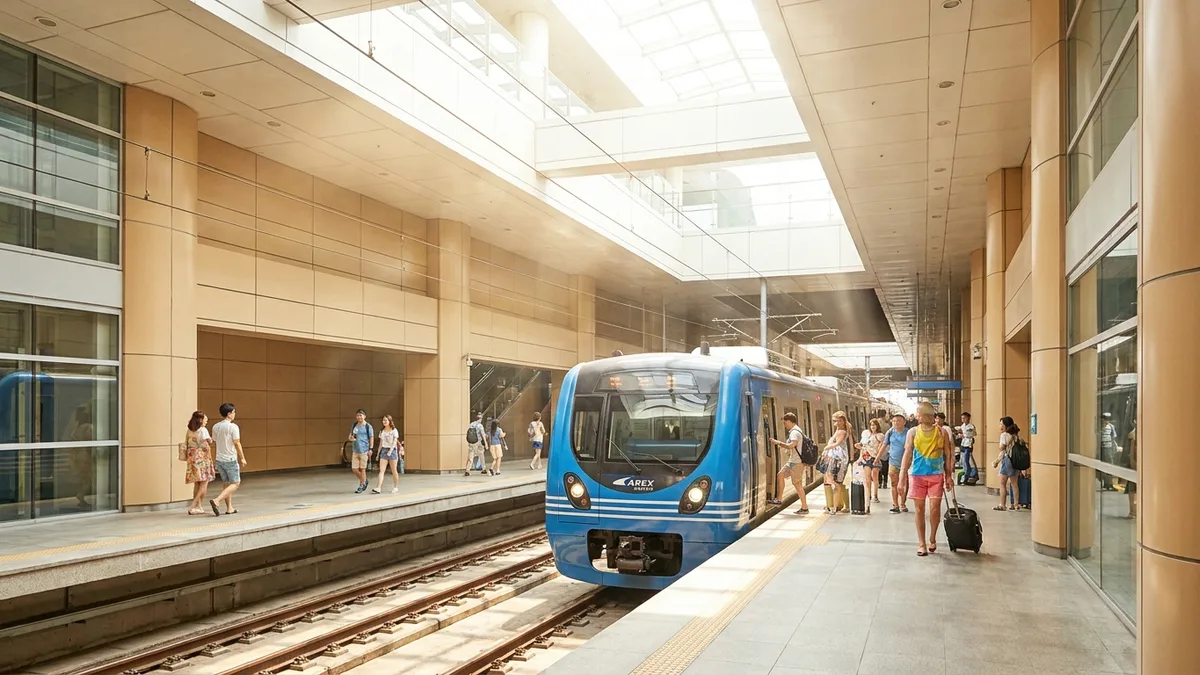
The airport railroad is easy to access. Platforms are on B1 of the T1 and T2 Transportation Centers, with information desks and ticket machines on the same level. However, we couldn't verify in a first-hand source whether express train wheelchair seats can be booked online, or how elevators and accessible restrooms are laid out at each station, because the airport railroad's official page wouldn't load. The difference between express and all-stop trains and how to buy tickets is covered in AREX Express vs. All-Stop Trains and How to Buy Tickets, so please check on wheelchair seats at the station counter.
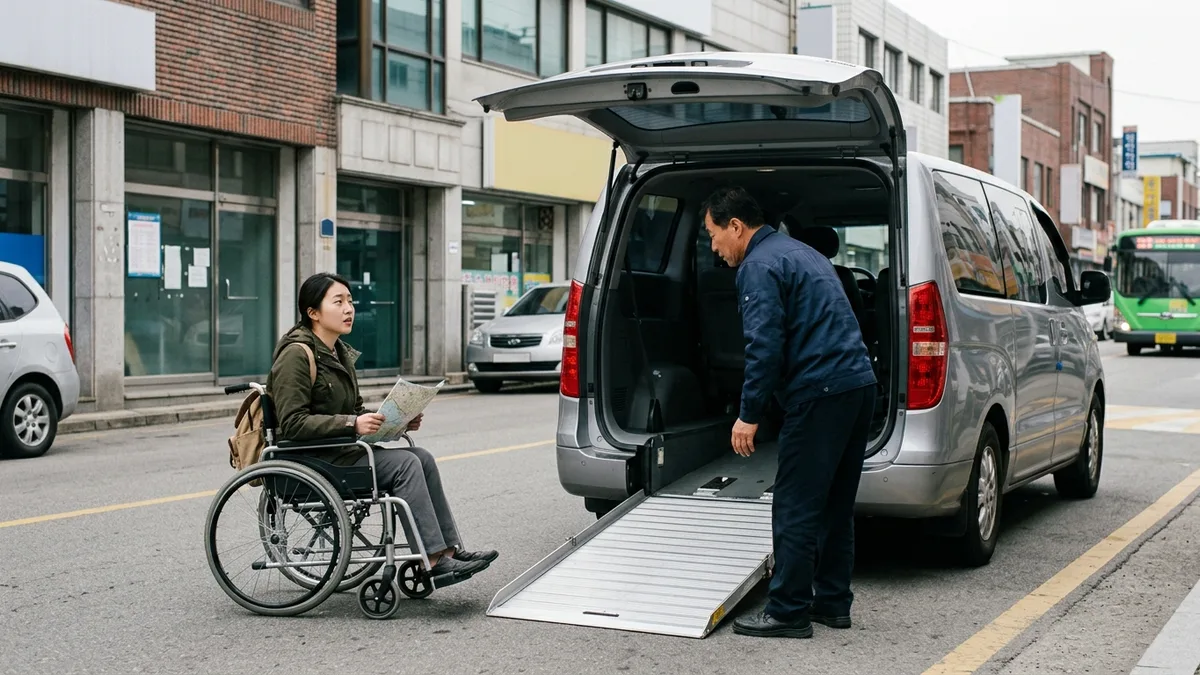
On the taxi side, the guidance conflicts. Incheon Airport's official taxi page lists, under "for persons with disabilities," the Incheon Transit Corporation call taxi (1577-0320) and the Seoul Facilities Corporation call taxi (1588-4388). But the two organizations' conditions differ from each other — and even differ page to page within a single organization.
- Seoul Facilities Corporation's "Usage Criteria" lists "foreigners with disabilities who use wheelchairs (boarding after verification of passport, etc.)" as eligible users, and lists Incheon International Airport among its service areas. Yet the same site's "Sign-up Guide" requires a welfare card, so the two notices conflict. Fares, request hours, the Korean-language phone call for new customers, and other Seoul-side conditions are covered separately in Seoul's Call Taxi for the Disabled: Foreigners Can Ride Too, so read that alongside this.
- Incheon's Bandi Call defines eligible users as people with severe walking disabilities, people who pass the comprehensive assessment, wheelchair users aged 65 and over, temporary wheelchair users, accompanying family members, and bedridden persons with disabilities — with no category for foreigners. The tracks for those 65 and over and temporary wheelchair users also require a diagnosis from a Korean medical institution containing wording to the effect that the person "uses a wheelchair and has difficulty using buses or subways."
- The door is narrow at the statutory level too. Article 6(1) of the Enforcement Rules of the Act on Promotion of Transportation Convenience for Mobility Disadvantaged Persons (in force from 2026-02-01) limits eligibility for special transport vehicles to persons with severe walking disabilities, seniors as defined by municipal ordinance, and the family members or caregivers accompanying them.
📌 Important: If you plan to use a call taxi for the disabled, call 1588-4388 (Seoul) before you come to Korea and confirm whether a passport alone is enough to be accepted, whether membership registration is required, and whether you can pre-register before entering the country. Bandi Call's wide-area service, per the Incheon Mobility Support Center's official guidance (2026-08), runs daily 07:00–22:00 across Seoul, Incheon, and Gyeonggi, with advance booking between 07:00 and 22:00 the day before your ride — so it isn't suited to hailing on the spot on arrival day. Please re-confirm service and booking hours at 1577-0320.
Let me be straight about limousine buses. We couldn't find official information on which routes have wheelchair boarding equipment (lifts). Incheon Airport's bus guidance page has no such item at all, and no consolidated information by bus operator could be verified either. Article 14(4) of the Enforcement Decree of the Act on Transportation Convenience (in force from 2026-02-01) lists mandatory low-floor bus replacement for city, rural, and village buses, but airport buses have different licensing formats route by route, so this provision alone doesn't settle the question. If you use a wheelchair, it's safer to default to the airport railroad or a taxi rather than trying to check at the limousine stand. Travel times and fare comparisons by option are in 4 Ways to Get from Incheon Airport to Downtown Seoul, and large taxis and vans for bigger groups or heavy luggage are covered in How to Book a Large Taxi or Van at Incheon Airport. Elevator routes and low-floor bus realities for getting around by subway and bus once you're in the city are covered in Riding the Seoul Subway and Buses in a Wheelchair.
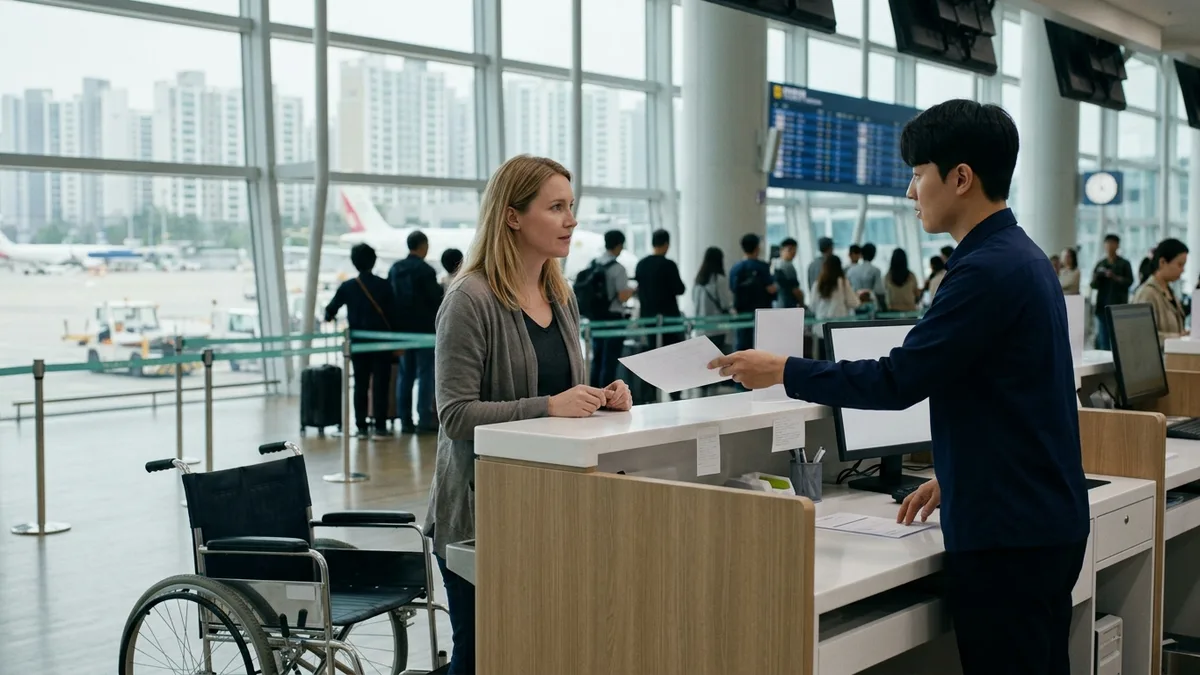
Support inside the airport is the domain of the airport corporation and the airlines, so no app can substitute for it. Discounted fares for persons with disabilities, wheelchair seat assignments, and boarding assistance requests are public programs applied through welfare card verification by the operating agencies — apps can't replace them. But payments for the airport railroad and taxis once you leave the airport are a different story. That's the stretch where people often get blocked by Korean bank accounts or mobile identity verification. LACHA is a transit and payment super app for foreigners that works right away with no identity verification, so you can start with just your passport and pay for taxi hailing, the airport railroad, KTX, express buses, and transit cards all in one place. It also accepts overseas mobile payments like Alipay and WeChat Pay, as well as foreign cards. So you don't have to fumble with payment methods on the arrivals floor while you're already struggling physically, sorting out at least your transport payments in advance makes things much easier.
Want to handle everything from your first ride after landing in one app? Check out LACHA.
Built to work without a Korean phone number or bank account, with overseas payment methods like Alipay, WeChat Pay, and Apple Pay. Taxi hailing plus KTX, express bus, and airport railroad (AREX) booking — all in one app.
Up to 60% off Korea transit with a coupon (max ₩3,000): enter code at sign-up. KTX gets up to 18% off on top
Download now


Frequently Asked Questions (FAQ)
Q1. I've landed at Incheon Airport and need a wheelchair. Where should I go? Head to the information desk in front of the 1st-floor arrivals hall. Free wheelchair rental is available at every information desk in the airport — at T1, in front of Arrivals Gates D-E and Arrivals Gates B-C; at T2, at the two 1st-floor information desks. Strollers are also free at the same spots. The priority lane, the Travel Assistance Center for Persons with Disabilities, and T2's autonomous mobility vehicles are all for departing passengers, so you can't use them right after arrival. If you need electric cart transport support after arrival, the Korean and English notices conflict, so check with the help desk (1577-2600) in advance.
Q2. I don't have a disability welfare card. Can I still use the priority lane? Yes, via the "airline passenger requiring medical assistance" track. It's for passengers using airline medical services (wheelchair, stretcher, medical oxygen, etc.), and since the proof is being accompanied by airline staff rather than a document, no welfare card is needed. The welfare card is available only to the five categories set out in Article 32-2(1) of the Act on Welfare of Persons with Disabilities (overseas Koreans with a domestic residence report, overseas nationals with resident registration, holders of permanent-residence-eligible status, marriage immigrants, and recognized refugees), so E-9, D-2, and D-10 visa holders and tourists can't obtain one. That said, the deadline and method for requesting wheelchair assistance vary by airline, so after booking your ticket, request it directly with your airline and re-confirm that it was registered.
Q3. Can I rent a power wheelchair at Incheon Airport? You can borrow one free of charge from WheelShare, but foreigners can't apply alone. A Korean-national guarantor must register as a member, make the rental booking, then visit with you on the rental day and rent under their own name. The rental station is outside Exits 7 and 8 on T1's 3rd floor, open 07:00–19:00 daily, year-round. Online advance booking must be done at least 5 days before your use date, and guaranteed foreign users can rent for up to 15 days per rental. Membership registration is only possible on the website, and inquiries go to 1670-7988 (ext. 2).
Q4. Can foreigners call a taxi for the disabled? Seoul's rules include a category for foreigners; Incheon's Bandi Call does not. Seoul Facilities Corporation's "Usage Criteria" lists "foreigners with disabilities who use wheelchairs (boarding after verification of passport, etc.)" as eligible users and includes Incheon International Airport in its service area, but the same site's "Sign-up Guide" requires a welfare card, so the two notices conflict. The request procedure and fares are laid out in Seoul's Call Taxi for the Disabled: Foreigners Can Ride Too, so read that first, and before coming to Korea, call 1588-4388 (Seoul) or 1577-0320 (Incheon) to confirm whether you can be accepted.
Q5. I have three children. Can we use the priority lane? A multi-child family track was added on June 10, 2025. It's for households with three or more children who are all under age 19, and it can be used when at least one parent and at least one child depart together. Proof is a passport plus a family relation certificate or resident registration abstract (physical or electronic both accepted, issued within the past three months). This track appears only on the Korean guidance page, not the English one, so it's easy to miss if you only check in English. However, the guidance doesn't say what documents foreign-national households can substitute, so it's safest to check with the airport call center before you fly.
Note: This article is for general informational purposes. The eligibility, proof, procedures, contacts, and hours in the text were verified as of 2026-08 from Incheon International Airport Corporation's Korean and English guidance (priority lane, accompanying mobility-impaired passengers, Travel Assistance Center for Persons with Disabilities, inter-terminal transfers, taxis), WheelShare operator guidance, Seoul Facilities Corporation and Incheon Mobility Support Center guidance, and the original texts of Article 32-2 of the Act on Welfare of Persons with Disabilities, Article 6 of the Enforcement Rules of the Act on Promotion of Transportation Convenience for Mobility Disadvantaged Persons, and Article 14 of the same Act's Enforcement Decree. Whether airport railroad wheelchair seats can be booked online, the list of station accessibility facilities, which limousine bus routes have wheelchair boarding equipment, and whether foreigners can rent from WheelShare on site could not be verified through primary sources and remain unconfirmed. Hours and coverage change with peak-season operations and facility construction, so please be sure to re-confirm with each organization's official channels and by phone before you travel. LACHA does not sell airline tickets or provide airport convenience services.