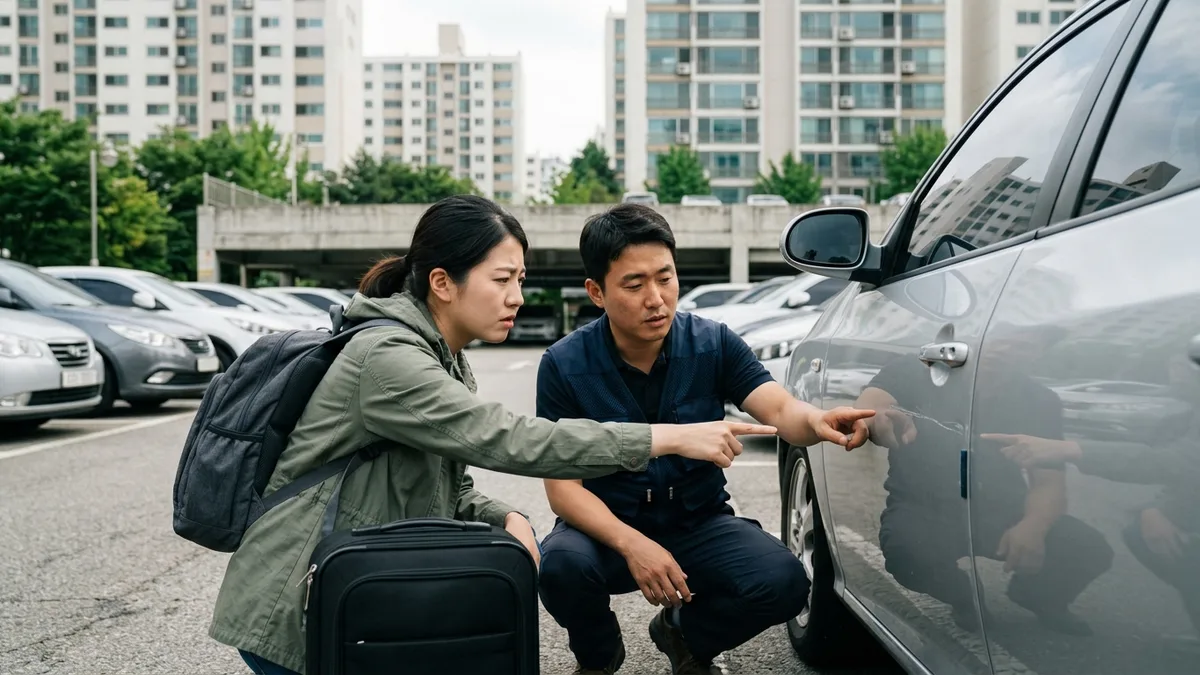
Getting a bill after you've returned the car, even though you bought full CDW, happens all the time. And the reason is written right into the terms. Article 18(2) of the Fair Trade Commission's Standard Terms for Vehicle Rental (Standard Terms No. 10064, amended Oct 29, 2021) caps the deductible for customers enrolled in a vehicle damage waiver program at "the actual repair cost incurred" — but adds in parentheses that "loss-of-use damages borne by the customer under Article 19 are excluded." In other words, the terms treat loss-of-use damage as an obligation entirely separate from your deductible.
And the amounts aren't small. Article 19(3) of the standard terms even includes a worked example in the text itself. If a passenger car with a daily rental rate of 73,000 KRW (rented for 7 days or more) is damaged through the customer's fault and takes 10 days to repair, then 73,000 KRW × 10 days = 730,000 KRW, and 50% of that — 365,000 KRW — is the loss-of-use damage the customer owes. This clause is the basis for the charge regardless of whether you bought CDW.
The rate of incorrect billing has already been surveyed, too. According to a press release issued by the Korea Consumer Agency on June 22, 2021, out of 28 people who actually paid a loss-of-use fee, only one person — 3.6% — was billed on the "actual rental rate" basis required by the standard terms. 60.7% received bills calculated on the standard listed rate, and 35.7% on the regular rate. In practice, calculating with the more expensive rate table was the norm.
For foreigners, there's one more layer on top. Some companies close off the cheaper CDW products to foreigners that Koreans can choose, and the far cheaper alternative rider that Koreans add to their own auto insurance requires having a Korean auto insurance policy in the first place. There have even been rental refusals on the grounds of Korean-language service, despite the customer having every document in order. Let's work through it clause by clause.
Note: The article numbers in this piece follow the original text of Fair Trade Commission Standard Terms No. 10064. Older versions of the terms posted on company websites may use different article numbers. Deductibles, coverage limits, and loss-of-use fee rules vary by company and by product, so use the information below — compiled as of 2026-08 — as a reference, but be sure to re-check with the specific company's terms before booking.
Insurance already included in your contract — unlimited bodily injury, but 20 million KRW property damage
First, the reassuring part. Article 11(1) of the standard terms requires companies to rent out vehicles covered by liability insurance under the Guarantee of Automobile Accident Compensation Act plus comprehensive auto insurance (bodily injury liability, property damage liability, and personal injury coverage). Under the auto insurance policy, you as the customer become an "approved insured" party. That means bodily injury, property damage, and personal injury coverage are already in place and the renter doesn't need to buy them separately.
The issue is the limits. As of 2026-08, the figures confirmed across multiple companies' terms are unlimited bodily injury, 20 million KRW per property damage claim, and 15 million KRW per person for personal injury. Twenty million KRW for property damage can feel low if you're coming from a country with higher norms. If repairs to the other party's car exceed that limit, the excess falls on the renter under Article 18(4).
| Category | Who buys it | Confirmed limit example | What to know |
|---|---|---|---|
| Bodily injury liability | The company (Art. 11(1)) | Unlimited | Liability insurance and comprehensive insurance stack together |
| Property damage liability | The company (Art. 11(1)) | 20 million KRW per claim | Excess is on the renter (Art. 18(4)) |
| Personal injury (self) | The company (Art. 11(1)) | 15 million KRW per person | The more passengers you have, the more this matters |
| Own vehicle damage (CDW) | Customer's choice (Art. 11(2)) | Varies by product | This is the "CDW" this article is about |
If you've seen an English-language travel guide say "bodily injury liability of 150 million KRW per person," that's a different figure. The 150 million KRW is the death benefit limit for liability insurance (bodily injury liability I) set by Article 3 of the Enforcement Decree of the Guarantee of Automobile Accident Compensation Act, while Article 11(1) of the standard terms also requires comprehensive insurance, layering on unlimited bodily injury liability II. "Unlimited," as written in company terms, is the correct figure.
One more thing. Compulsory insurance doesn't mean everything is covered for free. Confirmed company notices show that Sun Rent-a-Car sets separate renter deductibles of 500,000 KRW for bodily injury (per person), 500,000 KRW for property damage (per claim), and 500,000 KRW for personal injury (per person), while Login Rent-a-Car lists 300,000 KRW for bodily injury, 300,000–500,000 KRW for property damage, and 300,000 KRW for personal injury. Check before signing whether your company applies deductibles even on the compulsory insurance.
For short-term rentals, the property damage limit is around 20 million KRW per claim even at large companies, while long-term rentals reportedly let you choose between 100 million, 300 million, and 500 million KRW (per a June 2021 news report). We couldn't confirm whether the industry has raised short-term property damage limits since 2021, but as of 2026-08, multiple companies' terms still list 20 million KRW.
"CDW" is optional — and it may not even be insurance
Article 11(2) of the standard terms provides that the customer may choose and enroll in one of either "own vehicle damage insurance" or a "vehicle damage waiver program" operated by the company. Two things branch off here. CDW isn't mandatory, it's optional — and the nature of the product isn't even a single thing.
A large share of what gets called "CDW insurance" at Korean rental companies isn't an insurance product under the Insurance Business Act at all; it's a vehicle damage waiver program the rental company runs on its own. Because it's a waiver agreement between the renter and the rental operator, it isn't subject to Financial Supervisory Service insurance oversight. The standard terms themselves list the two as separate, parallel items.
Why does this matter? Because it changes where you go when a dispute arises. Foreigners who were told it was "insurance" in English sometimes try to file a complaint with the Financial Supervisory Service when they have a problem with a charge — but a waiver program isn't insurance, so that's the wrong door. The actual channels are the Korea Consumer Agency and civil proceedings. If you operate on the assumptions of your home country's insurance regulatory system, you'll just lose time.
Tip: When you sign, write down the exact product name. Whether it's "own vehicle damage insurance" or a "vehicle damage waiver program (waiver product)" determines which documents and which channels you can rely on if a dispute comes up. If you only received English-language materials, it's worth asking for the Korean product name too.
Without CDW, an accident means paying for the car's value — not the repair cost
The real risk of skipping CDW is widely misunderstood. Article 18(3) of the standard terms provides that if the vehicle is damaged in an accident while the customer has enrolled in neither own vehicle damage insurance nor a vehicle damage waiver program, the customer must compensate the company based on "the standard vehicle value at the time of the accident" and similar measures. Meaning the basis for the claim is the vehicle's value, not the repair cost.
And even if you did enroll, a coverage limit means you can't relax. Article 18(4) provides that if the coverage amount of the CDW or waiver program falls short of the compensation liability, the customer bears the shortfall. In practice, Sun Rent-a-Car states that its standard and premium waivers share a coverage limit of 5 million KRW for all vehicle classes, with only the super waiver being unlimited. Even if the product is named "waiver," if there's a limit attached, the excess is on the renter.
If you're in the habit of declining CDW at the counter back home because your credit card includes rental car coverage, be especially careful here. Structurally, a card benefit cannot eliminate the contractual compensation liability created by Article 18(3). The order is: the renter compensates the rental company first, then files a claim with the card issuer for reimbursement. Some English-language sources say it's common for Korean rental companies not to accept overseas card benefits as a substitute for their own CDW, but this needs to be checked against each card issuer's and each company's individual terms (we couldn't confirm an official interpretation).
The deductible — flat-rate, percentage-based, and the "actual repair cost" cap
Even with CDW, you pay a set amount out of pocket when an accident happens. That's the deductible. Because the design varies by company, saying "it's usually about X" is inaccurate in itself.
| Type | Confirmed company example | How it's calculated | Cap that applies across the board |
|---|---|---|---|
| Flat-rate | Light/compact 100,000 KRW / mid-size, RV, van 300,000 KRW / premium, imported, large 500,000 KRW | Fixed amount by vehicle class | Actual repair cost incurred (Art. 18(2)) |
| Percentage-based | 20% of repair cost, minimum 500,000 KRW to maximum 1,000,000 KRW, etc. | Repair cost multiplied by a rate | Actual repair cost incurred (Art. 18(2)) |
| Premium CDW | 0 KRW deductible under full unlimited waiver, premium waiver, etc. | 0 KRW for car-to-car accidents (some products set a separate deductible for single-vehicle or unidentified-party accidents) | A separate coverage limit may still apply |
The most important column in that table is the one on the right. Article 18(2), newly added in the Oct 29, 2021 amendment, provides that the deductible for vehicle damage waiver enrollees is capped at the actual repair cost incurred. This is especially useful as a defense with percentage-based deductibles. If the repair came to 300,000 KRW but you were billed 500,000 KRW because of a "500,000 KRW minimum," you can push back citing this clause.
Some premium CDW products set the deductible at 0 KRW and, depending on the company, also state that the loss-of-use fee is waived. But that's a product-specific add-on benefit, not an automatic waiver under the standard terms. The legal default is that loss-of-use damage is an obligation separate from the deductible, so check the product terms specifically for whether the loss-of-use fee is waived.
We won't put daily CDW rates in this article as figures. Companies often only disclose them at the reservation consultation stage, and we couldn't cross-check them against official rate tables. Instead, here's a list of things to ask when you book.
- Is the deductible flat-rate or percentage-based? If percentage-based, what are the minimum and maximum amounts?
- Is the CDW coverage limit unlimited, or is there a cap like 5 million KRW?
- Is the loss-of-use fee waived under this product? If so, for which types of accidents?
- Does the same deductible apply to single-vehicle accidents and accidents where the at-fault party is unidentified?
- Are there separate deductibles on the compulsory insurance (bodily injury, property damage, personal injury)?
Caution: Don't take deductible amounts you see on English-language rental car comparison sites at face value. Some list the excess for Korean CDW in the 6.9–10.3 million KRW range, but the deductibles in Korean companies' own terms run in the 100,000–500,000 KRW range (or 20% of the repair cost). Those look like global default values auto-converted at exchange rates, so always confirm the numbers in the Korean company's own terms.
8 situations where even full CDW pays 0 — taking turns driving is one of them
Article 18(1) of the standard terms lists, item by item, the grounds on which nothing is covered even if you enrolled in CDW or a waiver program. There are eight.
| Item | Grounds for exclusion | Where foreigners actually get caught |
|---|---|---|
| 1 | Intentional accidents | — |
| 2 | Driving without a license | Driving without realizing your International Driving Permit has expired |
| 3 | Paid subletting or commercial use | Charging travel companions for a ride could become an issue |
| 4 | Use for criminal purposes | — |
| 5 | Drunk driving | Korea's enforcement threshold may be stricter than your home country's |
| 6 | Driving under narcotics, stimulants, or other drugs | Even prescription medication can lead to disputes depending on the ingredients |
| 7 | Use for racing, practice, or testing | — |
| 8 | Driving by someone other than the driver named in the rental contract | The common travel pattern of swapping drivers with a companion becomes fully out-of-pocket |
Item 8 is the most practically relevant one in this article. Two people taking turns on a long drive is a natural part of travel, but if an accident happens while someone whose name isn't on the contract is behind the wheel, coverage is excluded in full even if you bought CDW. The 2021 amendment carved out only designated-driver service providers under Article 173(1) of the Income Tax Act.
So there's one extra step. If two or more people will be driving, register every one of them in the driver section of the contract when you sign, and present each person's International Driving Permit, home country license, and passport together. Some companies charge a fee to add drivers, so it's worth asking at the booking stage. The scope of license recognition itself is covered in International Driving Permits and license exchange procedures.
Beyond the eight in the standard terms, companies add their own exclusions in their individual terms. Confirmed company notices list things like tire punctures and damage, glass and headlight damage, vehicle theft, exceeding passenger capacity, failure to report an accident immediately, more than one claim per accident, accidents within specific areas (e.g., Udo), and signal violations, center-line crossings, and speeding 20 km/h or more over the limit. A product named "full" doesn't mean it covers every situation.
Loss-of-use fee (NOC) — 50% of the daily rate × repair days, with a worked example in the terms
The loss-of-use fee isn't a familiar line item in English-speaking rental markets, so many people sign contracts without knowing the concept. It's the charge that makes the renter compensate the company for the business loss of not being able to rent out the car while it's in the shop.
Article 19(1) of the standard terms requires the customer to compensate for the business loss over the repair period when the vehicle is repaired due to an accident the customer caused, and — if the vehicle is damaged beyond repair or stolen — to cover the business loss for "the period required for repurchase and registration." That last part is the scary one. When the basis becomes the time it takes to buy and register a replacement rather than repair days, the day count grows a lot.
The calculation structure is in Articles 19(2) and 19(3). The company must present "objective calculation data" taking into account rental rates for comparable vehicles, and if it doesn't, the customer pays 50% of the rental rate corresponding to that period. Here, the daily rental rate is based on "the rate the customer actually paid."
| Item | Example in Art. 19(3) | What to check on your bill |
|---|---|---|
| Daily rental rate | 73,000 KRW (based on 7+ day rental) | Is this the amount I actually paid? |
| Repair period | 10 days | Are there shop documents showing the drop-off and pick-up dates? |
| Period total | 73,000 × 10 = 730,000 KRW | Does the multiplication check out as written? |
| Customer's share | 730,000 × 50% = 365,000 KRW | Did I receive calculation data, or is this the 50% rule? |
Two things are commonly misunderstood here. First, it is not the case that "the loss-of-use fee is always 50% of the daily rate." The 50% is a fallback rule for when the company fails to present objective calculation data; if the company does present data such as rental rates for comparable vehicles, an actual-loss basis may take precedence. Second, on the flip side, it's also hard to assert flatly that "it's always based on the rate I paid." That said, if the bill was calculated from a list-price table without calculation data, you have a clear basis for demanding the standard terms' benchmark.
The Korea Consumer Agency survey mentioned earlier lands exactly here. The fact that only 1 out of 28 people (3.6%) who paid a loss-of-use fee was billed on the actual rental rate basis means that receiving a bill calculated from a more expensive rate table was closer to the norm (as of the 2021 survey). When a bill arrives, start by checking the rate it's based on.
Three things to scrutinize when you get a bill
Consumer harm involving rental cars shows up in the statistics too. Rental car damage relief applications filed with the Korea Consumer Agency numbered 253 in 2018, 276 in 2019, and 342 in 2020 — 871 over three years — and the most common type was "accident-related" at 354 cases (40.6%), including excessive demands for repair costs, deductibles, and loss-of-use fees. In the follow-up three-year tally for 2019–2021 totaling 957 cases, "excessive repair cost billing" was the most common among the 339 accident-related cases, at 147 cases (55.9%).
First, check whether the deductible exceeds the actual repair cost. The cap in Article 18(2) is your basis. To verify it you need the repair details, so request a repair estimate and an itemized service statement. The 2021 amendment to the standard terms made providing an itemized service statement mandatory when billing repair costs.
Second, check the base rate and the number of days for the loss-of-use fee. Ask three things together: whether the basis is the daily rate you actually paid, whether the company presented objective calculation data, and whether the repair period matches the drop-off and pick-up dates in the shop documents (Art. 19(2) and (3)).
Third, check whether items were double-counted. The excess over the CDW coverage limit (Art. 18(4)), compulsory insurance deductibles, your CDW deductible, and the loss-of-use fee are all different in nature. Ask for the statement broken out line by line to see whether the same loss got split across two items.
Administrative fines are separate from this calculation. Article 16(2) of the standard terms provides that administrative fines, summary fines (notice disposition), and parking fees imposed for parking violations or traffic law violations during the rental period remain the customer's responsibility even after the car is returned. This applies regardless of CDW, so it's a good idea to check for any unpaid items before you leave the country.
📌 Important: If you have an accident, there's a set order. ① Notify the rental company immediately from the scene (failure to report is a listed exclusion in company terms), ② get the police and insurance claim numbers, and ③ photograph the condition of the vehicle. Photographing the exterior when you pick up the car is also something the Korea Consumer Agency recommends.
What closes differently for foreigners — product choice, alternatives, and service language
Everything so far applies to Koreans in exactly the same way. Now for the parts that work differently only for foreigners.
First, some companies require the top-tier CDW only for foreigners. Jeju OK Rent-a-Car states in its rental guidance that "foreign customers can only book after selecting the full unlimited CDW (bookings without CDW or with a partial unlimited CDW may be rejected or cancelled)," and requires the original International Driving Permit and original passport as documents for foreigners. Koreans can pick a lower-tier product with a 100,000 KRW deductible, while for foreigners that option is closed. We couldn't confirm whether this is a practice across the whole industry, but you should know before booking that the lowest price you saw on a comparison site may not apply to you. If you're renting on Jeju, there's an extra local system layered on — the route for picking up your car at the airport and the fare rules taking effect on September 16, 2026 are covered in Jeju Airport rental cars: 5 steps including the shuttle.
Second, the cheap alternative Koreans use is fundamentally blocked for you. Korea has a proper insurance option you can use instead of a rental company's waiver product: the "rental car damage coverage rider" created by the Financial Supervisory Service together with insurers, sold by Samsung Fire & Marine, Hyundai Marine & Fire, DB Insurance, and others, with premiums reportedly around 5,000–10,000 KRW per day depending on the vehicle. But it's an add-on rider to your own personal auto insurance policy, so without a car and auto insurance in Korea, you simply can't buy it. It's a structure where only foreigners pay full price for the same risk.
Third, you can be refused a rental even with every document in order. In October 2025 in Jeju, a foreign resident holding a valid International Driving Permit was unable to pick up a car he had reserved because "we can't provide service in Korean if there's an accident," and even a Korean colleague's offer to interpret was declined, leading to a lawsuit. The court issued a settlement recommendation ordering the company to pay 150,000 KRW, and the plaintiff filed an objection (the outcome of the lawsuit has not been confirmed as of 2026-08). So there's one extra step only foreigners need: confirming at the booking stage whether foreigners can rent and what language support is available in case of an accident.
Fourth, the security deposit pre-authorization (hold) placed at pickup ties up your overseas card's limit. If the hold occupies your available credit, subsequent payments at hotels and restaurants can get declined in a chain reaction. The impact is bigger for foreigners, who don't have a Korean bank account or domestic card as a fallback. How to handle this situation is covered separately in When your overseas card gets declined in Korea.
Requirements that trip people up at the pickup counter — license, age, a card in your own name — are covered separately in Korea rental car requirements for foreigners. It's safest to confirm that the rental can happen at all before worrying about insurance.
Here's a consolidated list of things to confirm by email or chat before booking.
- Whether foreigners can book and rent at all, and what languages are supported if there's an accident
- Whether there's a CDW product mandated for foreigners, and if so, what it costs
- Whether additional drivers can be registered and the fee to do so
- The security deposit pre-authorization amount and when it's released
- Whether the loss-of-use fee is waived, and which accident types aren't covered by that waiver
If you're planning to take the car onto an island, there's one more thing. Rental cars are reportedly prohibited from being loaded onto ferries under some companies' rental terms. Ferry routes and vehicle loading rules are covered in Korea ferry booking guide, so ask your rental company first before booking.

When an accident puts your car in the shop, your transportation for the rest of the trip disappears entirely for that period. The same goes for when the rental is refused outright because the license, age, or deposit card requirements don't line up. In both situations, the fallback is ultimately KTX, express buses, and taxis. LACHA is a transportation and payment super app for foreigners that you can use immediately without Korean identity verification, designed so you can handle all three in one place using your passport and an overseas payment method — no Korean bank account or phone number required. If your itinerary moves between cities, reading Transportation planning by travel itinerary alongside this will make it easier to map out alternate routes. LACHA does not handle rental car bookings or CDW products.
Want to search and book KTX and express buses in one app? Check out LACHA.
Built to work without a Korean phone number or bank account, with overseas payment methods like Alipay, WeChat Pay, and Apple Pay. Taxi hailing plus KTX, express bus, and airport railroad (AREX) booking — all in one app.
Up to 60% off Korea transit with a coupon (max ₩3,000): enter code at sign-up. KTX gets up to 18% off on top
Download now


Frequently Asked Questions (FAQ)
Q1. I bought full CDW — why am I still being billed a loss-of-use fee? Because Article 18(2) of the standard terms, while capping the deductible at the actual repair cost, explicitly states in parentheses that "loss-of-use damages borne by the customer under Article 19 are excluded." The terms treat loss-of-use damage as an obligation separate from the deductible, so the legal default is "even with full CDW, the loss-of-use fee is separate." Some companies do waive the loss-of-use fee along with premium CDW products, but that's a product-specific add-on benefit and doesn't apply automatically. Check that product's terms specifically for a loss-of-use fee waiver before you sign.
Q2. Can I calculate the loss-of-use fee in advance? The example in Article 19(3) of the standard terms shows you the structure. If a car with a daily rental rate of 73,000 KRW takes 10 days to repair, the customer's share is 50% of 730,000 KRW, or 365,000 KRW. That said, the 50% is a fallback rule for when the company doesn't present objective calculation data (Art. 19(2) and (3)); if the company presents rental rates for comparable vehicles and similar data, an actual-loss basis may take precedence. If the vehicle can't be repaired or was stolen, the calculation uses the time required for repurchase and registration rather than the repair period, which makes the amount larger.
Q3. My home country credit card includes rental car coverage — can I skip CDW? We don't recommend it. If the vehicle is damaged while you haven't enrolled in CDW, Article 18(3) of the standard terms creates a contractual liability for the renter to compensate the rental company "based on the standard vehicle value at the time of the accident" and similar measures. A card benefit doesn't eliminate that liability; it reimburses money you've already paid. Some guidance also says it's common for Korean rental companies not to accept overseas card benefits as a substitute for their own CDW, so check your card issuer's terms and the rental company's policy separately.
Q4. Can my friend and I take turns driving? Both of you have to be registered as drivers on the contract. Article 18(1), item 8 of the standard terms excludes coverage for accidents that occur while "a person other than the driver named in the rental contract" is driving, so if an unregistered person is at the wheel when an accident happens, coverage is excluded in full even with CDW. When you sign, present and register the International Driving Permit, home country license, and passport of everyone who will drive. Some companies charge a fee to add drivers.
Q5. Where do I go for help if I think a charge is unfair? A large share of Korean rental car "CDW" isn't insurance under the Insurance Business Act but a vehicle damage waiver program run by the rental company, so it isn't subject to Financial Supervisory Service insurance oversight. The actual channels are the Korea Consumer Agency and civil proceedings. Before you file, get the repair estimate, the itemized service statement, and the loss-of-use fee calculation data in writing. The 2021 amendment to the standard terms made providing an itemized service statement mandatory when billing repair costs, and the company must present objective calculation data for loss-of-use damages (Art. 19(2)).
Note: This article is for general informational purposes and is not legal advice. The clauses cited follow the original text of the Fair Trade Commission's Standard Terms for Vehicle Rental, Standard Terms No. 10064 (amended Oct 29, 2021); older versions posted on company websites may use different article numbers. Coverage limits, deductibles, loss-of-use fees, and rental conditions for foreigners differ by company and product and change frequently, and the company-specific examples in this article are values confirmed from each company's public information as of 2026-08. Daily rates for CDW products, product-specific deductibles at major companies, whether overseas card benefits are recognized domestically, and the outcome of the 2025 Jeju rental refusal lawsuit could not be confirmed from primary sources and are therefore not stated as figures or conclusions in the text. Before booking or signing, always re-confirm with the rental company's own terms and rate tables. LACHA does not book or broker rental cars, nor does it sell rental car insurance or CDW products.