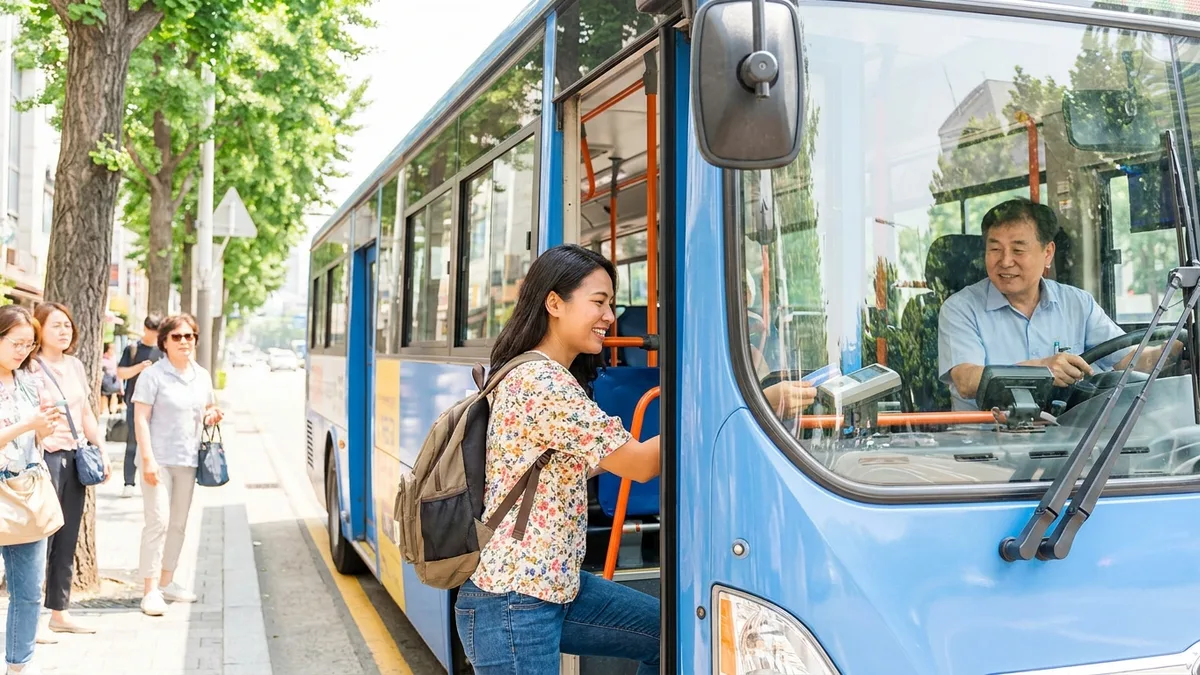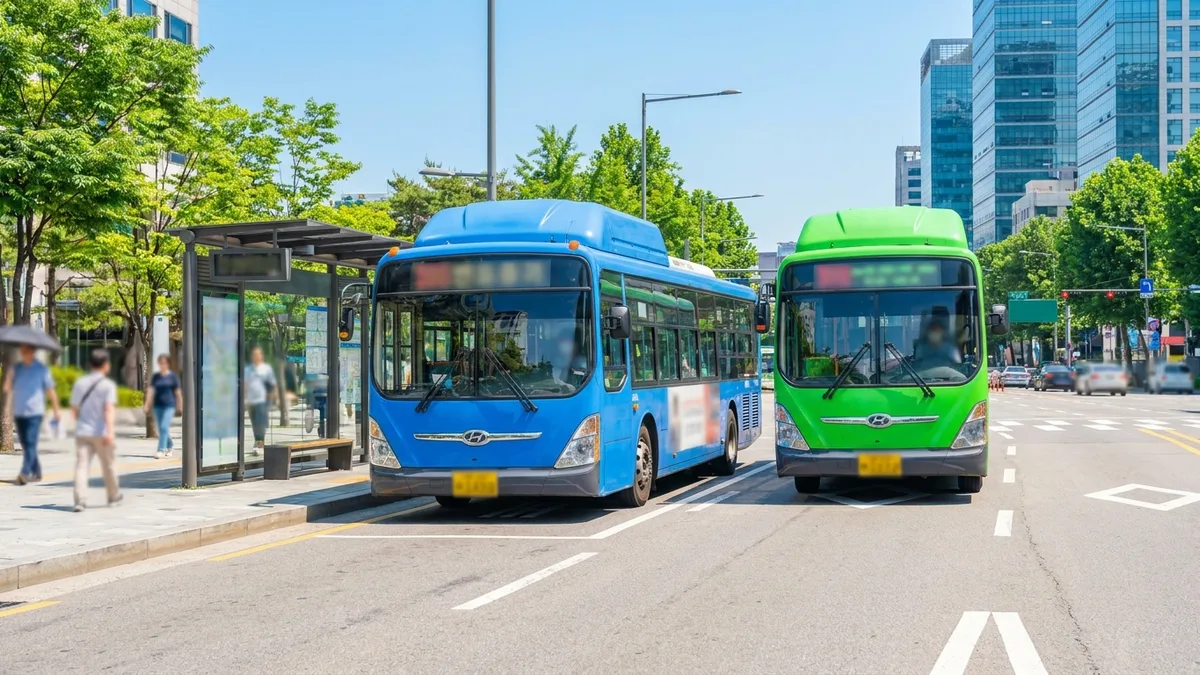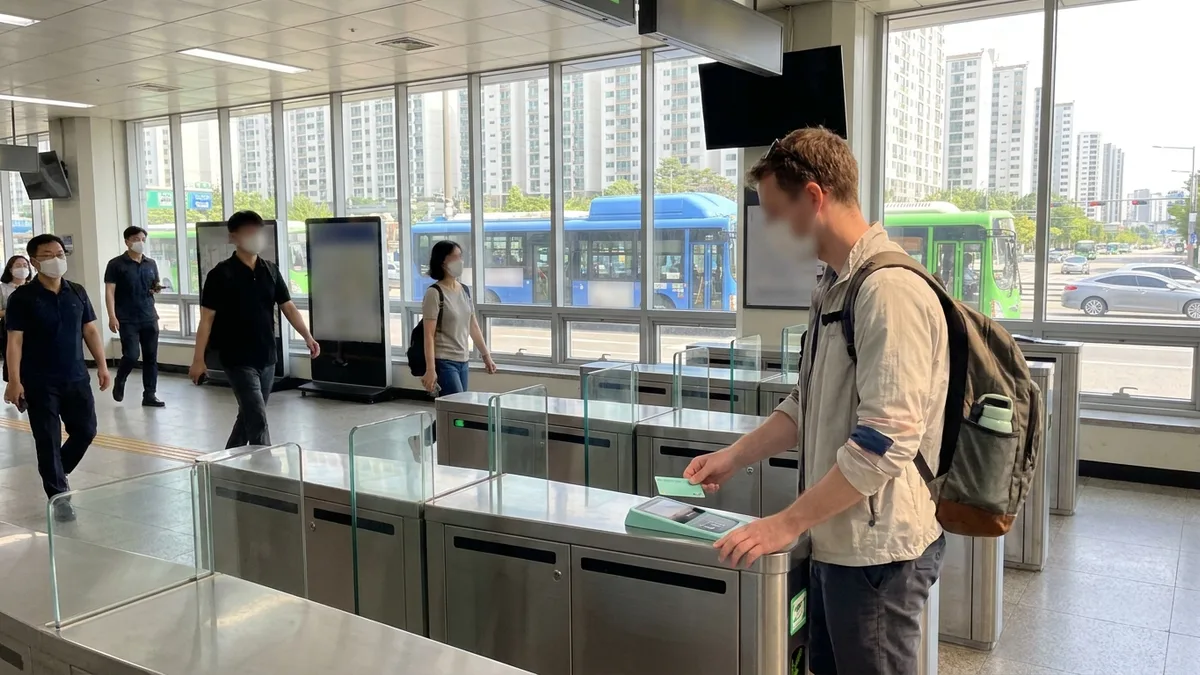
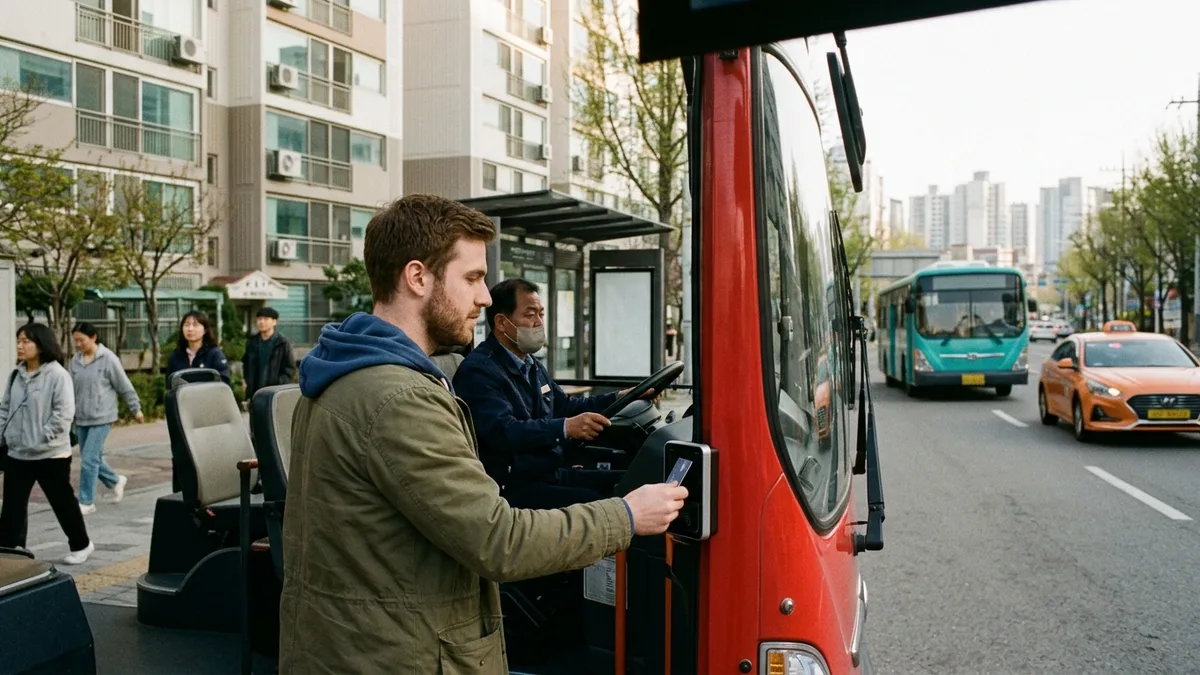
A Seoul city bus costs 1,500 KRW with an adult transit card, but a Gyeonggi Province direct-seat express bus costs 3,200 KRW. That fare took effect with the first bus of October 25, 2025, and it's more than double a Seoul bus. Ride round trip every day and that's 6,400 KRW a day — so if you were spending 3,000 KRW on the same round trip in Seoul, your budget is off by 3,400 KRW a day.
Cross into Incheon and the chart changes again. Similar-looking red buses that stop at the same stop split into 3,000 KRW and 3,200 KRW in Incheon. Whether there's an M in front of the route number is what makes that 200 KRW difference — and there's essentially no foreign-language signage at the stop or on the bus explaining it.
The cash rules are the opposite of Seoul's, too. In Seoul, adults pay the same whether it's cash or card, so you learn that "paying cash isn't a loss." But an Incheon seat bus (intercity) is 1,550 KRW by transit card and 2,300 KRW in cash. That's 750 KRW extra per ride, about 48% more.
The hardest part is verifying any of this. Among the primary pages that publish these fares, the Incheon Bus Information System (bus.incheon.go.kr) fare page was Korean-only as far as we could confirm. The Gyeonggi Provincial Government site (gg.go.kr) has an English, Chinese, Vietnamese, and Japanese language menu, but we couldn't confirm whether the fare tables themselves are translated. In other words, there's no convenient way to check exact amounts in a foreign language. The tables below are a direct transcription of those Korean originals.
Note: The fares in this article were confirmed as of 2026-08 from the Gyeonggi Provincial Government's G-Bus fare page, Gyeonggi Bus Information (gbus.or.kr), the Incheon Bus Information System, and the Seoul Metropolitan Government's integrated transfer discount guide. Gyeonggi bus fares are current as of the 2025-10-25 revision; in Incheon, only M-Bus (metropolitan express) at 3,200 KRW reflects the 2025-10-25 increase, while the other types still reflect the 2023-10-07 adjustment. Fares and routes change by local government notice, so please check again before you travel.
Same Red Bus, 3,000 KRW vs. 3,200 KRW — Why Seoul Fares Don't Apply
Korean city bus fares aren't the same nationwide. The agency that licensed the bus sets the fare. Seoul sets its own fares, Gyeonggi Province sets its own, and Incheon sets its own. So the "buses cost 1,500 KRW" instinct you picked up in Seoul stops working the moment you cross the Han River.
And there's one more layer. Metropolitan express buses (M-Bus) that cross multiple local governments are licensed not by a city or province but by the Chairperson of the Metropolitan Transport Commission (MTC) under the Ministry of Land, Infrastructure and Transport. That's why two fares coexist within Incheon itself.
- Metropolitan buses (direct-seat) licensed by Incheon: 3,000 KRW, adult transit card
- M-Bus (metropolitan express) licensed by the MTC: 3,200 KRW, adult transit card (raised 2025-10-25)
- Direct-seat type licensed by Gyeonggi Province: 3,200 KRW, adult transit card
You can't tell them apart by appearance. All three are red-toned long-distance buses with seats, and they often line up at the same stop. The route number is your clue. If there's an M in front of the number, it's an M-Bus; if it's a metropolitan bus in Incheon without an M, it's 3,000 KRW. If reading bus types by color and number is unfamiliar to you in the first place, start with How to Read Korean Bus Numbers and Colors and the rest will click faster.
📌 Important: You'll find posts online saying "Incheon metropolitan buses cost 3,200 KRW" — that's the M-Bus and Gyeonggi direct-seat fare. Incheon-licensed metropolitan buses are still 3,000 KRW (as of 2026-08). This is the single most common mistake, so always read the type name alongside the number in the table.
Full Gyeonggi Bus Fare Table (Effective 2025-10-25)
Gyeonggi buses come in five types. Below are the adult, youth, and child transit-card fares published by the Gyeonggi Provincial Government and Gyeonggi Bus Information.
| Bus Type | Adult Card | Youth Card | Child Card | Adult Cash |
|---|---|---|---|---|
| Regular (city general) | 1,650 KRW | 1,160 KRW | 830 KRW | 1,700 KRW |
| Seat type | 2,650 KRW | 1,860 KRW | 1,330 KRW | 2,700 KRW |
| Direct-seat type (red bus) | 3,200 KRW | 2,300 KRW | 1,600 KRW | 3,200 KRW |
| Gyeonggi Circular | 3,450 KRW | 2,420 KRW | 1,730 KRW | — |
| Metropolitan express (M-Bus) | 3,200 KRW | — | — | 3,200 KRW |
Just remember three things from this table.
- The blue and green city buses you'll see most often in Gyeonggi are the regular type at 1,650 KRW — 150 KRW more than Seoul (1,500 KRW).
- The direct-seat type at 3,200 KRW is the red bus people use to commute into Seoul. More than double a Seoul city bus.
- Gyeonggi Circular at 3,450 KRW is the priciest Gyeonggi type. These routes loop around the outer edge of the province without passing through Seoul.
The blanks (—) in the table are values we couldn't confirm in the official sources. Rather than invent numbers, we left them empty — if you need one of those combinations, check directly with the Gyeonggi Provincial Government fare page.
Full Incheon Bus Fare Table — From 1,200 KRW Branch Buses to 8,000 KRW Airport Buses
Incheon splits its types more finely. Below are the adult transit-card fares from the Incheon Bus Information System.
| Bus Type | Adult Card | Good to Know |
|---|---|---|
| Branch (jiseon) | 1,200 KRW | The cheapest bus in Incheon |
| Trunk (ganseon) | 1,500 KRW | Same as a Seoul city bus |
| Seat bus (intercity) | 1,550 KRW | Cash is 2,300 KRW — 750 KRW more |
| BRT | 2,600 KRW | Trunk express running on dedicated lanes |
| Metropolitan bus (direct-seat) | 3,000 KRW | Routes licensed by Incheon |
| M-Bus (metropolitan express) | 3,200 KRW | Reflects the 2025-10-25 increase |
| Yeongjong seat bus | 1,900 KRW | 1,500 KRW if you board and alight within Yeongjong |
| Late-night bus (N50 · N80 · N81 · N90) | 1,900 KRW | The N in front marks a late-night route |
| Airport bus 6777 · 6777-1 · 6770 | 8,000 KRW | Flat fare regardless of distance |
The 1,200 KRW branch bus and the 8,000 KRW airport bus differ by more than 6x within the same city. If you absentmindedly hop on the 6777 coming into the city from Incheon Airport, 8,000 KRW disappears in one tap — so if you're traveling light, it's worth comparing other options.
Caution: Incheon seat buses, metropolitan buses, and M-Buses add distance-based charges whether or not you transfer. That rule differs from Gyeonggi's, so we cover it separately in the "base distance" section below. The amounts in the table above are fares within the base zone.
Village Bus Fares Vary by City and County — Move House, and Your Fare Changes
The most confusing thing in Gyeonggi is the village bus (maeul bus). They're all "Gyeonggi village buses," yet each city and county publishes a different fare. Here's the city/county village bus fare table posted by the Gyeonggi Provincial Government (table as of 2026-02).
| Adult Card Fare | City / County |
|---|---|
| 1,350 KRW | Gwacheon |
| 1,450 KRW | Bucheon |
| 1,550 KRW | Pyeongtaek · Gimpo · Gwangju · Gunpo · Seongnam |
| 1,650 KRW | Suwon · Siheung · Hwaseong · Namyangju · Goyang · Hanam |
So just moving within the same province can change your village bus fare by up to 300 KRW. For foreign residents who can't feel administrative boundaries by instinct, the "why did I pay more today?" moment really does happen. What matters isn't the moment you cross a border — it's which city or county licensed the village bus you boarded.
One more thing to know: the table above doesn't include every city and county in Gyeonggi. Ansan, for example, isn't on it. We couldn't confirm whether missing areas simply have no village buses or whether the table is incomplete, so if you live in one of them, check directly with your city or county transportation office or the signage at the stop.
For Incheon, the fare table we checked doesn't list "village bus" as a separate type, and the lowest fare is the branch type at 1,200 KRW.
The Buses Whose Base Distance Is 30km, Not 10km — How Metropolitan and Direct-Seat Fares Work
The Seoul metropolitan area's integrated transfer discount uses the concept of a "base zone." Within that distance you pay only the base fare; beyond it, 100 KRW is added every 5km (80 KRW for youth, 50 KRW for children).
This is where people go wrong. If you only remember "10km base" from Seoul, your metropolitan bus math will be off in both directions — because the base zone for metropolitan buses is 30km. The Seoul city and Gyeonggi provincial guides agree on this point.
| Category | Base Distance | When Distance Charges Kick In |
|---|---|---|
| Regular city buses (Seoul · Gyeonggi · Incheon) | 10km | When total distance exceeds it after transferring |
| Gyeonggi seat · direct-seat · Circular | 30km | Flat fare if ridden alone; distance-based if you transfer |
| Gyeonggi village bus | Flat fare | Riding alone, distance doesn't matter |
| Incheon seat bus | 10km | Applies regardless of transfers |
| Incheon metropolitan bus · M-Bus | 30km | Applies regardless of transfers |
That third column is the real difference between Gyeonggi and Incheon. A Gyeonggi direct-seat bus ridden on its own is a flat 3,200 KRW no matter how far you go, but Incheon metropolitan buses and M-Buses charge more past 30km even if you never transfer. Incheon's own guide literally includes the phrase "(regardless of transfers)."
Not knowing about the 30km rule costs you in both directions.
- Underestimate the fare and your prepaid card runs short, so your exit tap fails.
- Overestimate it — "transferring will just cost me more" — and you skip transfers that would have been free within 30km.
A real example makes it click. If you ride a Gyeonggi direct-seat bus into Seoul and transfer to a Seoul trunk or branch bus, you're charged only 3,200 KRW as long as the total distance is 30km or less. Two rides, one fare.
When Transferring Still Costs You — How the Differential Works
Transfers aren't "always free." When you move from a cheaper bus to a pricier one, the difference is topped up to the pricier bus's base fare.
Per the sample calculation the Gyeonggi Provincial Government gives, it works like this. Ride a Gyeonggi village bus (1,550 KRW) for 9km, get off, transfer to a direct-seat bus, and go another 20km: an additional 1,650 KRW is charged at the boarding tap when you transfer, for a total of 3,200 KRW. That's the amount needed to reach the direct-seat base fare of 3,200 KRW.
The problem is that this 1,650 KRW comes out with no warning the instant you transfer. If you boarded with about 1,500 KRW left, thinking "transfers are free so I'm fine," your balance goes short right there. Then your exit tap fails, and without an exit tap your next boarding breaks the transfer chain and gets charged extra — a domino effect.
Tip: If your trip involves a metropolitan or direct-seat bus, load at least 10,000 KRW onto your prepaid transit card in advance. Even if you transfer from a village bus, your one-way total stops at the direct-seat base fare of 3,200 KRW, so 6,400 KRW round trip is your baseline — but once total distance passes 30km, another 100 KRW is added every 5km.
The "top up to the pricier mode's base fare" pattern shows up consistently across the Gyeonggi Provincial Government's sample calculations, but we couldn't find a separate provision stating it as a single rule. So treat it as a principle to understand, and confirm actual amounts in your card transaction history.
Transfer validity and limits (within 30 minutes after alighting, 60 minutes between 9 p.m. and 7 a.m., up to 4 transfers) come from the Seoul city integrated transfer guide. We couldn't confirm identical wording in the Gyeonggi and Incheon originals, but it operates as a shared system across the metropolitan area. The rules themselves are covered in detail in Seoul Public Transit Transfer Discounts Explained.
Leave Before Dawn and Save 20% — Early-Bird Discounts and the Cash Penalty
For anyone heading out before dawn on manufacturing or construction shift work, the early-bird discount is the biggest benefit at stake. But it comes with three conditions, and those conditions appear only in footnotes on the Korean fare tables.
- You must board before 06:30. Past 06:30 it's the regular fare.
- You must pay by transit card. Cash doesn't qualify.
- It applies only to your first boarding. It doesn't carry over to a second bus after a transfer.
The size of the discount varies by region. Incheon gives 20% off the base fare, so a metropolitan bus drops from 3,000 KRW to 2,400 KRW, while the M-Bus is set at 2,800 KRW for fairness. Gyeonggi publishes early-bird fares of 2,800 KRW for direct-seat and 1,450 KRW for regular type.
It looks small but adds up. Commuting before dawn on a Gyeonggi direct-seat bus saves 400 KRW each way — 8,800 KRW over 22 days a month.
Cash, on the other hand, costs you. In Seoul adults pay the same in cash or card, so it never mattered; in Gyeonggi and Incheon it does.
- Gyeonggi regular type: card 1,650 KRW / cash 1,700 KRW — a 50 KRW gap.
- Gyeonggi seat type: card 2,650 KRW / cash 2,700 KRW — a 50 KRW gap.
- Gyeonggi direct-seat and metropolitan express: card and cash are both 3,200 KRW.
- Incheon seat bus (intercity): card 1,550 KRW / cash 2,300 KRW — a 750 KRW gap.
On top of that, cash gets you neither the transfer discount nor the early-bird discount. People who stick with cash because getting and reloading a transit card feels like a hassle lose the most on exactly these routes. If you haven't gotten a card yet, read Comparing Transit Card Types and settle on one.
If you live in Gyeonggi or Incheon and commute daily by metropolitan bus, the K-Pass family of rebate programs is worth a look. That said, The Gyeonggi Pass and Incheon I-Pass require an address on the resident registration, while foreign nationals have alien registration — that is, a registered place of stay — and the official local government notices don't state whether a place of stay qualifies. Enrollment conditions and rebate rates are laid out in the K-Pass Guide for Foreign Residents, so check there, and confirm regional add-on eligibility directly with your city hall.
Routes With Extra Fares on Top — Shinbundang Line, GTX, Airport Buses
Buses aren't the only thing to watch. The metropolitan area has routes that stack a separate fare on top of the base fare. You often only find out the amount after you tap, so it helps to know in advance.
The Shinbundang Line adds a separate fare per section on top of the 1,550 KRW metropolitan subway base fare. Per the Shinbundang Railroad Co. notice (as of 2025-06-28), there are six tiers.
- Sinsa–Gangnam section only: 700 KRW
- Gangnam–Jeongja section only: 1,000 KRW
- Jeongja–Gwanggyo section only: 1,000 KRW
- Gangnam–Jeongja + Jeongja–Gwanggyo: 1,500 KRW
- Sinsa–Gangnam + Gangnam–Jeongja: 1,700 KRW
- Sinsa–Gwanggyo, full line: 2,200 KRW
GTX-A has its own separate fare system. The adult base fare with a pre- or postpaid transit card is 3,200 KRW on weekdays and 2,850 KRW on weekends, plus 250 KRW every 5km. Suseo–Dongtan (32.8km) comes to 4,450 KRW. Importantly, transfer discounts do not apply to this separate fare.
Incheon airport buses (6777 · 6777-1 · 6770) are a flat 8,000 KRW, as in the table above. Distance doesn't matter, and they aren't listed as eligible for transfer discounts. That said, we confirmed this amount — along with the Yeongjong seat bus and late-night bus fares — from a single source, the Incheon Bus Information System, so please double-check before boarding.
The Shinbundang Line and GTX-A figures were each confirmed from a single official operator page (though that operator is the entity that publishes the fare). These are big-ticket sections, so check once more with the operator's own guide before you ride.
Bus fares themselves can't be paid through any app. Gyeonggi and Incheon city buses, metropolitan buses, and subways only take a transit card tapped on the reader, and LACHA doesn't handle this segment either. Still, it helps in two spots. One is your balance — since transfer differentials drain a prepaid transit card faster than expected, it's safer to line up a reload option in advance (how to reload with an overseas card is covered separately in Reloading a Transit Card With a Foreign Card). The other is the last bus — when you miss the last metropolitan bus in the small hours, a taxi is all that's left, and LACHA is a transportation and payment super app for foreign visitors that works right away with no Korean identity verification, letting you hail taxis and book KTX, express metropolitan buses, and the Airport Railroad all in one place.
Want to search and book KTX and express buses in one app? Check out LACHA.
Built to work without a Korean phone number or bank account, with overseas payment methods like Alipay, WeChat Pay, and Apple Pay. Taxi hailing plus KTX, express bus, and airport railroad (AREX) booking — all in one app.
Up to 60% off Korea transit with a coupon (max ₩3,000): enter code at sign-up. KTX gets up to 18% off on top
Download now


Frequently Asked Questions (FAQ)
Q1. It was 1,500 KRW in Seoul — is 3,200 KRW really right for a Gyeonggi red bus? Yes. The adult transit-card fare for Gyeonggi's direct-seat type (red bus) has been 3,200 KRW since the first bus on October 25, 2025. That's more than double Seoul's 1,500 KRW city bus. Bus fares aren't uniform nationwide — each licensing local government sets its own — so the amounts you learned in Seoul don't carry over to Gyeonggi and Incheon. Even Gyeonggi's regular city buses are 1,650 KRW, 150 KRW more than Seoul (as of 2026-08).
Q2. Why do metropolitan buses and M-Buses in Incheon charge different fares? Because different agencies license them. Metropolitan buses (direct-seat) licensed by Incheon are 3,000 KRW with an adult transit card, while M-Buses (metropolitan express) licensed by the Metropolitan Transport Commission under the Ministry of Land, Infrastructure and Transport have been 3,200 KRW since October 25, 2025. Two fares coexist in the same city. You can't tell them apart by looks, so check whether there's an M in front of the route number. Posts online saying "Incheon metropolitan buses cost 3,200 KRW" are mostly quoting the M-Bus fare.
Q3. If I take a metropolitan bus and transfer to the subway or another bus, do I pay again? It depends. Gyeonggi direct-seat buses have a 30km base zone, so if your total distance is 30km or less you can transfer having paid only 3,200 KRW. Past 30km, 100 KRW is added every 5km (80 KRW for youth, 50 KRW for children). Incheon seat buses, metropolitan buses, and M-Buses, on the other hand, add distance-based charges regardless of transfers (10km base for seat, 30km for metropolitan and M). Also, when you transfer from a cheaper mode to a pricier one, the difference is topped up to the pricier base fare — so keep a healthy balance on your card.
Q4. How much do I lose by paying cash on the bus? It varies by route type. Gyeonggi regular and seat types cost 50 KRW more in cash, while Gyeonggi direct-seat and metropolitan express are 3,200 KRW either way. The biggest gap is the Incheon seat bus (intercity): 1,550 KRW by card versus 2,300 KRW in cash, so you pay 750 KRW more. On top of that, cash gets neither the transfer discount nor the early-bird discount. In Seoul adults pay the same either way, but Gyeonggi and Incheon are different — so it's well worth getting a transit card.
Q5. How do I get the early-bird discount? You have to meet all three conditions: board before 06:30, pay with a transit card, and it has to be your first bus. It doesn't apply to a second bus after a transfer. Incheon gives 20% off the base fare, making metropolitan buses 2,400 KRW and M-Buses 2,800 KRW, while Gyeonggi publishes early-bird fares of 2,800 KRW for direct-seat and 1,450 KRW for regular type. Commuting before dawn on a Gyeonggi direct-seat bus saves 400 KRW each way — 8,800 KRW over 22 days a month.
Note: This article is for general information purposes. The fares, base distances, and discount conditions above were confirmed as of 2026-08 from the Gyeonggi Provincial Government's G-Bus fare page, Gyeonggi Bus Information (gbus.or.kr), the Incheon Bus Information System (bus.incheon.go.kr), Incheon Metropolitan City's fare adjustment notice, the Seoul Metropolitan Government's integrated transfer discount guide, Shinbundang Railroad Co., and the GTX-A fare guide. Gyeonggi bus fares are current as of the 2025-10-25 revision; in Incheon, only the M-Bus (metropolitan express) reflects the 2025-10-25 increase, while the other types still reflect the 2023-10-07 adjustment. The city/county village bus fare table is dated 2026-02 and omits some cities and counties. Transfer validity and limits, the differential settlement principle, Incheon's Yeongjong, late-night, and airport bus fares, and the Shinbundang Line and GTX separate fares were confirmed from a single source each and are marked as provisional. Fares change by local government notice, so please recheck with each agency's official guide before you travel. LACHA does not handle Gyeonggi or Incheon city buses, metropolitan buses, or the subway.