If you're pushing a stroller, Korean law names you as one of the "mobility-disadvantaged." Article 2, Subparagraph 1 of the Act on Promotion of Transportation Convenience of Mobility Disadvantaged Persons defines them as "persons with disabilities, the elderly, pregnant women, persons accompanying infants or toddlers, children, and other persons who experience inconvenience in moving about in daily life" (Act No. 20756, effective February 1, 2026). Article 3 of the same Act goes on to state that mobility-disadvantaged persons have "the right to travel by using all means of transportation, passenger facilities, and roads safely and conveniently, without discrimination."
The problem is that this right is put into practice very differently depending on the mode. On the subway, Article 36 of Seoul Metro's passenger transport terms lists strollers as an explicit exception to the size and weight limits. City buses, on the other hand, have no rule addressing strollers at all. In an August 2025 case in Suwon where a stroller was refused boarding, the city of Suwon answered that "there is no provision making an exception for strollers," and Seoul stated that it has no authority to impose administrative fines, so the matter would be closed with guidance only.
On top of that, there's one more wall that only foreign parents run into. The one official app that combines stroller-based route guidance with advance reservations for low-floor buses is effectively Seoul Donghaeng Map — and even on the English (en_US) Google Play store page, the app's name and description appear only in Korean (confirmed 2026-08-25). The single most important tool for this topic happens to be one Korean parents use and foreign parents can barely learn exists.
Below we'll go through subways, city buses, village buses, and taxis in order, looking at what backs you up and where you actually get blocked, based on the text of the statutes and the terms themselves.
Note: The provisions, terms, and figures in this article are values confirmed as of 2026-08 from the Korea Law Information Center of the Ministry of Government Legislation, Seoul Metro's passenger transport terms, and publicly released Seoul city data. Fares, low-floor bus ratios, and app features change often, so please confirm again with each agency's official guidance before you travel.
Why each mode treats you differently — where rules exist and where they don't
Just because the law defines "mobility-disadvantaged persons" doesn't mean every mode gets a stroller clause. In that same Act, low-floor buses are defined as "low-floor buses and buses fitted with wheelchair boarding equipment" — and as written, the standard is the wheelchair; strollers are not mentioned. Strollers benefit from similar accommodations, but that's a side effect; the provision wasn't drafted with strollers in mind.
That's why the document you can actually point to on the spot is completely different from mode to mode.
| Mode | Rule that names strollers | What actually happens on the ground |
|---|---|---|
| Subway (Seoul Metro) | "Stroller" is spelled out in Article 36 and Article 6, Subparagraph 18 of the passenger transport terms | It's an exception to the size and weight limits, and pushing it through the station is not a prohibited act |
| City bus | None — even the Mobility Disadvantaged Act's definition of a low-floor bus is built around wheelchairs | You can only load it if a low-floor bus comes, and if you're refused, there's no provision to cite |
| Village bus | None | The low-floor share is so far below city buses that some days you simply can't ride at all |
| Taxi | None — Article 50(1) of the Road Traffic Act and Article 31, Subparagraph 8 of its Enforcement Rule cover only child car seats (child protection devices) | Taxis carrying car seats are practically nonexistent, and the provisions only set out the driver's exemption from liability |
The mobility rights provision in Article 3 of the Mobility Disadvantaged Act is a declaratory statement of rights. There is no clause in that article imposing an administrative fine for violating it. So arguing "the law gives me this right, so you have to let me on" may be morally sound, but it carries no enforcement power on the spot. Knowing that difference before you head out genuinely wears you out less.
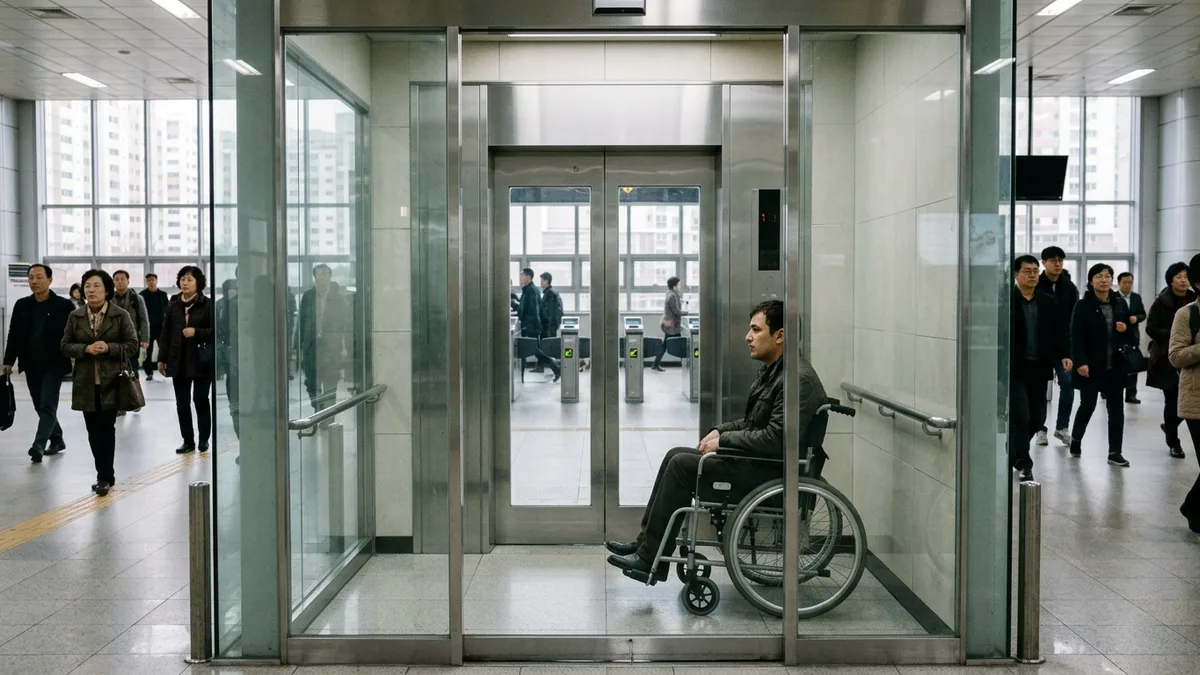
Subways — the terms permit strollers by name
On the subway, the anxiety of "am I even allowed to bring this on?" is settled by a single line in the terms. Article 36 of Seoul Metro's passenger transport terms (Restrictions on Carry-On Items) prohibits bringing aboard items whose combined dimensions reach 158 cm or more, or that exceed 32 kg in weight — and then immediately adds this proviso.
Note: "Provided, that wheelchairs, strollers, and folding bicycles in a folded state may be brought aboard" — Seoul Metro Passenger Transport Terms (Lines 1–8), Article 36, as amended 2026-03-07, Regulation No. 577.
Read the provision closely and you'll see folding bicycles carry the condition "in a folded state," while strollers carry no such condition. In other words, the terms contain no requirement that strollers alone be folded. That said, on-site instructions during rush hour can vary with conditions at the station, so avoiding the busiest times makes life easier for everyone.
Moving around inside the station is fine too. Article 6, Subparagraph 18 of the terms lists riding on something to move about within station premises and inside trains as a prohibited act, but then states "provided, that wheelchairs and strollers are excepted." Pushing a stroller from the fare gates to the platform is behavior the terms specifically carve out.
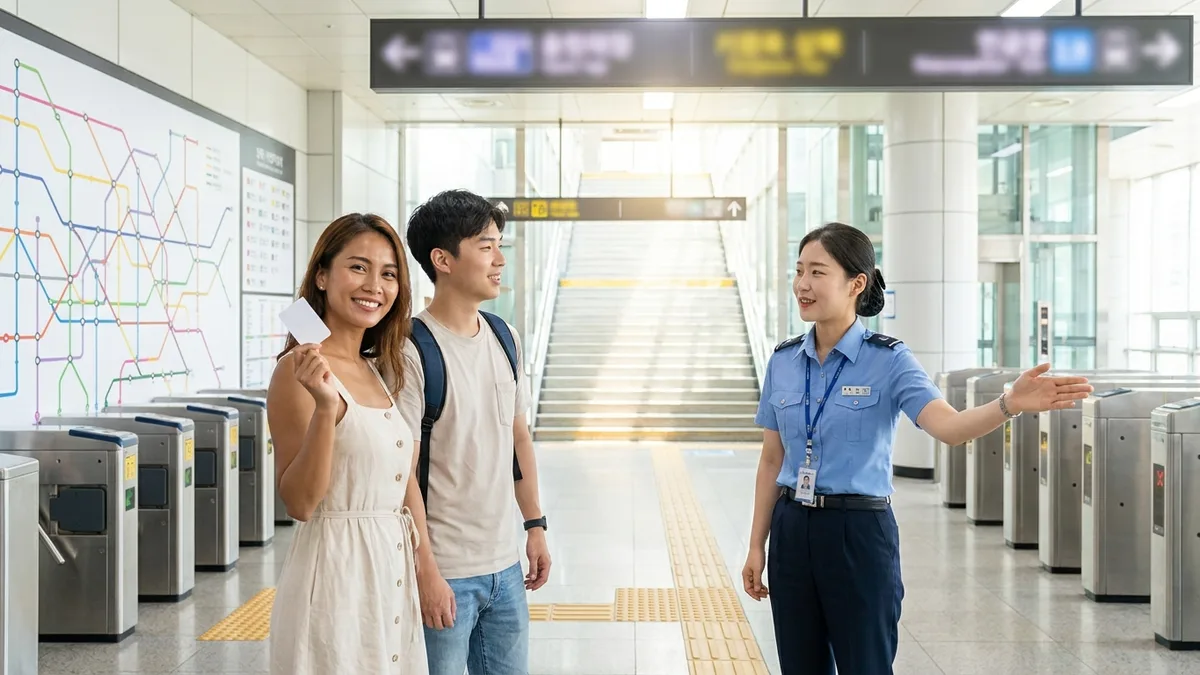
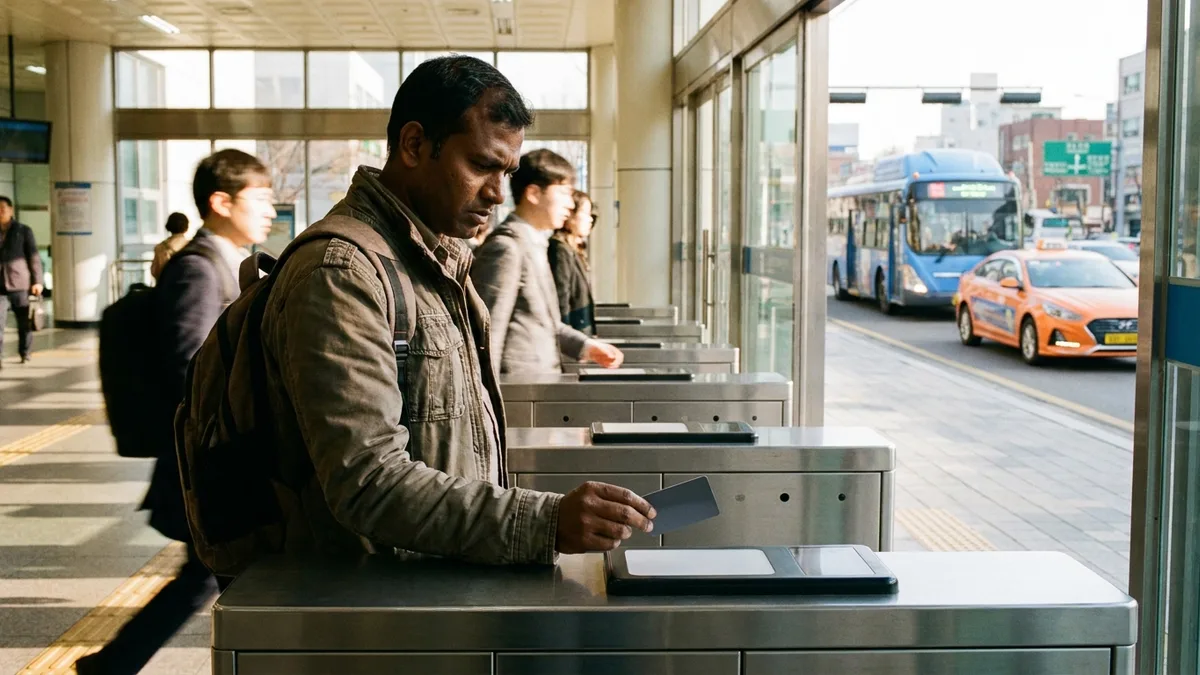
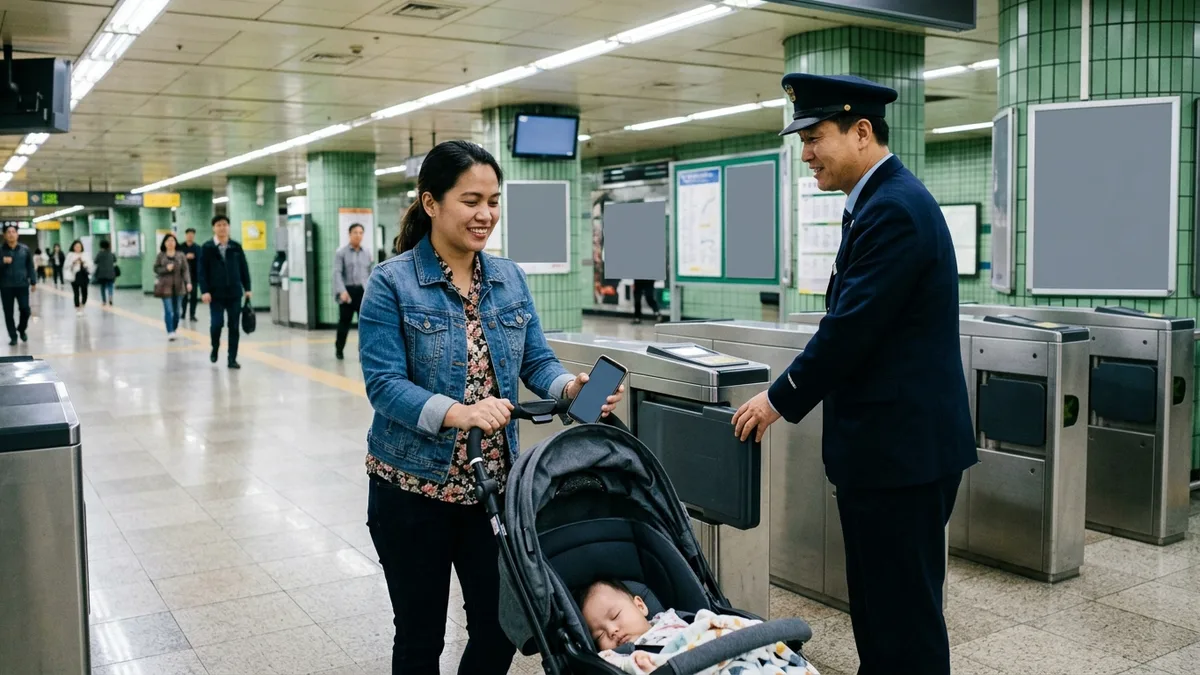
When you pass the fare gates, use the wide accessible gate at the far end of the row or beside the station office, and the stroller rolls straight through. You tap your card exactly as at a regular gate; the doors just open wider. For riding the Seoul subway in general, see The Complete Seoul Subway Guide.
Tip: On the platform, front wheels dropping into the gap between the train and the platform edge is a common accident. Push the stroller in lifting the front wheels first, and always lock the brake once you're on board. Curved platforms have wider gaps, so glance down at your feet before you board.
"100% elevator coverage" may not be about the station you're using
On December 29, 2025, the city of Seoul held a ceremony at Kkachisan Station on Line 5 to announce that Seoul Metro had completed "one step-free route per station" at all 338 stations it operates. That means you can get from a street-level entrance to the platform by elevator alone, with no stairs, and about 175.1 billion won has gone into 79 aging stations since 2008. But this "100%" is limited to sections operated by Seoul Metro — stations operated by Korail (Korea Railroad Corporation) are excluded.
This is where foreign parents most often get it wrong, because a route map doesn't show you which agency runs what. Article 5, Subparagraph 6 of the terms limits the "Seoul Metro section" on Line 1 to "Seoul Station (underground) to Cheongnyangni (underground)," on Line 3 to Jichuk–Ogeum, and on Line 4 to Jinjeop–Namtaeryeong. Even on the same navy-blue Line 1, the stretches running down toward Incheon or Suwon are operated by other agencies.
| Line | Total stations | Stations operated by Seoul Metro | Section included in the "one step-free route per station" announcement |
|---|---|---|---|
| Line 1 | 102 | 10 | Underground section, Seoul Station–Cheongnyangni |
| Line 3 | 44 | 34 | Jichuk–Ogeum |
| Line 4 | 51 | 26 | Jinjeop–Namtaeryeong |
| Lines 2, 5, 6, 7, 8 | — | The sections defined in Article 5, Subparagraph 6 of the terms | Line 2 City Hall–via Wangsimni–City Hall (loop), Sinseol-dong–Seongsu, Sindorim–Kkachisan; Line 5 Banghwa–Macheon, Gangdong–Hanam Geomdansan; Line 6 Eungam–Sinnae; Line 7 Jangam–Onsu; Line 8 Byeollae–Moran |
Take Line 1: only 10 of its 102 stations fall under that announcement. For the rest, you have to check elevator routes separately. As for how far Korail-operated wide-area rail stations have gotten with one step-free route per station, we were unable to confirm any figure in this research, so if you're using a station on a Korail section, it's safest to check that station's facility information yourself before you set out.
Caution: Take "every station on the Seoul subway has an elevator" at face value and you'll get burned on Lines 1, 3, and 4. When you're choosing your destination station, first check the station information in Naver Map or KakaoMap, or the station map, for which exit number has an elevator — and write that exit number down.
Buses — this is where you get blocked most
With buses, two things go wrong at once. One is the vehicle, and the other is a gap in the rules.
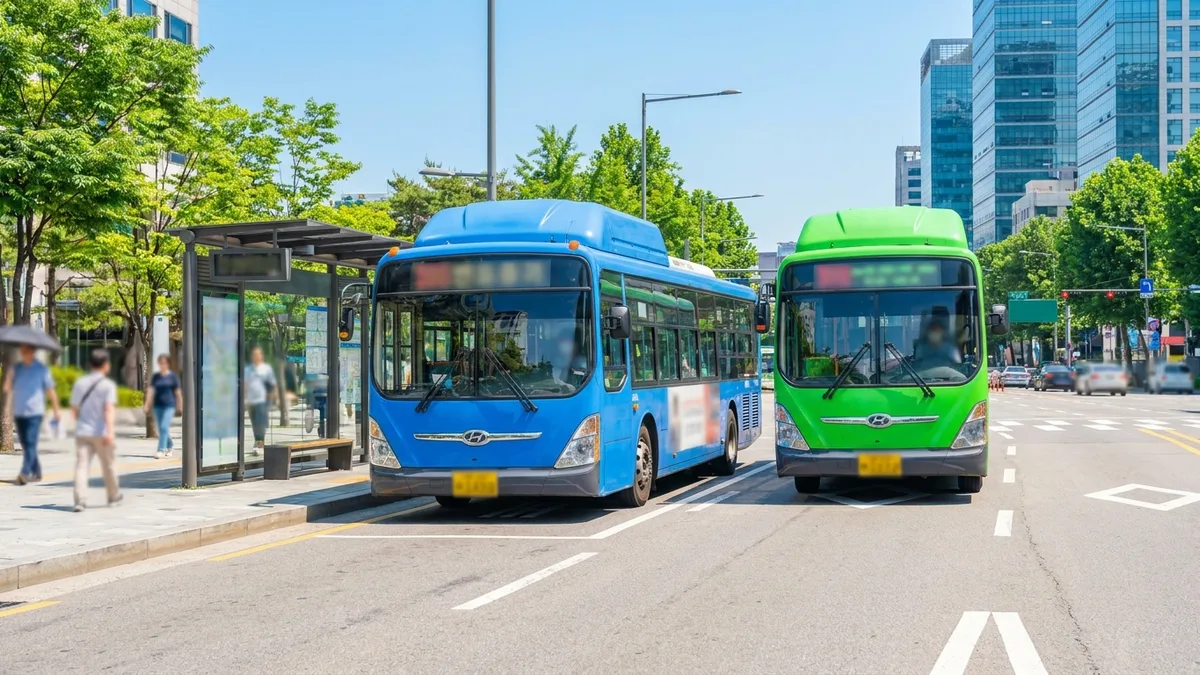
Start with the vehicle. To load a stroller without folding it, a step-free low-floor bus has to show up — and the supply rate varies enormously by bus type. According to Seoul's "Bus Status" statistics as of January 2026, city buses number 7,383 licensed vehicles of which 5,439 are low-floor (about 73.6%), while village buses number 1,626 of which 318 are low-floor (about 19.5%). This is a single-source figure, so read it together with its reference month.
That gap isn't unique to Seoul. The Ministry of Land, Infrastructure and Transport's own 2026 low-floor bus adoption targets are set differently — 62% for city buses and 49% for village buses. Village buses are placed behind from the policy-target stage onward.
The second issue is the gap in the rules. Article 26(1), Subparagraph 1 of the Passenger Transport Service Act provides that transport service employees must not "refuse to allow a passenger to board without justifiable grounds, or make a passenger get off partway." But this provision doesn't address strollers explicitly. Gyeonggi Province's standard terms for city bus transport services say only that "boarding may be restricted for persons carrying items that obstruct passage," and make no exception for strollers.
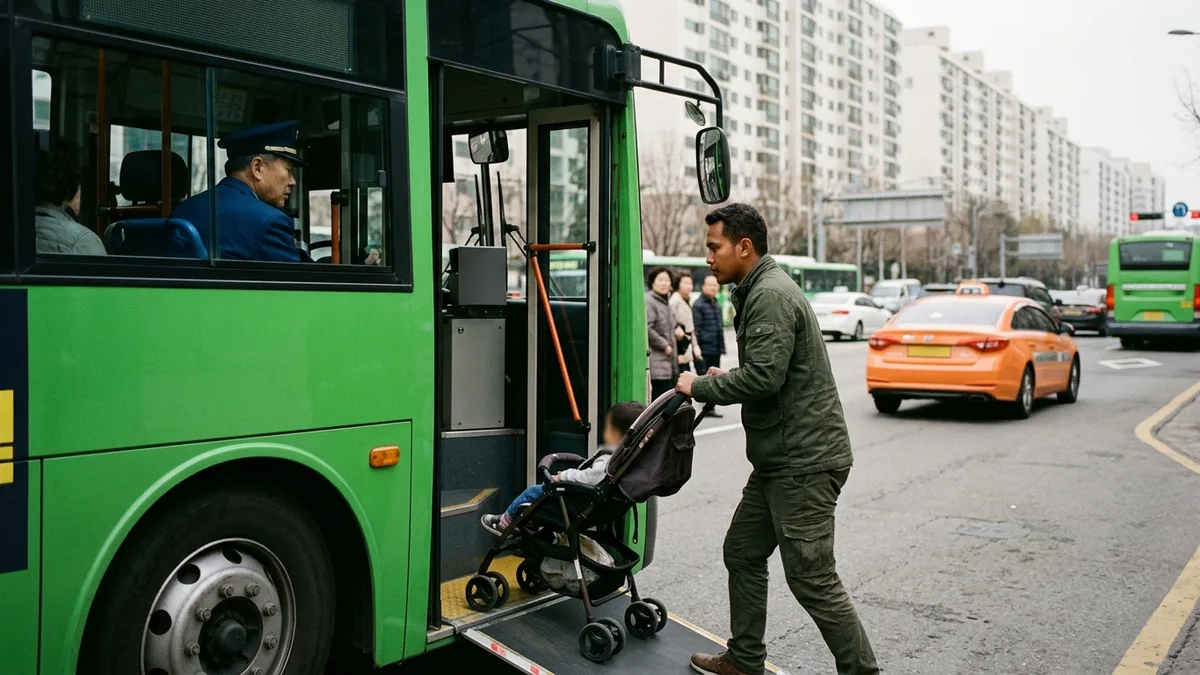
Caution: You can't flatly claim that "refusing a stroller is illegal and carries an administrative fine." In the August 2025 Suwon case, Suwon answered that there is no stroller exception clause, and Seoul answered that it has no authority to impose administrative fines. Insisting "this is illegal" on the spot can just escalate the dispute while leaving you with nothing to cite. Rather than arguing with the driver, waiting for the next low-floor bus or switching modes is the realistic move.
If you absolutely have to take a bus within Seoul, there's the option of an advance reservation for a low-floor bus. Book through Seoul's "Seoul Donghaeng Map" app and, when a bus arrives near the stop you reserved at, the reservation details are passed to the driver, who then prepares for boarding and makes an announcement. The language problem with this app, though, we'll come back to below.
Plan your route with village buses left out of the math
The routes map apps recommend mix city buses and village buses together. But as we saw above, as of January 2026 in Seoul, the low-floor share for village buses is about 19.5%. That means four out of every five are vehicles with steps.
Korean parents glance at the number and the color and filter them out — "oh, that's a village bus" — but foreign parents end up waiting at the stop holding a stroller and then watching the bus go by. In practice it's easier to work it out like this.
- Green neighborhood loop routes with short numbers of roughly two digits are likely village buses. How to read numbers and colors is covered in How to Read Korean Bus Numbers and Colors
- For village bus segments, it takes less time to swap them out from the start for subway + walking, or a taxi
- For places only village buses reach, like a destination up a hill, budget for taxis both ways
- If you're prepared to fold the stroller and carry it on, you'll have to fold it while holding your child — so moving the trip to a day when you have a second adult along is another option
No official standard has been confirmed on whether you must fold a stroller inside a city bus or may board with it open. Assume the driver's instructions can vary with the vehicle and how crowded it is, and if your stroller folds, treating "fold it" as the default causes the least friction.
Taxis — understanding the car seat question through the statutes
In many home countries car seats are mandatory in taxis too, so plenty of people are thrown just by the fact that Korean taxis don't have them. Once you understand how the provisions are structured, the picture clears up.
Article 50(1) of the Road Traffic Act requires a driver to wear a seat belt and to "ensure that passengers in all seats also wear seat belts (in the case of infants and toddlers, this means the seat belt after a child protection device has been installed)." That's the principle. But a proviso in the same paragraph opens an exception for "cases where grounds prescribed by Ordinance of the Ministry of the Interior and Safety exist."
That Ordinance of the Ministry of the Interior and Safety is Article 31 of the Enforcement Rule of the Road Traffic Act. Subparagraph 8 lists, as grounds for non-use of a seat belt, the case where the driver of a vehicle used for passenger transport business has instructed the passenger to buckle up and the passenger nonetheless does not. Looking at how the provision is built, this is a liability exemption for the driver.
Caution: What has been confirmed here is only two things — the principle in Article 50(1) that a child protection device must be used, and the driver's exemption under Article 31, Subparagraph 8 of the Enforcement Rule. No provision expressly stating that "taxis have no obligation to carry car seats" was confirmed in this research. So don't conclude either that "taxis are exempt from car seats" or that "carrying a child without a car seat is illegal" — and if you need certainty, check directly with the taxi division of the local government with jurisdiction.
In practice, here's how a lot of people handle it. Folding the stroller into the trunk is the default, but a large stroller sometimes won't fit in a mid-size taxi's trunk. So people call a 5- or 6-seat van (large taxi) and load the stroller into the rear space as is. The cargo area is roomy enough to take a stroller and a suitcase together. For taxis refusing passengers, Article 26(1), Subparagraph 1 of the Passenger Transport Service Act, which we saw earlier, applies just the same.
Clearing the way with apps — this is exactly where foreigners get stuck
Seoul's "Seoul Donghaeng Map" is an app for mobility-disadvantaged users that officially launched on November 1, 2024. It targets wheelchair and stroller users, offering route guidance that accounts for level differences, slopes, sidewalk width, and elevators, and it's also where the low-floor bus advance reservations we saw earlier are made. As far as we could confirm, it's the only official app that plans routes on a stroller basis.
Open its Google Play store page (package kr.go.seoul.mydata, developer Seoul Metropolitan Government) in English (en_US), though, and the app name and description still appear only in Korean (confirmed 2026-08-25). Seoul's official press releases likewise make no mention of multilingual or English support. We were not able to verify on a physical device whether the in-app screens and route guidance are offered in multiple languages, so we'd suggest checking the language on the store page before you install. The sign-up methods are also based on a 2024 press release, so current procedures need to be reconfirmed.
Things are better on the subway side. Seoul Metro's "TTOTA Subway" app went through about a month of pilot operation starting May 15, 2026, and was revamped into a four-language system — Korean, English, Chinese, and Japanese. It applies automatically based on your smartphone's language setting, and unsupported languages default to English. That said, whether elevator locations and accessible-route guidance are included in those four languages isn't spelled out in the press release, so it needs confirmation.
| App | What it offers for stroller travel | Languages | Where it trips you up |
|---|---|---|---|
| Seoul Donghaeng Map | Stroller-based route guidance, low-floor bus advance reservation | Korean only, even on the English Google Play page (confirmed 2026-08-25) | Whether the in-app screens are multilingual has not been confirmed |
| TTOTA Subway | Subway announcements and delay information | Korean, English, Chinese, Japanese (2026-05 revamp) | Whether accessible-route guidance is included is unconfirmed |
| KakaoT | Taxi and large taxi hailing | English supported | Korean phone verification and a domestic payment method are often required |
| LACHA | Taxi and large taxi (5–6 seats) hailing, KTX and express bus booking, transit cards | English and other languages | Doesn't handle city buses or village buses |
So here's the summary. Stroller route guidance lives in a Korean-only app, and multilingual support lives in apps that have nothing to do with strollers. That leaves foreign parents stitching three things together by hand: plan the route in a map app, confirm by eye at the stop whether the bus is low-floor, and switch to a taxi when you're blocked.
Fares — infants ride free, up to three per accompanying adult
"Where do I buy a ticket for the baby?" is the question that comes up most often right in front of the fare gates. The answer is that you don't need to buy one.
Article 10(1), Subparagraph 1 of Seoul Metro's passenger transport terms defines an infant as "a person under 6 years of age," and provides that when an infant travels alone, when the number of infants accompanied by one guardian exceeds three (for those in excess), and when infants travel as a group, they are treated as children. The widely circulated explanation of "two per guardian" is a different figure from what the terms actually say.
As for fares, Article 12(4) sets infants as free (100% discount), and the proviso to Article 23(4) excludes infants from the obligation to issue a complimentary single-journey ticket to those entitled to free travel. In other words, no ticket is issued for the baby to tag in the first place. The guardian just tags their own card and the child goes through with them.
| Category | Criteria | Fare | Ticket |
|---|---|---|---|
| Infant | Under 6 years old, up to 3 accompanied by one guardian | Free (100% discount) | Excluded from complimentary single-journey ticket issuance |
| From the 4th infant onward | When infants accompanied by one guardian exceed three | Child fare | Child ticket |
| Traveling alone or in a group | When an infant rides alone or as part of a group | Child fare | Child ticket |
| Child | 6 years old and above | Child discount | Requires a dedicated transit card + age registration |
The moment your child turns 6, the story changes. A child transit card doesn't apply the discount automatically just because you bought it — you have to register the age at a convenience store or the station office. Skip the registration and the adult fare comes straight out. Whether foreign children can be registered, and what documents are needed, varies by retailer, so it's safest to check with the retailer where you buy the card or with T-money customer service in advance. Handling card problems in general is covered in Solving Transit Card Loss and Balance Problems.
Important: The terms above are based on Seoul Metro sections. Other regional urban railways such as Busan, Daegu, and Incheon have their own separate passenger transport terms, so the number of infants who ride free and the rules on bringing strollers aboard may differ. If you're traveling with a child outside Seoul, please check that operator's terms once.
In the end, the option left for stroller routes is the taxi
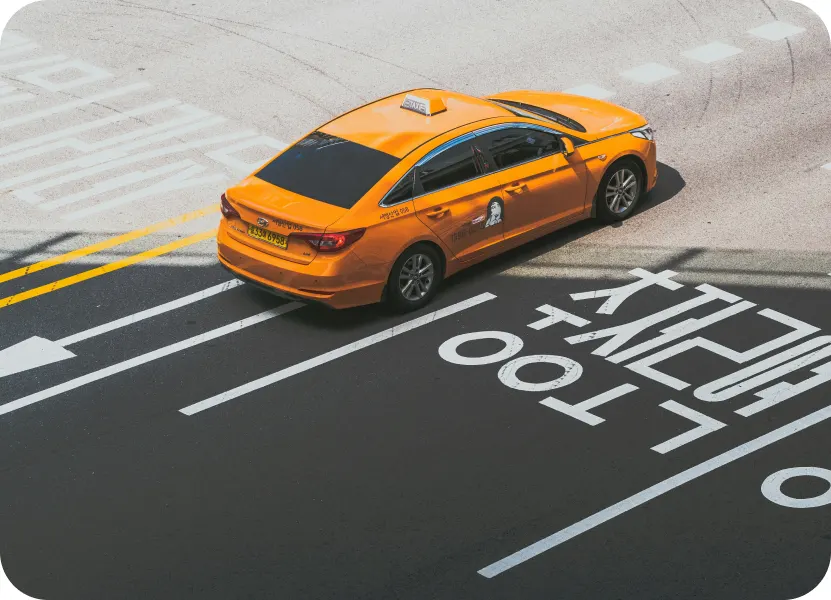
Put everything we've seen together and it converges on one conclusion. The subway's terms recognize strollers, but the elevator route can break down on Korail sections; city buses require a low-floor bus to show up; and village buses are effectively out of the math. That's why you end up needing a plan to switch to a taxi wherever you get blocked — and here, foreigners without a Korean phone number or bank account run into the wall again. Hailing apps demand identity verification, or the overseas card gets rejected at the payment step.
LACHA is a transportation and payment super app for foreigners that you can start using right away without identity verification. It's designed so that identity confirmation isn't required under its formal process, which means you can hail taxis, book KTX and express bus tickets, and use transit cards without a Korean bank account or phone number, and you pay with overseas payment services like Alipay and WeChat Pay. On days when you have to fit both a stroller and luggage, you can choose to hail a 5- or 6-seat van (large taxi). If you're planning intercity travel by KTX, children under 6 ride free when they don't occupy a seat and sit with a guardian, so you only need to buy one seat — the differences between classes are covered in KTX Seat Classes and Refund Rules. Do note that LACHA doesn't handle city buses or village buses, so you'll still need to check for low-floor buses using the methods above.
Want to get a taxi without a Korean phone number? Check out LACHA.
Built to work without a Korean phone number or bank account, with overseas payment methods like Alipay, WeChat Pay, and Apple Pay. Taxi hailing plus KTX, express bus, and airport railroad (AREX) booking — all in one app.
Up to 60% off Korea transit with a coupon (max ₩3,000): enter code at sign-up. KTX gets up to 18% off on top
Download now


Frequently Asked Questions (FAQ)
Q1. Can I board the subway without folding my stroller? Article 36 of Seoul Metro's passenger transport terms prohibits bringing aboard items with combined dimensions of 158 cm or more or over 32 kg, but writes strollers in as an exception: "Provided, that wheelchairs, strollers, and folding bicycles in a folded state may be brought aboard." Only folding bicycles carry the condition "in a folded state"; strollers carry no such condition. Pushing one through the station isn't a prohibited act either, since Article 6, Subparagraph 18 makes wheelchairs and strollers an exception. That said, on-site instructions during peak hours can vary with conditions at the station.
Q2. Where do I buy a ticket for the baby? What do I tag at the gate? There's nothing to buy and nothing to tag. Article 12(4) of the terms sets infants under 6 as free (100% discount), and the proviso to Article 23(4) excludes infants from complimentary single-journey ticket issuance, so no ticket is issued for the baby at all. The guardian tags their own card and goes through together with the child. Free travel covers up to three infants accompanied by one guardian; from the fourth onward it's the child fare. Urban railways outside Seoul may have different terms, so check that agency's guidance.
Q3. What do I do if a bus driver refuses to let my stroller on? Article 26(1), Subparagraph 1 of the Passenger Transport Service Act prohibits refusing boarding without justifiable grounds, but that provision doesn't address strollers explicitly. In the August 2025 Suwon case, Suwon answered that there is no stroller exception clause, and Seoul answered that it has no authority to impose administrative fines. In short, your grounds for claiming "this is illegal" on the spot are weak. Rather than arguing, waiting for the next low-floor bus or switching to a taxi is the realistic move, and if the problem repeats, there's the route of filing a complaint with the bus company and the transportation department of the local government with jurisdiction.
Q4. The taxi has no car seat — can I just hold my baby? Article 50(1) of the Road Traffic Act requires that passengers who are infants or toddlers wear a seat belt after a child protection device has been installed, with a proviso allowing exceptions on grounds prescribed by Ordinance of the Ministry of the Interior and Safety. Article 31, Subparagraph 8 of that Enforcement Rule lists the case where the driver of a vehicle used for passenger transport business has instructed the passenger to buckle up and the passenger does not — and this is a liability exemption for the driver. No provision expressly stating that "taxis have no obligation to carry car seats" was confirmed in this research, so don't treat it as settled; if you need certainty, check with the taxi division of the local government with jurisdiction.
Q5. Does every station on the Seoul subway have an elevator? The "100% coverage of one step-free route per station" that Seoul announced on December 29, 2025 is limited to the 338 stations operated by Seoul Metro, and excludes stations operated by Korail. On Line 1 only 10 of 102 stations, on Line 3 only 34 of 44, and on Line 4 only 26 of 51 are Seoul Metro sections. You can't tell them apart from the colors on the route map, so if you're using a station on a Korail section, check in advance which exit has an elevator using the station information in a map app or the station map. Figures on coverage for Korail sections could not be confirmed.
Note: This article is intended to provide general information. The provisions, terms, and figures in the text are values confirmed as of 2026-08 from the Korea Law Information Center of the Ministry of Government Legislation (the Act on Promotion of Transportation Convenience of Mobility Disadvantaged Persons, the Passenger Transport Service Act, the Road Traffic Act and its Enforcement Rule), Seoul Metro's passenger transport terms (Lines 1–8, as amended 2026-03-07), and publicly released Seoul city data. The low-floor bus supply rate is a single source as of January 2026 in Seoul, and some items — the scope of multilingual support in the apps, the low-floor bus reservation procedure, elevator status on Korail sections — could not be confirmed and are marked as unconfirmed. Statutes and terms get amended, and fares, supply rates, and app features change, so please confirm again with each operator's official guidance before you travel. LACHA does not operate or sell tickets for city buses or village buses.