The GTX-A weekday base fare is 3,200 KRW for an adult paying by transit card. The metropolitan subway base fare at the same point in time is 1,550 KRW, so that is about 2.06 times as much. But this 3,200 KRW is not a fare you racked up by traveling far. Open the operator's official fare table and you will see a "GTX separate base fare" of 1,650 KRW stacked on top of the "metropolitan express railway base fare" of 1,550 KRW. Whether you ride one stop or ten, the moment you pass through a GTX fare gate, that 1,650 KRW is charged first.
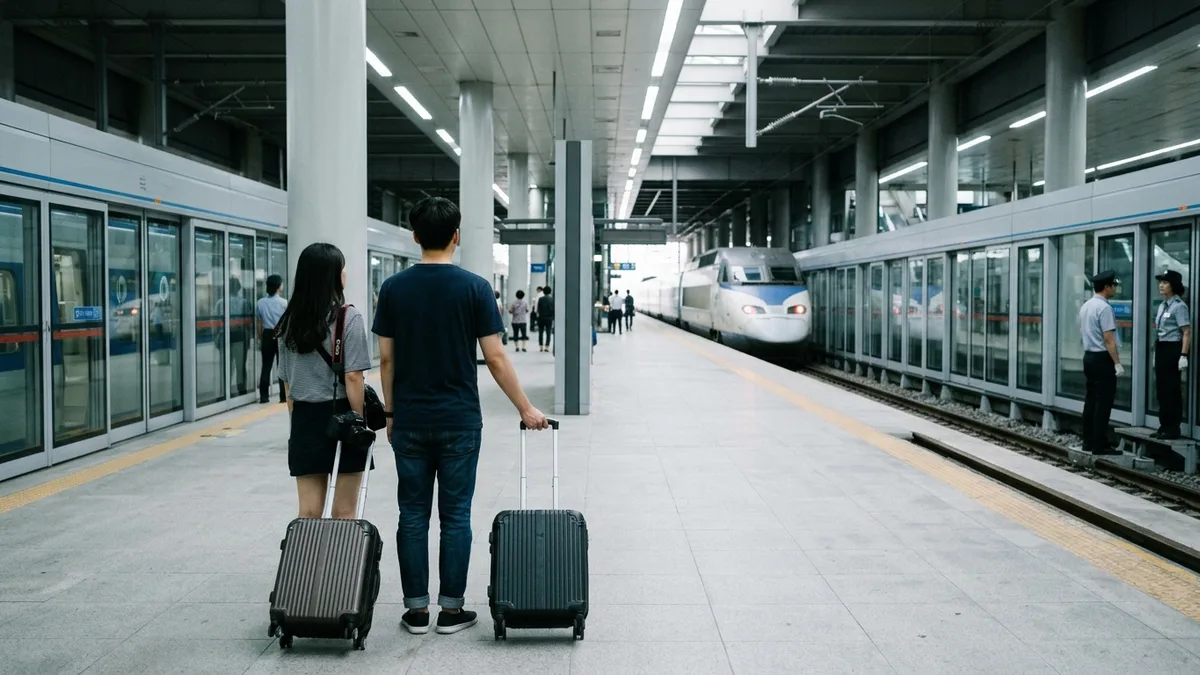
The second thing to know is the line itself. As of August 2026, GTX-A runs as two sections — "Unjeong Jungang–Seoul Station" and "Suseo–Dongtan" — that are not connected to each other. The stretch in between, Seoul Station–Suseo (13.7 km, with a single intermediate station at Samseong), has not opened yet. So right now you cannot reach Samseong Station by GTX-A, and you cannot ride straight through from Paju to Dongtan.
Third, there is no foreign-language channel where you can verify any of this. The operator's official website (gtx-a.com) is Korean-only. The document declares just lang="ko", strings like "English" or "multilingual" appear zero times on the page, and /eng/ and /en/ addresses all return 404 (checked 2026-08-25). The fare table, the timetable, and the passenger transport terms exist only in Korean. So every number and rule below comes only from what we verified in those Korean originals, down to the article number.
Note: The GTX-A route maps on Naver Map and Google Maps are drawn as one continuous line from Unjeong Jungang to Dongtan. But the actual trains are cut off between Seoul Station and Suseo Station. If you plan a "one ride on GTX" itinerary based on the map alone, you will end up stopping at Seoul Station or Suseo Station.
First things first — as of August 2026, GTX-A is in two pieces
Operator SG Rail's official station information page still has two tabs. It is split into "Unjeong Jungang Station–Seoul Station" and "Suseo Station–Dongtan Station," and Samseong Station is not on the list of served stations. Timetables are also provided separately by section, and the most recent notice (2026-08-24) was a schedule change announcement covering only the "Suseo–Dongtan" section.
The two sections even opened at different times. The southern Suseo–Dongtan section opened first in March 2024, and the northern Unjeong Jungang–Seoul Station section opened on December 28, 2024. Only the Seoul Station–Suseo section in the middle remains.
The reasons for the delay on this middle section have already been reported repeatedly in the Korean press. The target opening slipped once from the end of June 2026 to August, and then it was delayed again after missing rebar was confirmed in 50 of the 80 columns on the GTX platform on basement level 5 of Samseong Station. As of June 2026, the Ministry of Land, Infrastructure and Transport stated that "from safety inspections through revenue test operation, at least four to five months are needed, and opening in mid-August is not a feasible schedule."
As of this writing (2026-08), we could not find a confirmed announcement of a new opening date. Since Seoul City and the Ministry of Land, Infrastructure and Transport had differing outlooks, please re-check SG Rail's notices and the Ministry's announcements before you plan your travel. Only one thing is certain right now — the two sections are still not connected.
In practical travel terms, it works out like this.
- If you board GTX at Unjeong, KINTEX, Daegok, or Yeonsinnae, the terminus is Seoul Station. From there you have to switch to the subway or a taxi.
- If you board GTX at Seongnam, Guseong, or Dongtan, the terminus is Suseo Station. To go deeper into central Seoul, transfer to Line 3 or the Suin-Bundang Line.
- If you booked lodging in Gangnam or Samseong-dong, GTX alone will not get you there. You have to continue from Seoul Station or Suseo Station by another mode.
The real reason the fare is double the subway — the 1,650 KRW "separate base fare"
The GTX-A fare table has two layers. The table below breaks it down (adult rates).
| Category | Weekday | Weekend |
|---|---|---|
| Metropolitan express railway base fare | 1,550 KRW | 1,550 KRW |
| GTX separate base fare | 1,650 KRW | 1,300 KRW |
| Total (prepaid/postpaid transit card) | 3,200 KRW | 2,850 KRW |
| Single-journey transit card | 3,300 KRW | 2,950 KRW |
| Single-journey deposit | 500 KRW (refunded on return) | 500 KRW (refunded on return) |
The lower layer, 1,550 KRW, is the same amount as the subway base fare. The upper layer, 1,650 KRW, is the portion charged only on GTX. So the truth behind "GTX costs twice as much as the subway" is not distance or speed — it is this one line item, the separate base fare.
On weekends, that separate base fare drops from 1,650 KRW to 1,300 KRW. That makes the weekend adult fare 2,850 KRW, which is 350 KRW cheaper than on weekdays. The supporting provision is Article 11(2)2 of the GTX-A Passenger Transport Terms.
Tip: The weekend discount is not calculated as "a percentage of the total fare." Only the separate base fare is reduced, so it is more accurate to simply read the fixed amounts printed in the fare table.
What you will actually pay — section fares and distance surcharges
The distance-based fare stacked on top of the base fare also has two layers. On GTX-A sections, once your travel distance exceeds 10 km, 250 KRW per adult is added for every 5 km, and that 250 KRW is itself the sum of a 100 KRW metropolitan express railway distance surcharge and a 150 KRW separate distance surcharge (Terms, Article 10(1)2).
Here are the official section fares. All are adult, weekday, prepaid/postpaid transit card rates.
| Section | Distance | Weekday adult fare |
|---|---|---|
| Suseo–Dongtan | 32.8 km | 4,450 KRW |
| Suseo–Guseong | 21.6 km | 3,950 KRW |
| Suseo–Seongnam | 10.6 km | 3,450 KRW |
| Unjeong Jungang–Seoul Station | — | 4,450 KRW |
| Unjeong Jungang–Yeonsinnae | — | 3,950 KRW |
| Daegok–Seoul Station | — | 3,700 KRW |
| Yeonsinnae–Seoul Station | — | 3,200 KRW |
Look at the bottom row. Yeonsinnae–Seoul Station is 3,200 KRW, exactly the base fare. That means no distance surcharge is applied at all on that section. Conversely, end to end on each section (Suseo–Dongtan and Unjeong Jungang–Seoul Station) both come to the same 4,450 KRW.
Transfer discounts apply — but only halfway. Calculation rules and tagging conditions
The first rule anyone learns about Korean public transit is the integrated transfer discount: switch from bus to subway and you only pay the base fare once. On GTX, that rule only half applies.
Article 10(4) of the Terms states that when transferring between GTX-A and urban rail or buses, the separate base fare is added only once. In other words, even if you transfer several times, you are not charged 1,650 KRW twice. But flip that around: if you ride GTX even once, that 1,650 KRW is always charged. That is why someone who has only been riding the subway suddenly sees an extra 1,650 KRW deducted the moment they transfer to GTX, and why a whole trip comes to at least 3,200 KRW. It is not a card malfunction or an over-deduction.
The remaining calculation rules break down like this.
- Up to four transfers are recognized, and a single trip can include up to five boardings in total (Terms, Article 10(3)).
- You must board the next mode within 30 minutes of alighting from the previous one. However, from 21:00 to 07:00 the next day, the window is one hour.
- If the combined transfer distance is within 30 km for wide-area buses, or within 10 km for other buses and urban rail, the fare is calculated at the highest fare among the modes used. Beyond that, a distance surcharge is added for every 5 km, but never exceeding the total you would pay for each mode separately (Terms, Article 10(2)2 and 3).
- Integrated fares apply "only where a transit card is tapped on the terminal at both boarding and alighting for each mode so that the travel distance can be calculated" (Terms, Article 10(2), proviso). If you skip the exit tap, the transfer discount calculation does not happen at all.
If Seoul's subway and bus transfer rules are new to you, read How to Get Subway and Bus Transfer Discounts first — this section will make far more sense afterward.
Note: We could not verify whether the separate base fare is charged once or twice if you ride GTX on the northern section, take the subway from Seoul Station, and then board GTX again at Suseo. The Terms say it is "added only once," but it is not clear whether that provision contemplates riding GTX twice. If you are planning this route, please check with SG Rail's customer center (1551-2979) first.
Three things that stop you at the fare gate — balance, single-journey tickets, and tagging
Article 12 of the Terms recognizes prepaid cards, postpaid cards, single-journey tickets, and transit cards approved by the company for use on GTX-A sections. The catch is that which one you are holding changes what happens at the gate.
First, the prepaid card minimum balance. Article 13(3) of the Terms requires "a balance of at least the metropolitan express railway base fare" to board GTX. What matters is that the Terms define the minimum with that phrase rather than a set amount. The amount listed on the "metropolitan express railway base fare" line of the fare table is 1,550 KRW, but which amount the gate actually uses to open or close has not been confirmed in official guidance. What is certain is that when your balance is short, you are blocked by the minimum balance rule, not by insufficient fare, and the signage alone makes that hard to figure out. On top of that, even if you just clear the minimum and get in, the GTX fare is at least 3,200 KRW for a weekday adult, so you will not be able to exit because the fare is short. In that case, top up at a transit card charging machine inside the station and then exit (Terms, Article 19(2)). So it is safest to load at least the 3,200 KRW weekday adult fare before you ride, and if you need the exact minimum amount, check with SG Rail's customer center (1551-2979).
Second, a GTX single-journey ticket is a different thing from a subway single-journey ticket. The names are the same, which makes it easy to mix them up, but the official ticket guidance states flatly that "transfer discounts with other modes of transport are not available," and Article 12-2(2) of the Terms specifies that single-journey tickets can be used only on GTX-A sections.
| Item | Prepaid/postpaid transit card | Single-journey transit card |
|---|---|---|
| Weekday adult fare | 3,200 KRW | 3,300 KRW |
| Weekend adult fare | 2,850 KRW | 2,950 KRW |
| Deposit | None | 500 KRW (return to the refund machine after exiting) |
| Transfer discount with other modes | Applies if you meet the tagging conditions | Not available |
| Use outside GTX-A sections | Yes | No |
| Condition for boarding | Balance of at least the metropolitan express railway base fare (prepaid; 3,200 KRW or more recommended) | Choose your destination and insert fare + deposit |
Third, time and tagging. A ticket is valid for up to five hours after entry, and if you exceed five hours you must pay that ticket's base fare again (Terms, Article 14(2) and (4)). If you exit through the automatic fare gates mid-journey and re-enter, you pay the fare anew (Article 15(2)).
Note: Which payment methods the single-journey ticket machines accept could not be confirmed — the official guidance only says "insert the fare and deposit." The same goes for whether overseas-issued cards work. It is safer to carry a little cash, or to ride with a transit card you have topped up in advance. For the differences between transit card types, see T-money vs. WOWPASS vs. Climate Card Comparison.
Walls that only foreigners hit — Climate Card, Modu Card, and senior discounts
From here on are items that are rarely a problem for Korean users.
| Card/program | On GTX-A | Where foreigners get stuck |
|---|---|---|
| Climate Card | Excluded | Even with an unlimited Seoul pass, the GTX gate will not open |
| Modu Card (formerly K-Pass) | Eligible for rebates | Sign-up requires an alien registration number, and you need 15+ rides a month to get money back |
| Prepaid transit card | Accepted as a ticket | If the balance is below the metropolitan express railway base fare, you cannot even board (3,200 KRW or more recommended) |
| Single-journey transit card | GTX-A sections only | No transfer discount |
| Concession (senior) transit card | Issued by Shinhan Bank | The ID list in the Terms does not include the alien registration card |
Seoul City's official guidance lists the Shinbundang Line, GTX, subways outside the Seoul area, wide-area buses, airport buses, and buses licensed in other regions as excluded from the Climate Card. That means a pass used by a substantial share of foreign residents in Seoul is entirely invalid on GTX.
Conversely, Modu Card (formerly K-Pass) does cover GTX for rebates. The official guidance explicitly states that "only usage of buses (including wide-area buses), urban and metropolitan rail (including the Shinbundang Line and GTX), and the Airport Railroad is eligible for rebates." That said, payouts are made only in months with 15 or more rides between the 1st and the last day of the month, and the sign-up process is described as requiring an alien registration number. Sign-up requirements and the refund process are laid out in detail in Modu Card (K-Pass) Guide for Foreigners.
Senior discounts are a bit murkier. Article 17(1)2(a) of the Terms lists only three IDs to present when staff request one from a concession transit card user: the resident registration card, the overseas Korean resident registration card, and the driver's license. The alien registration card is not on that list. Eligibility is also defined as "a person aged 65 or older subject to the Welfare of Senior Citizens Act." That is not enough to conclude flatly that foreigners aged 65+ cannot receive the discount, but if you are asked to verify on the spot with an ID that is not on the list, there is a good chance you will be blocked. If this applies to you, check in advance with the card issuer, Shinhan Bank, or with SG Rail.
Note: Budgeting for GTX with a subway-fare mindset will throw you off. The metropolitan subway fare system is covered separately in The Complete Seoul Subway Guide, but it is more accurate to think of GTX as a separate calculation with the separate base fare stacked on top of that system.
When you board the wrong train or miss your stop — how to avoid the penalty fare
Let's start with the most expensive mistake. If you board without a ticket, or enter past the fare gates without tapping in, or in the other cases specified in the Terms, you must pay the single-journey ticket fare for the section traveled plus a penalty fare of 30 times that amount (GTX-A Passenger Transport Terms, Article 20(1)). However, under the proviso to that same article, if you report the unavoidable circumstance to staff in advance and it is accepted, you pay only the single-journey ticket fare. That word "in advance" is everything.
If your boarding station cannot be identified, you are treated as having boarded at the station with the longest fare-calculation distance on the GTX-A network (Article 20(2)). That provision is why a missed tap results in such a big charge.
Here is how to handle each situation.
- You tapped in and headed the wrong direction — Report it in advance and staff will guide you back in through the correct side (Article 21(2)).
- You realize the mistake right after exiting the gate — With a prepaid or postpaid card, if you tap in again at the same station with the same card within 10 minutes of exiting, the base fare is waived once. In exchange, one transfer is deducted from your count (Article 21(3), proviso).
- You picked the wrong destination on a single-journey ticket — Use the "transit card fare adjustment/charging machine" in the station, or have a station attendant correct the destination and pay the difference (official ticket guidance; Terms, Article 19(3)).
- You traveled beyond the section shown on your single-journey ticket — Pay the difference between the printed section and the section you actually rode at your arrival station.
The real wall for foreign travelers here is not the rules but the fact that every one of these procedures happens face to face, in Korean. The fare adjustment machine screens and staff assistance are all Korean by default. If you push through the gate without knowing the procedure, you trigger the penalty-fare grounds above — so when you get stuck, calling a staff member right there is far cheaper.
Tip: If language becomes the barrier, pull these sentences up on your screen and show them. "목적지를 잘못 선택했습니다. 정산 부탁드립니다." (I chose the wrong destination. Please adjust my fare.) / "반대 방향으로 탔습니다. 다시 들어가도 될까요?" (I went the wrong direction. May I re-enter?) The very fact that you reported it first is the condition in the proviso to Article 20(1).
After you get off the GTX — continuing from Seoul, Suseo, and Dongtan Stations
A GTX trip almost always ends in a transfer. With the two sections disconnected and Samseong Station not yet open, deciding in advance what you will take next is essentially mandatory.
Seoul Station is the terminus of the northern section and also where KTX and the Airport Railroad meet. Riding GTX from Unjeong, KINTEX, Daegok, or Yeonsinnae to Seoul Station and then heading to the provinces by KTX, or to Incheon Airport on the Airport Railroad, is a natural route. How to book train tickets without a Korean bank account or phone number is covered in KTX Booking Without a Korean Card.
Suseo Station is the terminus of the southern section and the departure point for the Suseo-origin high-speed trains. You can come up from Dongtan, Guseong, or Seongnam and transfer straight onto a high-speed train. To go deeper into central Seoul, take Line 3 or the Suin-Bundang Line.
Dongtan Station is the far end of the southern section. If your destination from here is toward Hwaseong or Osan, you will need a city bus or taxi, and since notices about schedule changes on the southern GTX section due to high-speed train adjustments go up frequently, it is worth checking the official notices once before you head out.
LACHA is a transit and payment super app for foreigners that you can use right away without identity verification. It is designed so that no identity verification is required under the formal procedures, so you can book KTX and express buses, hail taxis, ride the Airport Railroad, and use a transit card all in one app, without a Korean bank account or phone number. GTX itself is not covered, but the KTX and Airport Railroad bookings that continue from Seoul Station, and taxi hails to Gangnam and Samseong-dong where GTX does not reach, can all be handled here.
Want to search and book KTX and express buses in one app? Check out LACHA.
Built to work without a Korean phone number or bank account, with overseas payment methods like Alipay, WeChat Pay, and Apple Pay. Taxi hailing plus KTX, express bus, and airport railroad (AREX) booking — all in one app.
Up to 60% off Korea transit with a coupon (max ₩3,000): enter code at sign-up. KTX gets up to 18% off on top
Download now


Frequently Asked Questions (FAQ)
Q1. Can I ride GTX-A straight through from Paju Unjeong to Dongtan? No. As of August 2026, GTX-A operates as two separate sections, "Unjeong Jungang–Seoul Station" and "Suseo–Dongtan," and the Seoul Station–Suseo stretch between them (13.7 km) has not opened yet. Samseong Station is also not on the list of served stations, so you cannot get there by GTX. Even though map apps draw it as one continuous line, it is not a through service. You have to travel from Seoul Station to Suseo by subway or taxi and board again, and please re-check the opening date in SG Rail's notices.
Q2. I transferred from the subway to GTX and 1,650 KRW extra was deducted. Is that an error? It is most likely a normal deduction. On GTX-A, a "separate base fare" of 1,650 KRW (weekday adult) is charged on top of the 1,550 KRW subway base fare. Under Article 10(4) of the Terms, this separate base fare is added only once even when you transfer, but conversely, it is always charged if you ride GTX even once. That is why 1,650 KRW extra comes off the moment you transfer, and why a whole trip starts at a minimum of 3,200 KRW for a weekday adult. Beyond 10 km, another 250 KRW is added for every 5 km.
Q3. My card has a balance but the fare gate will not open. What Article 13(3) of the Terms requires is "a balance of at least the metropolitan express railway base fare." The Terms define the minimum with that phrase rather than a specific amount, and which amount actually opens the gate has not been confirmed in official guidance. Either way, when your balance is short, you are being blocked by the minimum balance rule, not by an insufficient fare, so the signage alone makes the cause hard to identify. And even if you clear the minimum and ride, you cannot exit if the fare comes up short, so it is safest to load at least the 3,200 KRW weekday adult fare. If you are already inside, top up at a charging machine in the station and then exit.
Q4. Can I save on GTX fares with the Climate Card or Modu Card? The Climate Card cannot be used — GTX is on Seoul City's official list of exclusions. Modu Card (formerly K-Pass), on the other hand, does cover GTX for rebates and genuinely lowers your cost, but sign-up requires an alien registration number and you need 15 or more rides a month to get money back. In short, neither program is realistic for a short-term visitor.
Q5. I picked the wrong destination, or I missed my stop. What should I do? Do not just push through the fare gate. Article 20(1) of the Terms imposes the single-journey ticket fare plus a penalty fare of 30 times that amount if you board without a ticket or enter without tapping in, but the proviso to that same article lets you pay only the single-journey ticket fare if you report it to staff in advance and it is accepted. With a single-journey ticket, use the "transit card fare adjustment/charging machine" or have a station attendant correct the destination and pay the difference; with a prepaid or postpaid card, if you tap in again at the same station with the same card within 10 minutes of exiting, the base fare is waived once (Article 21(3), proviso).
Reference: The fares, sections, and rules in this article were verified as of 2026-08 against SG Rail's official GTX-A fare system, ticket guidance, and station information, the GTX-A Passenger Transport Terms, the Seoul Metropolitan Government's Climate Card guidance, and the official Modu Card rebate guidance. The opening date of the Seoul Station–Suseo middle section, the actual minimum balance amount for prepaid cards, the payment methods accepted by single-journey ticket machines, first and last train times and headways, and how the separate base fare is aggregated when riding GTX twice could not be confirmed in official sources, so no figures for those are given here. Fares, operating sections, and schedules are subject to change, so please re-check gtx-a.com notices and SG Rail's customer center (1551-2979) before you ride. LACHA does not book or operate GTX.