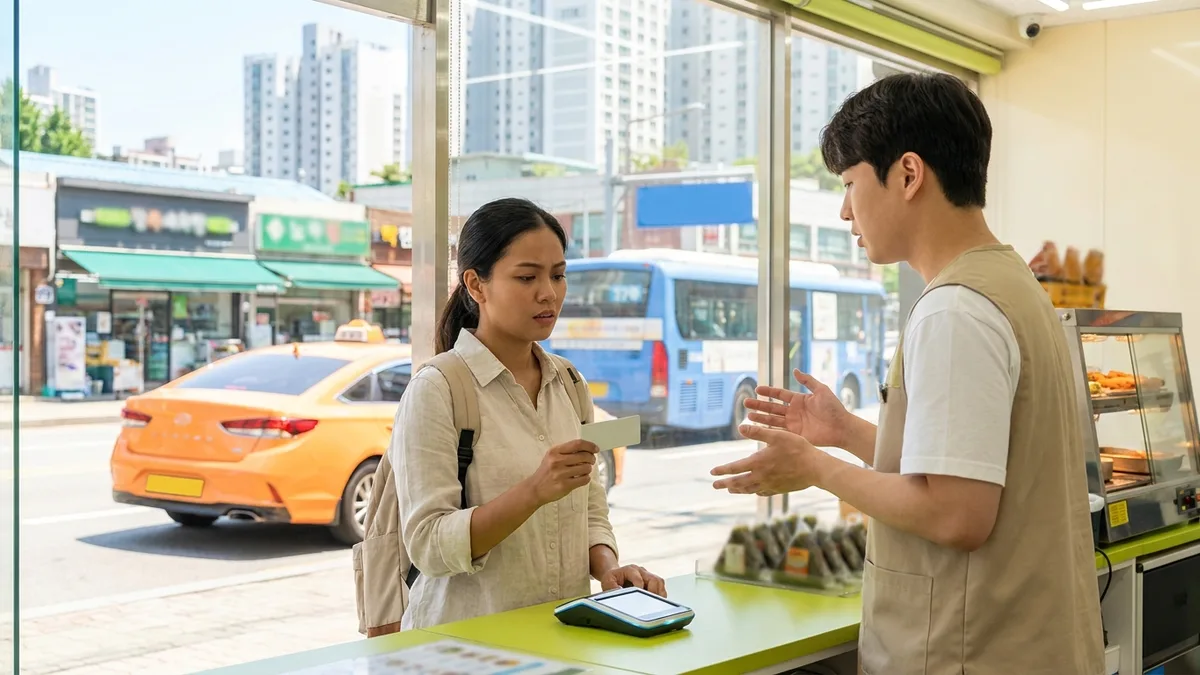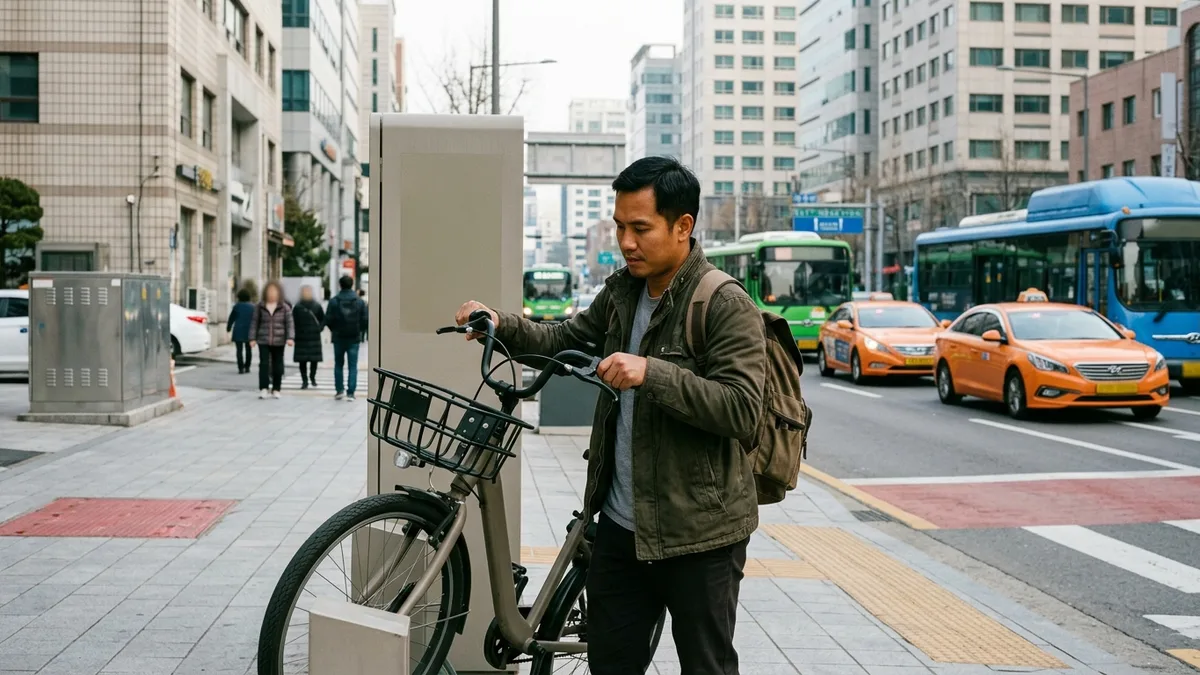
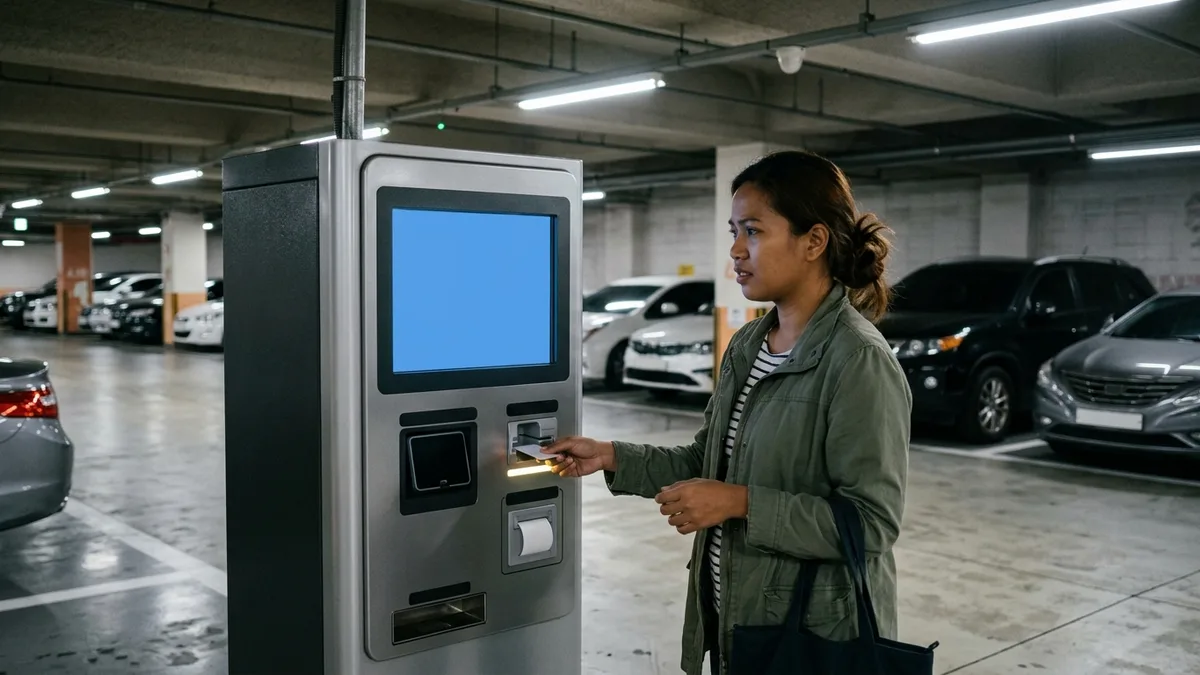
The automated unmanned public parking lots run by Seoul Facilities Corporation don't accept cash. The official FAQ states flatly that "payment is only possible by credit card, transit card, or Zero Pay." If all you have in your wallet is cash, you literally can't get your car out — your only remaining option is to press the "call" button on the exit kiosk and talk to an attendant. That conversation happens in Korean.
There's a trap in the opposite direction too. Some municipal public parking lots take only cash and refuse cards, and complaints about it have made the news. Which means neither "just bring a card" nor "just bring cash" works nationwide.
Fee structures are also designed differently from city to city. Seoul charges in 5-minute increments with no blanket daily cap across its lots, while Busan charges in 10-minute increments and sets a daily cap by rate zone. Even looking only at lots directly operated by Seoul Facilities Corporation, under the very same "public parking lot" sign, zone 3 runs 1,560 KRW per hour while zone 1 runs 8,400 KRW — a gap of more than five times.
Below, we'll go through payment methods first, then the rate zone concept, Seoul and Busan rate tables, Incheon and Gimpo airport parking, parking violation fines, and finally a 5-minute checklist to run before you park.
Note: The rates and fines in this article are values verified on each operator's official pages as of 2026-08. Parking rates are set by district ordinances and by individual lot notices, so they differ even within the same city and are revised often. Please re-check the information board at the lot before you park.
No Card, No Exit — What Unmanned Kiosks Accept and What They Don't
Here's the exact wording in the Seoul Facilities Corporation public parking FAQ: "Payment is only possible by credit card, transit card, or Zero Pay, though at some lots we help you use methods such as mobile phone payment." Cash payment simply isn't on the list of options.
Why does this become a real incident specifically for foreign visitors? Because the place where it blows up is right in front of the exit gate. Cars are backed up behind you, and in front of you is an intercom that speaks Korean. It's not a problem of not knowing the fee — it's a problem of having no way to pay it, which is why it can't be solved on the spot.
The Korea Tourism Organization's official English driving guide warns foreign drivers about this separately. It notes that "cash is rarely accepted at unmanned garages," and advises preparing a prepaid IC card for foreigners in advance so you don't get stuck.
| Where you pay | Accepted payment methods | Cash |
|---|---|---|
| Seoul Facilities Corporation unmanned public lots | Credit card, transit card, Zero Pay (some support mobile phone payment) | Not accepted — press the "call" button at the exit to speak with an attendant |
| Incheon Airport unmanned kiosks | Prepaid/postpaid cards, credit cards, transit cards | Not accepted |
| Incheon Airport staffed booths | Cash, prepaid/postpaid cards, credit cards, transit cards, Hi-Pass (transactions of 50,000 KRW or less) | Accepted |
| Some municipal public parking lots | Mostly cash — there have been reported complaints about lots refusing cards | Accepted |
We won't make a definitive claim in this article about whether a card issued overseas will go through an unmanned kiosk. Seoul Facilities Corporation's guidance just says "credit card" without distinguishing domestic from foreign issuance, and there's no official data or statistics on actual approval rates. The best we can say based on current evidence is: don't rely on a single card. For what to do when a card is declined in the first place, see What to Do When Your Overseas Card Is Declined in Korea.
Warning: If payment fails and you just drive through the gate, it gets far more expensive. Article 9 of the Parking Lot Act allows a surcharge of up to four times the parking fee for unpaid on-street parking fees, as set by ordinance, and Seoul Facilities Corporation does in fact charge four times. The process runs: on-site notice (attached to the windshield, 7 days to pay) → first mailed notice (15 days) → second notice (15 days, with reminder and seizure warning) → re-notice for returned mail → request for seizure of the vehicle or real estate.
Look at the Rate Zone, Not the Sign — Why the Same "Public Parking Lot" Can Cost 5x More
Public parking rates in Korea are divided by "rate zone" (급지). The more central the area — where land values and demand are high — the closer it is to zone 1; the farther out you go, the more likely it's zone 3 or 4, and rates are published by zone. The concept doesn't translate cleanly, but what actually determines the price isn't the name of the lot — it's this zone.
For lots directly operated by Seoul Facilities Corporation, the base rate ceiling per 5 minutes is 700 KRW for zone 1, 430 KRW for zone 2, and 130 KRW for zone 3. Converted to hourly, that's 8,400 KRW for zone 1 and 1,560 KRW for zone 3 — about a 5.4x difference. If you see the same "public parking lot" sign and assume the rates will be similar, your budget goes off the rails within a day.
On top of that come surcharges and discounts.
- Vehicle size surcharge — Mid-size vehicles pay 200% of the base rate, large vehicles 300%. If your rental is a van, you need to calculate 2–3 times the numbers in the table.
- Fine dust seasonal management surcharge — From December through March, emission grade 5 vehicles pay an additional 50% of the base rate, for 150% total.
- Discounts — Under Seoul Facilities Corporation rules, people with disabilities and wounded national merit recipients get 80% off; transfers, light cars, low-emission vehicles, and single-parent families get 50%; distinguished military service families and war veterans get 20%.
Tip: Don't pick a lot based only on your destination's address — check the rate zone first. For the price of three hours in a downtown zone 1 lot, parking one stop out in a zone 3 lot and taking the subway in is often far cheaper.
Seoul Public Parking Rates — Actual Published Rates in Gangnam-gu and Jung-gu, and How the 5-Minute Math Works
Even within Seoul, there are separate rate tables depending on whether the operator is the district office or Seoul Facilities Corporation. Here's how the actual published rates break down.
| Operator | Zone 1 | Zone 2 | Zone 3 | Zone 4 |
|---|---|---|---|---|
| Seoul Facilities Corporation, direct (ceiling) | 700 KRW / 5 min (8,400 KRW/hr) | 430 KRW / 5 min | 130 KRW / 5 min (1,560 KRW/hr) | — |
| Gangnam-gu (same for on-street and off-street) | 400 KRW / 5 min (4,800 KRW/hr) | 300 KRW / 5 min | 200 KRW / 5 min | 100 KRW / 5 min |
| Jung-gu, on-street | 500 KRW / 5 min | 250 KRW / 5 min | 150 KRW / 5 min | — |
| Jung-gu, off-street | 450 KRW / 5 min | 300 KRW / 5 min | 200 KRW / 5 min | — |
| Jung-gu, City Hall area district 1 | 600 KRW / 5 min (7,200 KRW/hr) | — | — | — |
The math is simple: the per-5-minute rate × 12 = the hourly rate. Park 2 hours 30 minutes in a Gangnam-gu zone 1 lot and that's 30 five-minute blocks, so 400 KRW × 30 = 12,000 KRW. Park 90 minutes in the Jung-gu City Hall area district 1 and it's 600 KRW × 18 = 10,800 KRW.
The 5-minute increment matters more than you'd think. "Let's stay just 10 more minutes" costs 1,200 KRW in Jung-gu district 1, and the 30 minutes it takes to drink a coffee runs 3,600 KRW. Estimating with hourly rates will leave you off from the actual charge.
📌 Note: The Seoul Facilities Corporation figures of 700, 430, and 130 KRW above are ceilings per zone. Within the same zone, individual lots have different published rates, so the accurate approach is to check that specific lot's rate on its entrance information board or on the operator's page.
Seoul Has No Daily Cap — 48 Hours Cost One Driver 144,000 KRW
The basic structure of the rate table for Seoul Facilities Corporation's directly operated lots is an increment "per 5 minutes." There is no daily cap applied uniformly across all lots. Whether you park for 12 hours or 48, the meter keeps climbing every 5 minutes.
Some lots do have a separate daily rate (24 hours from entry), but only certain off-street lots, and those amounts aren't low either: 50,400 KRW at the Seoul Global Center, 39,600 KRW at Hullyeonwon Park, 31,600 KRW at Jamsil Station. "There's a daily rate" does not mean "it's cheap."
There's a reported real-world case, too. A user who parked 48 hours at the Sadang Station public parking lot — a zone 2 lot at 250 KRW per 5 minutes, or 3,000 KRW per hour — was charged 144,000 KRW, more than the 130,000 KRW monthly pass for that same lot (reported November 2020). At the time, the city of Seoul responded that reducing vehicles entering the city center and discouraging long-term parking was the intent of the policy.
This structure is deliberate, not an oversight. So the instinct that "how much can a day of parking possibly cost?" doesn't hold up in Seoul. If you plan to park for more than a day, start by checking whether the rate table has a "daily parking rate (24 hours from entry)" line at all. If it doesn't, the per-5-minute rate accumulates all the way through.
For reference, we couldn't confirm from official sources when daily rates were first introduced at some Seoul lots, or how many lots they currently apply to. Checking the individual lot's rate table is the reliable route.
Busan Charges in 10-Minute Blocks and Has a Daily Cap — Change Cities, Change Rules
Busan is designed in exactly the opposite direction from Seoul. Charges are in 10-minute increments, and each rate zone has a daily parking rate cap. The official notices even spell it out: "If the amount exceeds the daily parking rate, the daily parking rate is collected."
| Rate zone | Per 10 min | Hourly equivalent | Daily parking rate |
|---|---|---|---|
| Zone 1 (A) | 700 KRW | 4,200 KRW | 21,000 KRW |
| Zone 1 (B) | 500 KRW | 3,000 KRW | 15,000 KRW |
| Zone 2 | 300 KRW | 1,800 KRW | 8,000 KRW |
| Zone 3 | 200 KRW | 1,200 KRW | 4,700 KRW |
| Zone 4 | 100 KRW | 600 KRW | 2,400 KRW |
Here's how big the gap gets. Seoul's zone 2 Sadang Station lot is 3,000 KRW per hour, so 24 hours would be 72,000 KRW (half of the reported 144,000 KRW for 48 hours) — while in Busan, a zone 2 lot stops at 8,000 KRW. Same "zone 2 public parking lot," and the daily cost differs by nearly nine times.
There's also a time-of-day split. Busan public parking lots divide the day into daytime (08:00–20:00) and nighttime (20:00–08:00 the next day), and monthly passes come in separate day and night versions. In other words, people who park only at night and people who park only during the day are on different rate systems.
Warning: The Busan rates above are the figures on which the official guidance from two district offices — Jung-gu and Dong-gu — agrees. However, we couldn't verify against the original ordinance appendix whether this table applies uniformly across all of Busan. It may differ by district or facilities corporation, so re-check the guidance at the lot where you park. If you're driving your own car from Seoul to Busan, just remembering that the two cities' rules run in opposite directions will keep your budget from going badly wrong.
Airport Parking — Incheon Ignores the Day of the Week, Gimpo Doesn't
Airport parking rules differ by airport. Incheon makes no distinction at all for weekdays or public holidays, while Gimpo charges differently on weekdays versus weekends and holidays.
| Category | Base | Additional | Daily (24 hr) |
|---|---|---|---|
| Incheon short-term lot (small vehicles) | First 10 min free → 1,200 KRW for 30 min | 600 KRW per 15 min (2,400 KRW/hr) | 24,000 KRW |
| Incheon long-term / reserved lots (small vehicles) | First 10 min free | 1,000 KRW per hour | 9,000 KRW |
| Gimpo, small vehicles | 1,000 KRW for 30 min | 500 KRW per 15 min beyond 30 min | Weekdays (Mon–Thu) 20,000 KRW / weekends and holidays 30,000 KRW |
| Gimpo, large vehicles | 1,200 KRW for 30 min | 400 KRW per 10 min | 40,000 KRW (regardless of day) |
At Incheon, the gap between short-term and long-term grows the longer your trip. Park five days and it's 45,000 KRW in the long-term lot versus 120,000 KRW in the short-term lot — a 75,000 KRW difference. Unless you're just dropping off luggage for a few minutes, the long-term or reserved lot is the default choice.
The reserved lot has set conditions. You can book online from 45 days before your scheduled entry time up to 4 hours before, and the parking period must be at least 1 day and less than 30 days. Large vehicles 2.8m or taller can't use it.
There are discounts as well. Incheon Airport applies a 50% discount for light cars, people with disabilities, wounded national merit recipients, May 18 Democratic Movement merit recipients, patients with Agent Orange aftereffects, multi-child households (2 or more children with the youngest 18 or under), and low-emission vehicle classes 1 and 2; low-emission class 3 gets 20%. Note that the automatic multi-child discount requires prior registration on the website, so showing up with your kids in the car won't get it applied. We couldn't confirm from official guidance what procedure a foreign family follows for this prior registration, so it's safest to check directly with the airport corporation.
Warning: Incheon Airport parking rates have been frozen since 2016 (as of 2026-08). The airport corporation announced in March 2026 that it is reviewing an increase in consultation with the Ministry of Land, Infrastructure and Transport, and the new rates haven't been released yet. The background is that the share of passengers arriving by private car rose from 36% in 2019 to 45.2%. Check the official page for current rates before you leave.
At Gimpo Airport, payment methods are another variable. Korea Airports Corporation's Gimpo parking guidance has no payment method section at all, so there's no basis for assuming it works the same way as Incheon. It's safest to bring both a card and cash. Routes from Gimpo into the city are covered in the Gimpo Airport Transportation Guide, and your options from Incheon are in How to Get from Incheon Airport to Seoul.
One more thing. Gimpo's daily rate is listed as "weekdays (Mon–Thu)" versus "weekends and holidays," but the notice doesn't specify which side Friday falls on. If you're flying out on a Friday, check with airport parking information first. Substitute holidays for Lunar New Year and Chuseok are also easy to miss if you don't follow the Korean calendar.
Where Not to Park, and the Fines — The 40,000 / 80,000 / 120,000 KRW Split
Sometimes those five minutes you "just" parked turn into an administrative fine. For passenger cars and cargo vehicles of 4 tons or less, the amounts break down like this.
- General parking/stopping violation — 40,000 KRW.
- Within 5m of a fire hydrant, senior protection zones, disabled protection zones — 80,000 KRW, double.
- School zones — 120,000 KRW. The alleys near schools count here.
- Vans and cargo vehicles over 4 tons — 50,000 / 90,000 / 130,000 KRW respectively, in the same order.
The legal basis is Article 160(3) of the Road Traffic Act. The general parking/stopping violation amount appears in Appendix 6 of that act's Enforcement Decree (criteria for imposing administrative fines), while the increased amounts for school zones and senior/disabled protection zones appear in the proviso to Article 88(4) of the same decree and in Appendix 7 (the school zone increase applies to violations between 8 a.m. and 8 p.m.). We couldn't verify the 80,000 KRW figure for within 5m of a fire hydrant in those two appendices, so it's based on the parking enforcement fine guidance from Incheon Yeonsu-gu Office.
Disabled-only parking spaces are covered by separate law. Parking there without a parking permit sign — or parking with the sign but without a person with a mobility disability in the vehicle — carries an administrative fine of 100,000 KRW. Obstructing the space by stacking objects or blocking the access path carries 500,000 KRW. The basis is Article 17(4) and (5) of the Act on Guarantee of Promotion of Convenience for Persons with Disabilities, the Elderly, Pregnant Women, etc., and Appendix 3 of Article 13 of its Enforcement Decree.
You read where you can park from the color of the curb. The Korea Tourism Organization's official English guide advises that parking is allowed only along white curbs or in on-street parking boxes, and that parking beside yellow curbs or near bus stops is a violation. The same goes for beside crosswalks, next to fire hydrants, and near intersections. The detailed distinctions between yellow dotted, solid, and double lines are grounded in Appendix 6 of the Enforcement Rules of the Road Traffic Act, but we verified that through summary material rather than the original text, so on the ground, prioritize the road markings and signs you actually see.
Warning: You can get an administrative fine even with no enforcement officer present. Under the Safety Report (Anjeon Sinmungo) citizen reporting system, a report is valid with two photos taken at least 1 minute apart at the same location. The license plate must be identifiable and the violation context (safety signs, crosswalk, etc.) must appear in the background. The reporting interval standard was unified nationwide at 1 minute in August 2023. "Nobody's watching, so it's fine" doesn't hold up structurally.
There's a way to save on payment. If you pay voluntarily within the period for submitting an opinion (at least 10 days, given along with the advance notice) after receiving the advance notice, you get a 20% reduction. The basis is Article 18 of the Act on the Regulation of Violations of Public Order and Article 5 of its Enforcement Decree. Conversely, if you miss the payment deadline, a surcharge is added: 3% once the deadline passes, plus 1.2% each month after, up to a maximum of 75% (up to 60 months), according to the guidance.
The problem is that the notice arrives at a Korean address, in Korean. Foreign residents who haven't reported an address change, and travelers who have already left the country, miss the 20% reduction window entirely and get hit with surcharges too. Whether you can look up and pay administrative fines with a foreign registration number on Gov24 or similar, and what authentication methods are required, isn't covered in official guidance — so that remains to be confirmed.
Rental cars add one more path. When a rental vehicle commits a parking violation, the company submits a "request to change the party liable for payment" to the police station covering the renter's residence, transferring liability to the renter. National Assembly data reported in the press showed that the non-payment rate for traffic administrative fines among foreign rental car users was 96.1% in 2023 — roughly four times the average for domestic rental car users (25.8%) — which is the background for why companies hold firm deposits or card charges. For reference, the Ministry of Justice's position is that it does not block a foreign national's departure solely because of unpaid administrative fines (National Human Rights Commission press release, date of publication unknown). For the license requirements you need before renting, see Driver's License Exchange Procedures.
The 5-Minute Checklist Before You Park — Where to Check Rates and How to Back Up Payment
- Check the rate in advance — Seoul's parking information system (parking.seoul.go.kr) shows real-time available spaces and rates without a login. It has no language switch button, though (verified 2026-08), so realistically you'll want to turn on your browser's translation feature.
- Prepare payment in two layers — Bring a credit card, cash, and a transit card with a balance. Bring only one and you'll fall into one of the two opposite traps described above.
- Check the rate zone and whether there's a daily rate — On the entrance information board, look for the rate zone, the per-5-minute (or per-10-minute) rate, and whether a "daily parking rate (24 hours from entry)" line exists. With those three, you can calculate your total.
- Treat private lots separately — Private lots set rates freely and payment methods vary, so check the rate board before you drive in. The gateless exit features in parking apps require pre-registering your license plate and payment method (iParking uses plate number and card number; Kakao T Parking links to Kakao Pay), and we couldn't confirm from official guidance whether foreigners can sign up or register overseas cards.
- Be ready to back in — Per Korea Tourism Organization guidance, nearly every car in Korea backs into parking spaces. It's because spaces are narrow — so if you come from a pull-in parking culture, check whether your rental has a rear camera and sensors when you book.
📌 Note: Free parking at supermarkets and department stores can't be calculated by chain name — each store publishes its own criteria. At paid E-Mart stores, the base rate is 1,000 KRW per 10 minutes with free turnaround within 30 minutes (except the Gangneung store), and free parking scales with purchase amount, from 2 hours for 10,000 KRW and up to 5 hours for 100,000 KRW or more, maxing out at 5 hours. To get automatic validation, though, you have to register your license plate, and that number is stored in your Shinsegae Point member profile (one vehicle per person). Lotte Department Store's Jamsil branch charges 3,000 KRW for the first 30 minutes and 1,000 KRW per 10 minutes after, with 1 hour free for 50,000 KRW in purchases, 2 hours for 100,000 KRW, and 3 hours for 150,000 KRW — and you have to register your receipt at the customer center or a kiosk for it to apply. Other stores have different criteria, so check the page for the store you're visiting; whether membership signup requires Korean-style identity verification isn't confirmed in official guidance.
For long-term residents, parking near home is the real issue, but the guidance for resident-priority parking applications in every district is written solely around Korean resident registration. Whether holders of an alien registration card can apply isn't specified anywhere, so there's no route other than asking your district's facilities management corporation or district office directly.
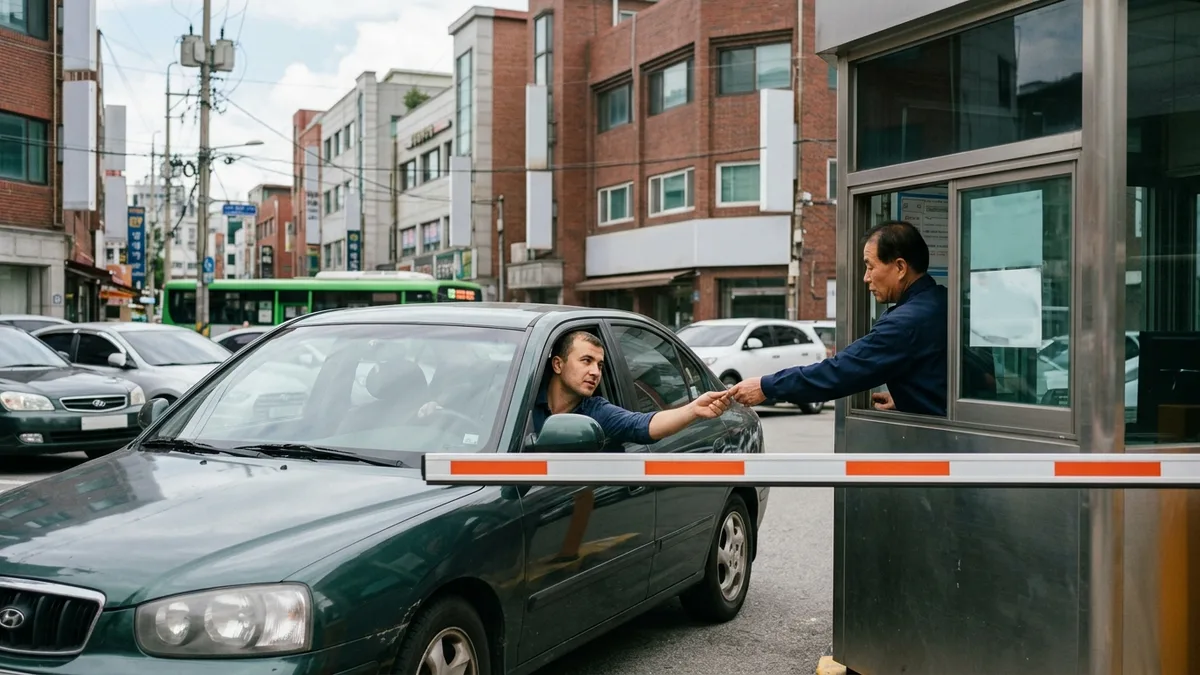
Parking isn't an area LACHA covers. LACHA is an app for the parts of your trip where you leave the car behind — KTX, express buses, taxis, the Airport Railroad, transit cards — so it doesn't offer parking or rental car reservations. That said, in a downtown zone 1 lot at 8,400 KRW per hour with no daily cap, the math often favors parking in a lower-rate zone and coming in by public transit. LACHA is a transportation and payment super app for foreigners that works without identity verification, so you can start with just your passport — no Korean bank account or phone number — and pay with overseas cards or overseas mobile payments like Alipay and WeChat Pay.
Want to search and book KTX and express buses in one app? Check out LACHA.
Built to work without a Korean phone number or bank account, with overseas payment methods like Alipay, WeChat Pay, and Apple Pay. Taxi hailing plus KTX, express bus, and airport railroad (AREX) booking — all in one app.
Up to 60% off Korea transit with a coupon (max ₩3,000): enter code at sign-up. KTX gets up to 18% off on top
Download now


Frequently Asked Questions (FAQ)
Q1. Can I put cash into an unmanned payment kiosk? Not at Seoul Facilities Corporation's automated unmanned public parking lots. The official FAQ states that payment is only by credit card, transit card, or Zero Pay, and to pay in cash you have to press the "call" button on the exit kiosk and speak with an attendant. Incheon Airport also doesn't accept cash at unmanned kiosks — only at staffed booths. Conversely, some municipal public lots take only cash and refuse cards, with complaints reported about it, so bringing both a card and cash is the safe move.
Q2. Can I pay parking fees with a card issued overseas? We can't tell you for certain that it works, or that it doesn't. Seoul Facilities Corporation's guidance just says "credit card" without distinguishing domestic from foreign issuance, and there's no official data or statistics on overseas card approval rates at unmanned kiosks. Payment method mismatches are a known problem — enough that the Korea Tourism Organization's English guide advises preparing a prepaid IC card for foreigners — but there's no guarantee anywhere that a given card will go through at every kiosk. Carrying a card, cash, and a transit card together is the surest preparation for now.
Q3. How much is a full day at a Seoul public parking lot? It depends on the rate zone and the lot, but Seoul Facilities Corporation's directly operated lots have no blanket daily cap, so the per-5-minute rate keeps accumulating. A case reported in November 2020 involved 144,000 KRW charged for 48 hours at the Sadang Station public lot (zone 2, 3,000 KRW per hour) — more than that lot's 130,000 KRW monthly pass. Even where daily rates are set, they run around 50,400 KRW at the Seoul Global Center, 39,600 KRW at Hullyeonwon Park, and 31,600 KRW at Jamsil Station, so they aren't low.
Q4. How much is five days at Incheon Airport? For small vehicles, the long-term and reserved lots are 9,000 KRW per day, so five days is 45,000 KRW; the short-term lot is 24,000 KRW per day, so five days is 120,000 KRW. Incheon has no difference by day of the week or public holiday. The reserved lot can be booked online from 45 days before your scheduled entry time up to 4 hours before, the parking period must be at least 1 day and less than 30 days, and vehicles 2.8m or taller can't use it. Note that these rates are as of 2026-08 and the airport corporation has said it's reviewing an increase, so check again before you travel.
Q5. What happens if I find out about a parking fine late? If you pay voluntarily within the opinion submission period (at least 10 days) after receiving the advance notice, you get a 20% reduction — but the notice arrives at a Korean address in Korean, so this window is easy to miss. Once the payment deadline passes, a 3% surcharge applies plus 1.2% per month, up to a maximum of 75%, according to the guidance. If it was a rental car, the company files a request to change the party liable for payment with the relevant police station and shifts it to the renter. Whether you can look it up and pay on Gov24 with a foreign registration number isn't covered in official guidance, so that needs to be confirmed.
Note: This article is intended as general information. The rates, fines, and rules in the text are values verified as of 2026-08 from Seoul Facilities Corporation, Gangnam-gu Urban Management Corporation, Jung-gu Facilities Management Corporation, Busan's Jung-gu and Dong-gu district offices, Incheon International Airport Corporation, Korea Airports Corporation, Incheon Yeonsu-gu Office, the Ministry of Government Legislation's Easy-to-Find Practical Laws service and the Korean Law Information Center (Road Traffic Act Enforcement Decree Appendices 6 and 7), and the Korea Tourism Organization's English guide. Parking rates are set by district ordinances and individual lot notices and change frequently, and an increase to Incheon Airport rates is under review. Some items (whether Busan's rate zone criteria apply uniformly across all of Busan, Gimpo Airport payment methods, whether alien registration card holders can apply for resident-priority parking, administrative fine lookups on Gov24, and overseas card approval at unmanned kiosks) could not be officially confirmed and have been left flagged as needing verification. Please re-check the lot's information board and the operator's official page both before you park and before you exit. LACHA does not provide parking or rental car services.