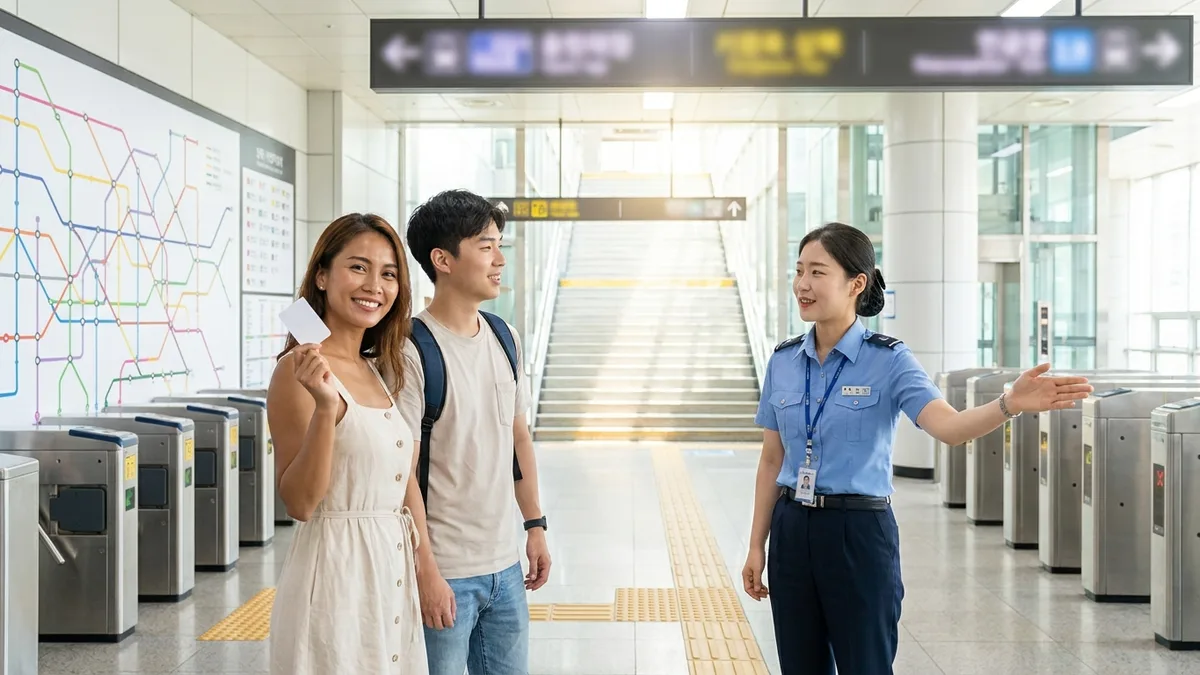
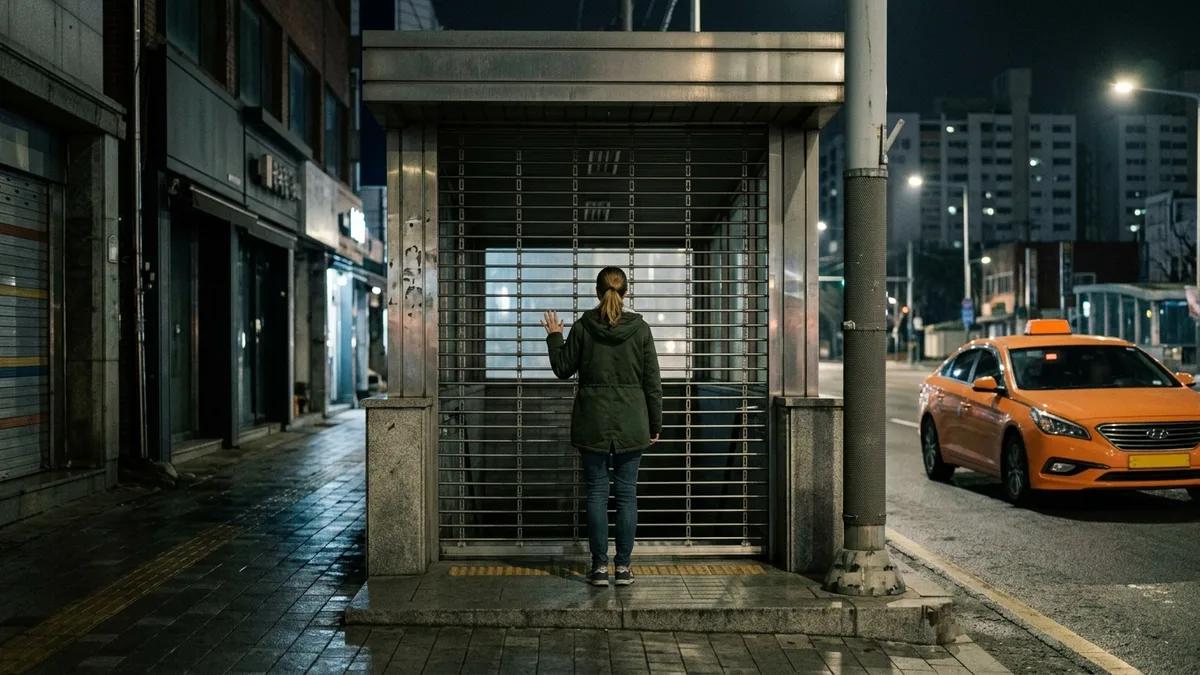
Not a single subway line in Seoul runs through the night. The official English transportation guidance from Seoul's Jung-gu District Office puts it plainly: "The subway operation hours are from 5:30 a.m. to around midnight." From 5:30 a.m. until roughly midnight — that's all of it. And it doesn't stretch later on weekends.
The next wall is trickier. The Seoul Metropolitan Government says it runs late-night-only city buses (Owl Buses) on 14 routes with 140 vehicles, in the 23:00–06:00 time band. Read that line alone and it sounds like there's a bus at 5 a.m. But open the route-by-route operating table on the same page and the last departure from each origin terminal falls between 03:10 and 04:10. "23:00–06:00" is just a label for the time band — the actual buses are all gone by around 4 a.m.
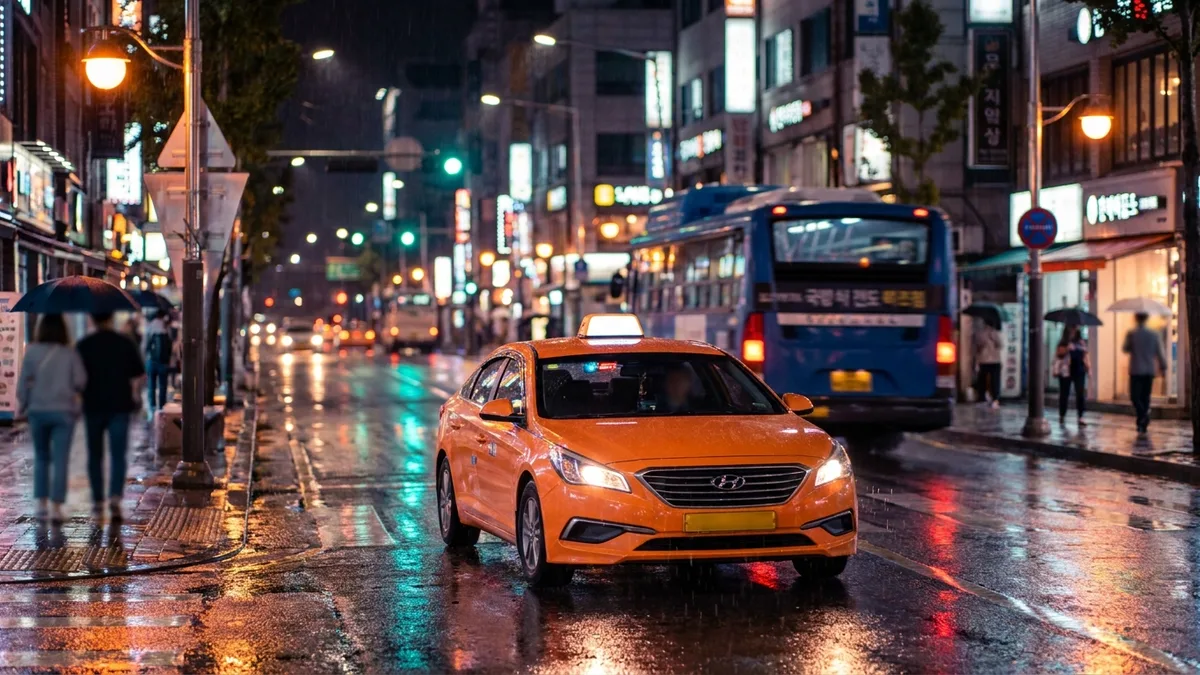
So the real gap isn't midnight. It's the hour and a half or so from 4 a.m. until the first train. The only thing left in that window is a taxi. From 04:00 the late-night surcharge lifts and the daytime base fare of 4,800 won applies, but the fact that there's no alternative stays exactly the same. Ironically, during the hours when the base fare is highest (23:00–02:00, 6,700 won), the late-night buses are still running.
This gap only becomes visible if you read the Korean-language timetables yourself. Map apps just tell you "No route available at this time" — they don't explain why there isn't one, or how long there was one.
Note: The fares, operating times, and route counts below are compiled as of 2026-08 from materials published by the Seoul Metropolitan Government, Seoul Metro, Gyeonggi Bus Information (GBIS), and the Korea Tourism Organization. Public transit fares and timetables get revised and route lineups change, so please re-check each agency's official page before you head out.
First Things First — Seoul Has No 24-Hour Subway
The New York subway runs around the clock, London runs the Night Tube on Friday and Saturday nights, and Berlin's U-Bahn runs all night on weekends. If you come from a city like that, the premise that "the subway stops completely" isn't even in your head. What Koreans never need explained is the very first thing a foreigner has to know.
Let's start by laying out what's still running at each hour. This table is the backbone of the article.
| Time (approx.) | Subway | Owl Bus | Taxi |
|---|---|---|---|
| 23:00 – around midnight | Last trains passing through, varies by line and station | Routes start in sequence (23:10–00:00) | 23:00–02:00 base 6,700 won (40% surcharge) |
| Around midnight – 03:10 | Not running | 14 routes running | 6,700 won until 02:00, then 5,800 won |
| 03:10 – 04:10 | Not running | Routes finish one by one | 5,800 won (20% surcharge) |
| 04:10 – first train (around 05:30) | Not running | Not running | Daytime fare 4,800 won from 04:00 |
The middle two rows are your breathing room, and the last row is the gap this article's title points to. Times in the table differ by route and station, so read them as ranges only.
Heads-up: You can't board at a station where the last train has already passed. We couldn't find official Seoul Metro guidance on what time subway station entrances close and reopen, so we haven't written it here. Don't walk to a station in the small hours assuming it will be open.
How to Check the Exact Last and First Train for Your Station (It Varies by Day and Direction)
The most common mistake here is memorizing "the last Seoul subway train is at midnight." The last-train time is not a single number.
Look at the Line 1–9 train timetable that Seoul Metro published on the Public Data Portal (provider: Seoul Metro, last revised 2026-06-17) and you'll see the data split along these axes.
- Three day types — DAY (weekdays), SAT (Saturdays), END (Sundays and public holidays)
- Direction is tracked separately — IN/OUT or UP/DOWN
- And each combination carries its own arrival and departure times for every station
In other words, the same station differs between a weekday and a Sunday, and even on the same day the inbound and outbound trains differ. That's why this article won't give you any specific station's last-train time as a number. Instead, learn the procedure for checking it yourself, for your own station.
- On Seoul Metro's Cyber Station (seoulmetro.co.kr), select in this order: line → station → weekday/Saturday/holiday → direction
- You can see the same values in "First and Last Train Information by Subway Line" (OA-15492, provider Seoul Metro) on the Seoul Open Data Plaza
- In a hurry, run the route search in a map app with the "last train" option so you get the arrival time too
Tip: What you need to check isn't the last train from your departure station — it's the last train at the station where you have to transfer. If the connecting train has already stopped for the night, catching that first train meant nothing. If the network itself feels unfamiliar, reading The Complete Guide to the Seoul Subway first makes this much easier.
From 11 p.m. to 4 a.m. — the 14 Owl Bus (N Bus) Routes
Owl Buses are late-night-only city buses operated by the Seoul Metropolitan Government. Their numbers start with an N.
The routes in service are N13, N15, N16, N26, N30, N31, N37, N51, N61, N62, N64, N72, N73, and N75 — 14 in all — with 140 vehicles deployed. The fare is 2,500 won by card (Seoul city official, as of 2026-03).
The catch is the timing gap mentioned above. Here are a few routes pulled from Seoul's official route table.
| Route | Section | First bus from origin | Last bus from origin |
|---|---|---|---|
| N30 | Gangil-dong – Seoul Station | 23:10 | 03:50 |
| N61 | Sinjeong-dong – Sanggye-dong | 23:40 | 04:10 |
| N62 | Sinjeong-dong – Myeonmok-dong | 23:40 | 03:10 |
| N37 | Jangji-dong – Jingwan-dong | 00:00 | 03:10 |
They're all called "late-night buses," yet both the start and the end can be an hour apart. N37 doesn't send out its first bus until midnight and finishes at 03:10. The values above are the origin-terminal times listed in Seoul's official route table, so the time a bus passes an intermediate stop may be later or earlier. We weren't able to cross-check them against an independent second source, so be sure to re-verify your own route on the city's announcement.
There's something to check before you board, too. You can't tell which direction a bus is heading from the number after the N alone. You have to open the route map and check the origin and terminus yourself. If you're curious about the logic behind Korean bus numbers, How to Read Korean Bus Numbers and Colors lays it out.
📌 Important: Owl Buses are licensed by the City of Seoul, so they end within Seoul. If you live outside the city — in Ansan, Siheung, Hwaseong, or Bucheon — and travel on Seoul late-night bus information alone, you'll be stranded somewhere inside Seoul. We'll cover the Gyeonggi side in its own section below.
From 4 a.m. to the First Train — the Taxi-Only Window
Route by route, the last buses finish between 03:10 and 04:10, and the first subway train is around 05:30. In between, there's effectively no public transit option. What's left is a taxi.
What makes this window tricky isn't only the fare. Sometimes a ride request doesn't get picked up on the first try — and on top of that come the barriers only foreigners run into.
- 3D Secure verification sometimes fails when you register an overseas-issued card in an app
- Without a Korean phone number you can't take the driver's call — the call to confirm your pickup point just dies
- If your request isn't accepted and gets cancelled, in the daytime you simply try again, but at 4 a.m. there's no fallback
So the surest preparation is to lower the odds of failure in advance.
- Walk out to a main road. Cars have a hard time getting into back alleys, and drivers have a hard time finding you
- Screenshot your destination address in Korean. If a call won't connect, showing the screen is the fastest way to communicate
- Set your pickup point at a landmark building or a convenience store name and write it into the notes field
- Register two or more payment methods in advance. If one card is declined at 4 a.m., you need a backup
If you call a taxi by phone, the call-out fee is 2,000 won at night (1,000 won during the day). Why app hailing keeps falling apart is covered in 10 Reasons Taxi Hailing Fails for Foreigners, and what to do when you have no Korean number at all is in How to Call a Taxi in Korea Without a Korean Phone Number.
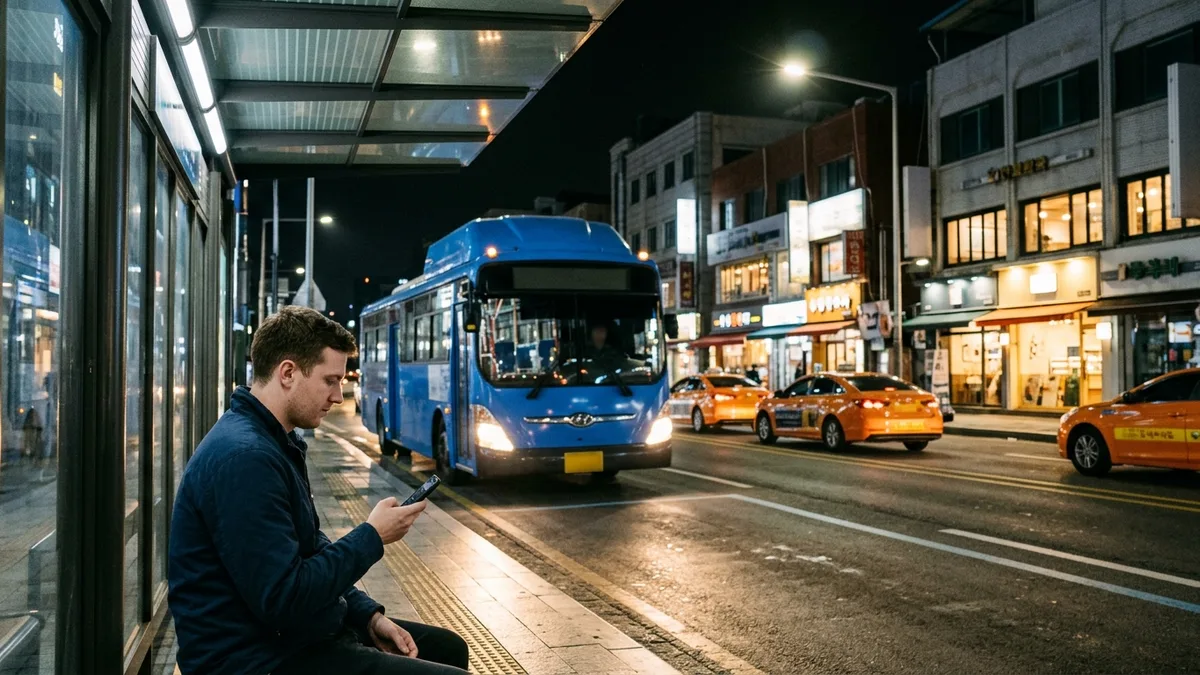
Comparing Late-Night Fares — a 2,500 Won Night Bus vs. a 6,700 Won Taxi Base Fare
Start with the opening price and the difference is clear. Below are the public transit fares and taxi fares published by the City of Seoul.
| Mode | Fare (by card) | Conditions |
|---|---|---|
| Late-night bus (Owl Bus) | 2,500 won | 14 routes within Seoul, 23:00 through the 4 a.m. hour |
| Trunk and branch city buses | 1,500 won | Regular operating hours |
| Village (maeul) bus | 1,200 won | Regular operating hours |
| Wide-area bus | 3,000 won | Operating hours vary by route |
| Taxi (mid-size), daytime | 4,800 won | 04:00–22:00, up to 1.6 km |
| Taxi (mid-size), 20% surcharge | 5,800 won | 22:00–23:00 and 02:00–04:00 |
| Taxi (mid-size), 40% surcharge | 6,700 won | 23:00–02:00 |
There's one thing about the taxi surcharge that's easy to miss. It isn't applied to the base fare only — it applies at the same rate to the distance-and-time metered fare as well (in effect since 2023-02-01). So the longer the trip, the wider the gap with the bus grows, far beyond the difference in starting price. You can see the hour-by-hour calculation structure in more detail in Korea's Late-Night Taxi Surcharge, Fully Explained.
If you're planning to change buses, there's one rule you really need to know. The valid transfer window under the metropolitan area's integrated transfer discount is normally 30 minutes after you tap out, but between 21:00 and 07:00 the next day it stretches to 60 minutes. Late-night buses run at wide intervals, so those 60 minutes are decisive.
- The transfer discount covers up to 5 consecutive boardings (= 4 transfers)
- If you don't tap out when you get off, your next boarding won't register as a transfer
- Board without knowing the rule and you'll pay the 2,500 won late-night bus fare twice
If you're from a country with no integrated transfer system at all, even the existence of the rule is new information. The math is laid out separately in How the Metropolitan Transfer Discount Is Calculated.
One thing to flag for anyone holding a Climate Card. The Climate Card works on Seoul-licensed city and village buses, and that includes late-night buses. Short-term passes run from 5,000 won for 1 day to 20,000 won for 7 days (as of 2026-07-22). However, the Sinbundang Line, GTX, subways outside the Seoul area, wide-area buses, airport buses, and buses licensed by other regions are not covered. Please check the latest schedule and conditions of the program in How Foreigners Use the Climate Card in Seoul.
If You Have to Get Out of Seoul — the Rules Are Different in Gyeonggi
A large share of E-9 workers and international students live outside Seoul, in places like Ansan, Siheung, Hwaseong, and Bucheon. In that case, Seoul late-night bus information alone won't get you home. Everything is separate, from the lookup system to the route network.
Gyeonggi Province runs its own 66 late-night city bus routes across 16 cities and counties, plus 9 wide-area late-night bus routes connecting to Seoul. Last departures from origin terminals generally end between 23:00 and 01:10 (GBIS route status, as of 2025-01). That means they stop earlier than Seoul's Owl Buses.
- Look routes up not on Seoul's system but on Gyeonggi Bus Information (GBIS, gbis.go.kr)
- Gyeonggi late-night bus fares aren't listed on the GBIS route status page, so we haven't put a figure here — check the stop signage or GBIS directly
- The Climate Card excludes "buses licensed by other regions," so it can't be used on Gyeonggi-licensed buses
That last item causes trouble in the small hours all the time: you board believing one card covers everything, then the payment won't go through and you're stuck.
When you switch to a taxi, the fare structure changes again. When a Seoul taxi leaves its business district, an out-of-district surcharge of 20% is added. So what happens when the late-night surcharge stacks on top of that?
Heads-up: The City of Seoul explicitly states "combined late-night and out-of-district surcharge: up to 60%." That means a taxi taking you from Seoul into Gyeonggi in the small hours can land in that range. A meter reading much higher than you expected may not be a rule violation, so get into the habit of stating your destination before you board and asking whether the out-of-district surcharge applies. It beats arguing about it afterward across a language barrier.
Where You Can Ask for Help in a Foreign Language Overnight
There's one more wall that doesn't exist for Korean speakers: there is effectively only one multilingual help line open in the small hours.
The Korea Tourism Organization's 1330 Travel Hotline runs 24 hours a day, year-round, free of charge (as of 2026-07-27). Inside Korea dial 1330 with no area code; from overseas, +82-2-1330. They handle nationwide travel information, travel interpretation, and travel complaint consultations. When you're stranded at 4 a.m., this number is your first option.
The languages confirmed as available 24 hours are Korean, English, Japanese, and Chinese. We weren't able to confirm the current operating hours for Russian, Vietnamese, Thai, and Malay/Indonesian (unconfirmed), so if you need one of those, please re-check with the Korea Tourism Organization's official guidance.
Seoul's own hotline, by contrast, is closed overnight. The 120 Dasan Call Center's foreign-language service (5 languages: English, Chinese, Japanese, Vietnamese, Mongolian) operates only on weekdays, 09:00–18:00. Korean-language service runs 24 hours a day, 365 days a year, but foreign languages are staffed during business hours only. Which means the city's hotline is closed at exactly the hour you get stranded.
- How to use it: (02)120 → press 9 → choose your language (1 English, 2 Chinese, 3 Japanese, 4 Vietnamese, 5 Mongolian)
- Calling from overseas, the number is +82-2-731-2120
- Operating hours can change, so check the official 120 Dasan Call Center page
📌 Important: In short, 120 Dasan during the day, 1330 overnight. Know that difference in advance and save both numbers in your phone, and you won't be scrambling to work out who to call at 4 a.m.
Some Days Do Run Later (Holidays and the New Year's Eve Bell)
"The subway runs late during Korean holidays" — you've probably heard that. It's true, but it's limited to specific dates, not a standing arrangement.
Two recent examples show what standard is being used.
- The New Year's Eve bell-ringing event for January 1, 2026: Lines 1–9, the Ui-Sinseol Line, and the Sillim Line extended service until 2 a.m. measured by arrival at the terminal station, and 45 city bus routes around the event area were extended on a 2 a.m. pass-through basis (Seoul city official)
- The 2026 Seollal holiday (February 17–18): Last services on the subway and on 121 city bus routes serving terminals and train stations were extended on the basis of 1 a.m. arrival at the terminal station or final stop, while the 14 Owl Bus routes ran as normal (based on news coverage citing the city's announcement — provisional)
There's one detail here you absolutely have to hold onto: the reference point is "the time of arrival at the terminal station or final stop."
Heads-up: If you see "extended until 1 a.m." and head to an intermediate station at 12:40, the train may already have gone through. To arrive at the terminal at 1 a.m., the train passes intermediate stations much earlier than that. Whenever you read an extension notice, translate it into a different question: what time does it pass the station where I'm getting on?
Whether service is extended, and on what basis, differs every year and is announced only in Korean-language press releases. Don't treat last year's notice as this year's standard. If you plan to be out late during a holiday or at year's end, re-check the city's notice for that year during that week.
That covers everything about missing the last train in Seoul. To close, here are all the options mentioned so far, side by side by what each one covers.
| Mode | What it covers overnight | Things to know |
|---|---|---|
| Owl Bus | 14 routes within Seoul | Ends between 03:10 and 04:10 depending on the route |
| Gyeonggi late-night bus | 16 Gyeonggi cities and counties, plus 9 Seoul-linked routes | Last departures from origin terminals are generally 23:00–01:10 |
| Taxi hailing apps (Kakao T, UT, K-RIDE, etc.) | Taxi hailing | Sign-up and payment requirements differ by app, so check in advance |
| LACHA | Taxi, KTX, express bus, Airport Railroad, transit card | Doesn't handle city or late-night bus route booking, or intercity buses (fares can be paid with a transit card) |
The fact that a taxi is the only thing left after 4 a.m. also means that if one hailing attempt falls apart at that hour, you have no alternative. If Kakao T stops you at Korean phone verification or your overseas card gets declined, in the daytime you just try again — at 4 a.m. there's no room for that. LACHA is a transportation and payment super app for foreigners that you can start using right away without identity verification. It's designed so that identity verification isn't required under the formal procedures, so you can get going with just your passport — no Korean bank account or phone number — and pay taxi fares with overseas payment services like Alipay and WeChat Pay, or with an overseas card. Think of it as one more taxi-hailing option to keep on hand alongside Kakao T and UT. That said, it doesn't book or operate late-night bus routes, so check routes and times on the city's notices; for fares, you can pay with the LACHA transit card, T-money, or the Climate Card.
Want to search and book KTX and express buses in one app? Check out LACHA.
Built to work without a Korean phone number or bank account, with overseas payment methods like Alipay, WeChat Pay, and Apple Pay. Taxi hailing plus KTX, express bus, and airport railroad (AREX) booking — all in one app.
Up to 60% off Korea transit with a coupon (max ₩3,000): enter code at sign-up. KTX gets up to 18% off on top
Download now


Frequently Asked Questions (FAQ)
Q1. Doesn't the Seoul subway run all night on weekends or Friday nights? It doesn't. No subway line in Seoul runs 24 hours, and the official English guidance from Seoul's Jung-gu District Office lists operating hours as "from 5:30 a.m. to around midnight." It's different from New York (24 hours) or London's Night Tube (Fri/Sat). That said, last- and first-train times differ by station, by day type (weekday / Saturday / Sunday and holidays), and by direction, so check for your own station on Seoul Metro's Cyber Station.
Q2. Seoul's guidance says Owl Buses run until 06:00 — can I catch one at 5 a.m.? It's safer to assume you can't. "23:00–06:00" is a label for the time band, and in Seoul's official route table the last departure from each route's origin terminal falls between 03:10 and 04:10. N37 (Jangji-dong–Jingwan-dong), for example, ends at 03:10, and N61 (Sinjeong-dong–Sanggye-dong) at 04:10. From 4 a.m. until the first subway train (around 05:30) there's effectively no option but a taxi, so if you plan to travel by late-night bus, check your route's last departure time in advance.
Q3. How much does a taxi from Seoul to my place in Gyeonggi cost in the small hours? It depends on distance and time, so we can't quote you an amount in advance — but you should know the structure before you get in. Seoul taxis add a 40% surcharge from 23:00 to 02:00 (base 6,700 won) and a 20% surcharge from 02:00 to 04:00 (base 5,800 won), and the surcharge applies at the same rate to the distance-and-time metered fare. On top of that, leaving the business district adds a 20% out-of-district surcharge, and the City of Seoul states that combined late-night and out-of-district surcharges reach up to 60%. It's best to state your destination and confirm before you board.
Q4. Do I pay 2,500 won again if I transfer between late-night buses? Not if you tapped out. The valid transfer window under the metropolitan integrated transfer discount is normally 30 minutes, but between 21:00 and 07:00 the next day it extends to 60 minutes. With wide gaps between buses at night, those 60 minutes matter. The transfer discount covers up to 5 consecutive boardings (= 4 transfers), and if you don't tap out when getting off, your next boarding won't count as a transfer.
Q5. Is there anywhere I can get help in English or my own language overnight? The Korea Tourism Organization's 1330 Travel Hotline runs 24 hours a day, year-round, free of charge (1330 inside Korea, +82-2-1330 from overseas). Seoul's 120 Dasan Call Center also offers service in 5 languages (English, Chinese, Japanese, Vietnamese, Mongolian), but only on weekdays 09:00–18:00, so it won't connect in the small hours (Korean-language service is 24 hours). The languages confirmed as available 24 hours on 1330 are Korean, English, Japanese, and Chinese; for the other languages, please re-check the operating hours with the official guidance.
Note: This article is intended as general information. The fares, operating times, and route counts in the text are values confirmed as of 2026-08 from Seoul Metropolitan Government transportation guidance, Seoul Metro public data, Gyeonggi Bus Information (GBIS), and the official pages of the Korea Tourism Organization and the 120 Dasan Call Center. Owl Bus service end times by route rest on Seoul's official route table as a single source, and the 2026 Seollal holiday extension is based on news coverage citing the city's announcement, so it's marked provisional. Subway station entrance opening and closing times, Gyeonggi late-night bus fares, and the operating hours for some 1330 languages are not given as figures here because we could not obtain primary sources. Public transit fares and timetables get revised and route lineups change, so please be sure to re-check the official channels of the Seoul Metropolitan Government, Seoul Metro, and GBIS before you travel. LACHA does not operate or sell tickets for city buses or late-night buses.