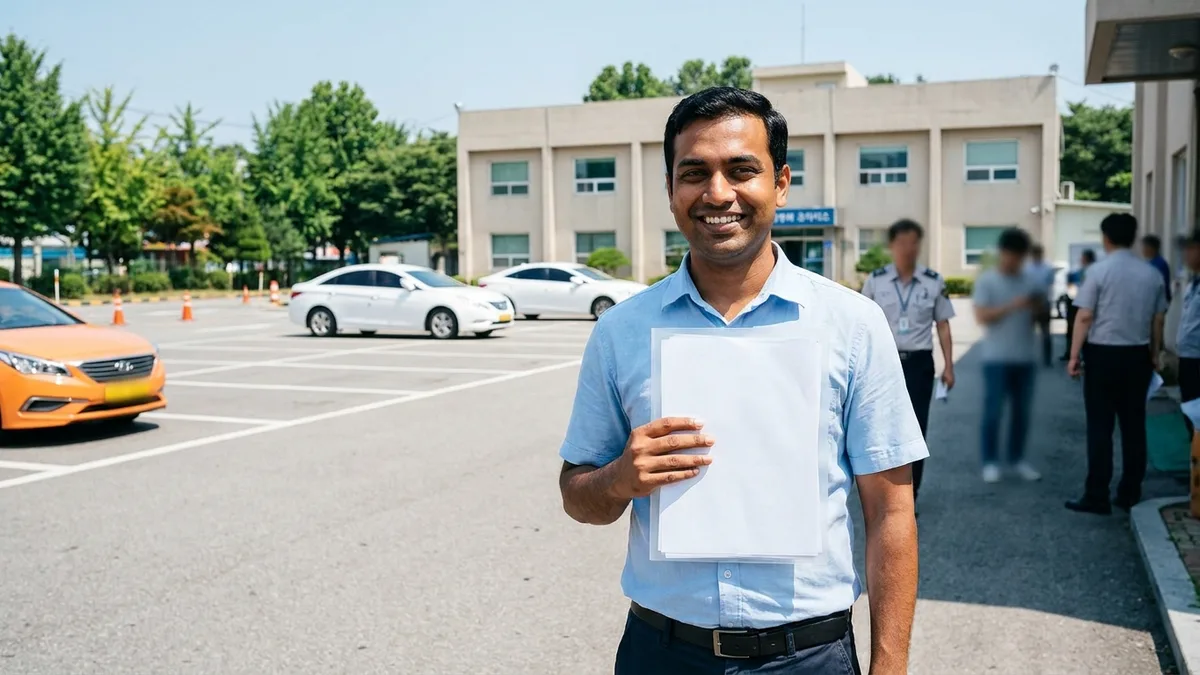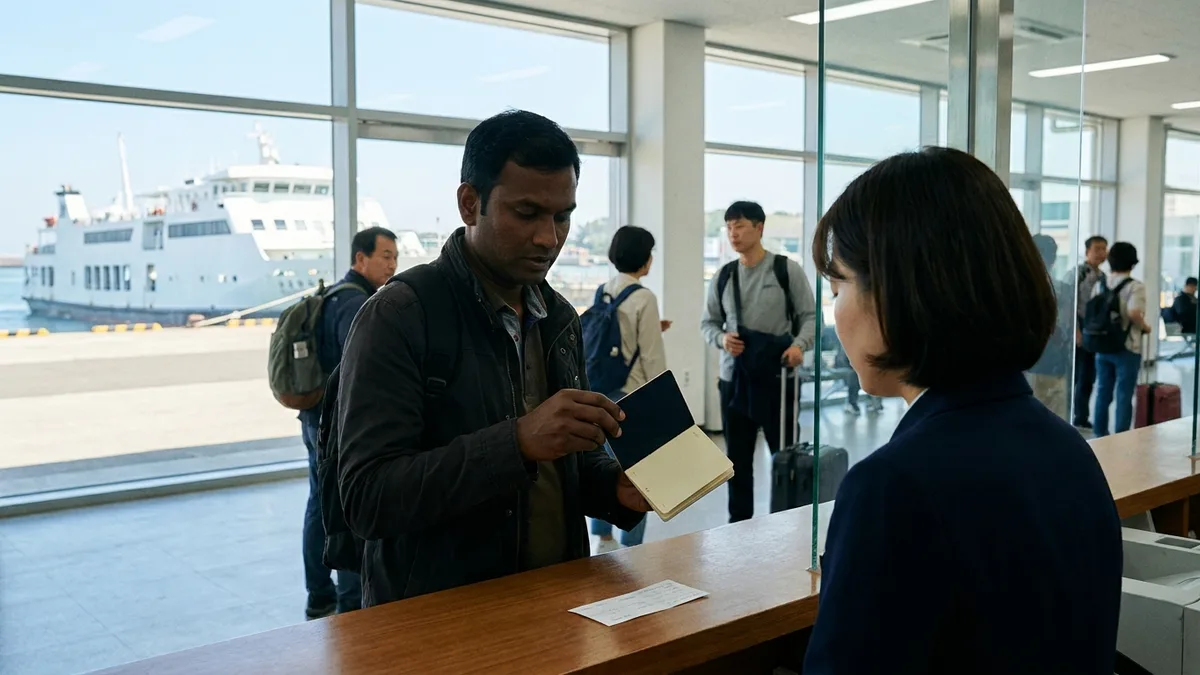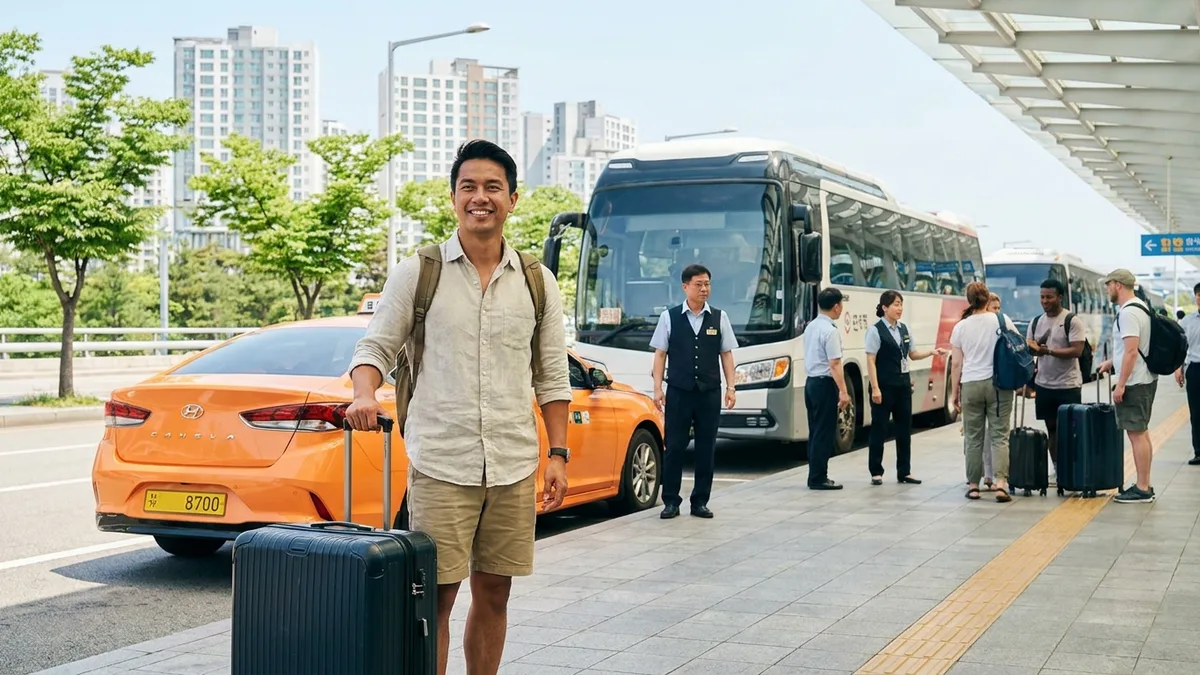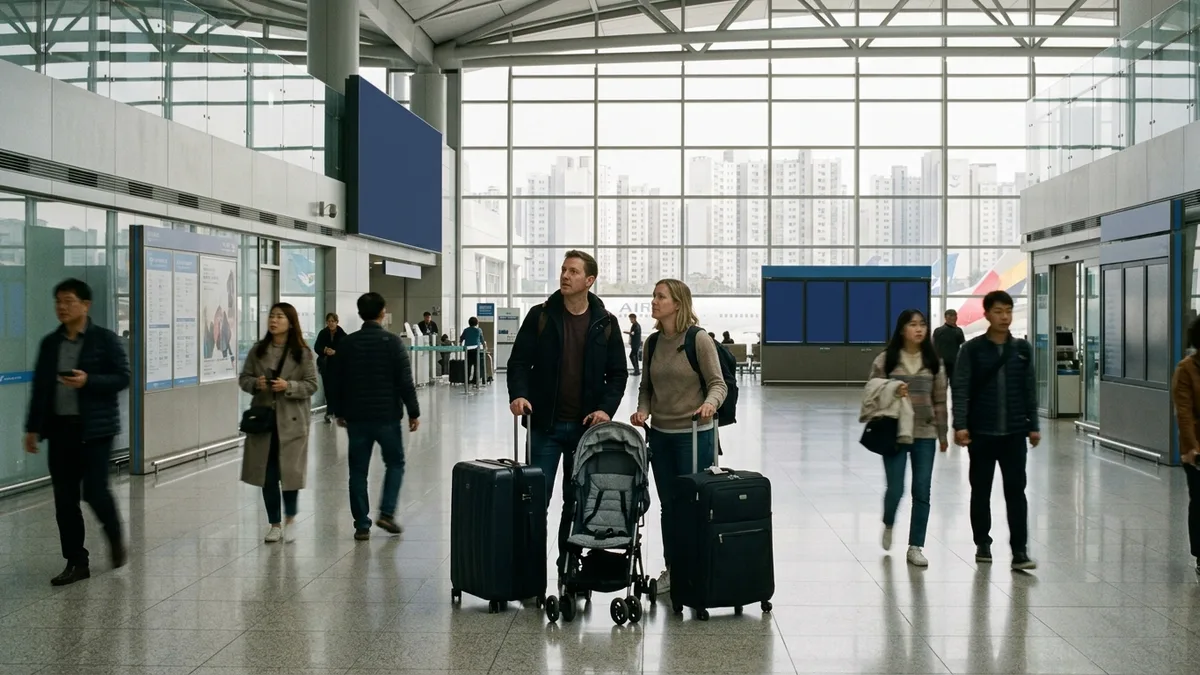
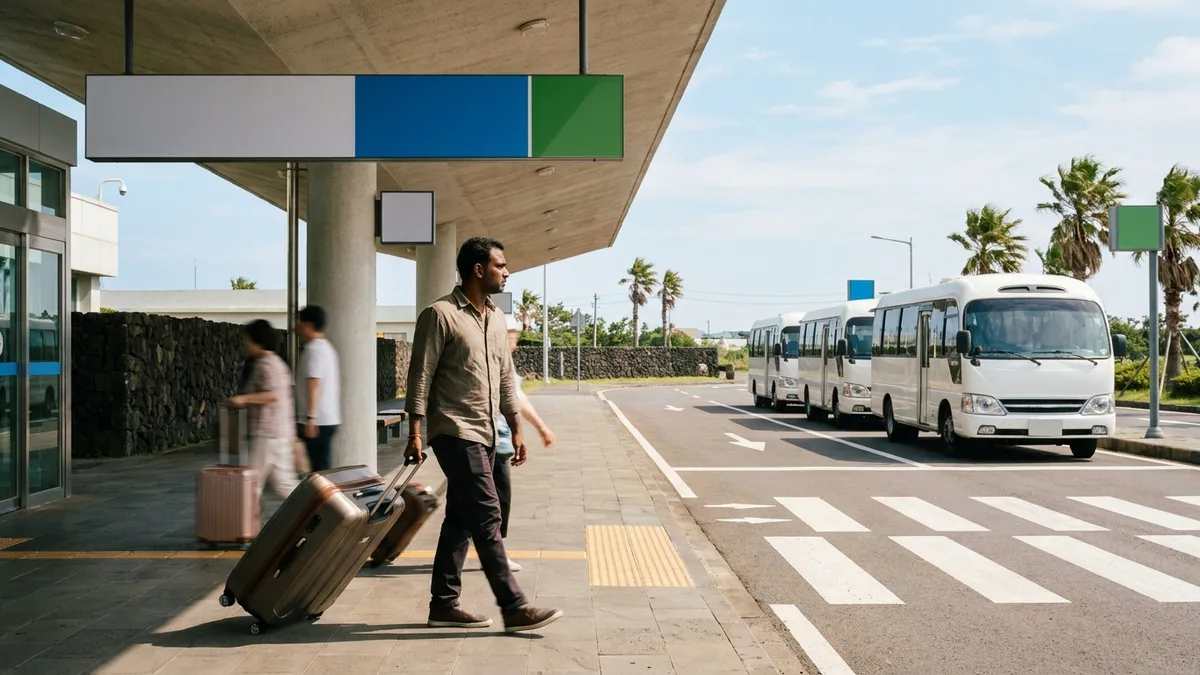
Jeju International Airport has no rental car counters where you sign the contract and pick up the car on the arrivals floor. The sequence laid out in the Korea Airports Corporation's official guidance is: exit through Gate 3 or Gate 5 → cross the crosswalk → follow the "Way to Rental Car House" sign under the canopy → check the shuttle bus stop number and location for your specific company → board the shuttle. That's five steps (as of 2026-08). The shuttle stops are located outside Gate 5.
The reason for this setup is simple. Rental car company offices aren't on airport property — they're scattered around Jeju City in Yongdam 2-dong, Yongdam 3-dong, Dodu 2-dong, Ora 3-dong, Iho 2-dong, Nohyeong-dong, Oedo 1-dong, and elsewhere (based on office addresses in the Jeju rental car registration records, 2026-06-30). Since the cars are off-airport, a shuttle ride is unavoidable.
The problem is that the airport's English-language guidance condenses these five steps into four. And the omitted item happens to be ④ "check the shuttle bus stop number and location for the company you're using." In other words, the step where foreign visitors get most lost on site is precisely the one not explained in English.
On top of that, two rules unique to Jeju overlap in September. The "Regulation on Vehicle Rental Terms Disclosure in Jeju Special Self-Governing Province" takes effect September 16, 2026, capping discounts on the daily rental rate at 60%, and the current application period for the rental car volume cap (the vehicle rental supply-demand adjustment plan) runs through September 20, 2026. If you're booking around mid-September, the price you saw in search results and the amount you actually pay may not match.
Note: The procedures, figures, and rules in this article are compiled as of 2026-08 from Korea Airports Corporation's Jeju International Airport guidance and Jeju Special Self-Governing Province press releases and registration records. Shuttle operations and rental conditions vary by company, and rules change around effective dates, so please re-confirm with your booking provider and the official Jeju Special Self-Governing Province site (jeju.go.kr) before booking and before departure.
There Are No Rental Car Counters on Jeju Airport's Arrivals Floor — 5 Steps to Getting Your Car
At most airports abroad, rental counters line the arrivals floor and you handle the contract and vehicle pickup all in one place. Jeju doesn't work that way. You don't receive the car inside the terminal, so even after you grab your bags there's still one more leg of travel ahead.
| Step | Where and what to do | Easy to miss |
|---|---|---|
| Step 1 | After arrival, exit through Gate 3 or Gate 5 | Searching for a counter inside the arrivals floor just wastes time |
| Step 2 | Cross the crosswalk | You're crossing a roadway, so allow extra time if you have lots of luggage |
| Step 3 | Follow the "Way to Rental Car House" sign under the canopy | Rental Car House isn't an indoor hall — it's an outdoor facility on the way to the parking lot |
| Step 4 | Check your company's shuttle bus stop number and location | This step is missing from the English guidance |
| Step 5 | Board the shuttle → sign the contract and pick up the car at the company office | The office is off-airport, so this is where real travel time gets added |
The airport's facility information also describes Rental Car House as an outdoor facility on the way to the parking lot, and the notice states that you use the shuttle bus from the Rental Car House waiting area. That said, the exact address of Rental Car House and its distance from the terminal aren't listed on official pages, so we can't say definitively that it's an X-minute walk.
Returns follow the same structure. You return the car at the company office (its depot), then take the shuttle back to the airport. That's based on booking platform guidance and may differ by company, so when planning your return time, set aside shuttle travel time separately from your flight departure time.
Caution: Shuttle frequency, travel time, whether they run late at night, and whether you need to show a booking confirmation when boarding are not covered in the airport's official guidance. Frequency and travel time vary by company and time of day, so they can't be pinned down to one figure — follow the instructions on your booking confirmation. If you're arriving on a late-night flight, it's safest to confirm with the company before booking whether the shuttle runs at that hour.
The One Step Missing from the English Guidance: Your Company's Shuttle Stop Number
Jeju Airport does provide its rental car guidance page in English. But put it side by side with the Korean version and one whole step is gone.
| Guidance step | Korean page | English page |
|---|---|---|
| ①~③ Gate → crosswalk → Rental Car House sign | Included | Included |
| ④ Check your company's shuttle bus stop number and location | Included | Missing |
| ⑤ Board the shuttle bus | Included | Included |
Korean users aren't badly affected even without this step written out. When they book, they receive the stop number by text message or KakaoTalk. Foreign visitors who booked through an overseas site, on the other hand, often receive no Korean-language guidance at all — or receive it and can't read it. So they end up looking for "which number is my company's shuttle" for the first time only after they're already outside the gate.
That creates one to-do before you leave home: check whether your booking confirmation lists a shuttle stop number, and if it doesn't, ask your booking provider in advance and screenshot the answer. Saving the company name in Korean as well makes it easy to show someone on site.
Tip: We weren't able to confirm whether the stop signage and on-board shuttle announcements are also provided in English, Chinese, or Japanese. Don't assume multilingual guidance exists — we recommend screenshotting three things on one screen: the Korean company name + stop number + booking number.
Three Things That Can Stop You Before You Even Book — Non-Treaty Licenses, IDP CLASS Stamps, Passport Spelling
Get tripped up here and you won't get a car even if you reach the airport just fine. Check these in order.
- Licenses from non-treaty countries simply don't work. If your license was issued by a country that hasn't joined the Geneva or Vienna Convention (China, for example), you can't legally drive in Korea even with an International Driving Permit (IDP). Jeju gets a high share of Chinese visitors, yet travel content rarely points this out.
- Start with the document's name. Company terms recognize only an "International Driving Permit" and explicitly state they won't accept documents labeled "International Driving License" (per company usage guidance, as of 2026-08).
- Without a CLASS stamp, you'll be refused a vehicle. Compact, small/mid-size, and mid-size cars require a CLASS B stamp on the IDP; 11–12 seaters require CLASS D. Some issuing offices back home hand out permits with that box left blank.
- If the English name on your IDP differs from your passport, it may be treated as invalid. Common causes: a missing middle name, surname/given name order differences, or different romanization. This happens especially often with languages that have multiple romanization systems, like Russian, Thai, and Chinese.
- There are also age and experience requirements. Typically you must be 21 or older with at least one year of licensed driving, and some vehicle classes require you to be 26 or older (this is based on company guidance and varies by class).
Where and how to get an IDP, plus the process for exchanging a foreign license for a Korean one, is covered separately in How to Exchange a Foreign Driver's License for a Korean One. This article focuses on the extra conditions specific to Jeju.
Caution: CLASS stamps and name spelling can't be fixed after you arrive in Korea. When you get your IDP from the issuing agency in your home country, keep your passport beside you and compare the spelling letter by letter, and confirm on the spot that the vehicle class box has been stamped.
Local Contact Number, Language, Mandatory CDW for Foreigners — Where the Listed Price and Your Actual Cost Diverge
Even with all your documents in order, there's one more hurdle here. Many company terms require a phone number reachable in real time for the duration of the rental, and state that without one, the rental is not permitted. It doesn't matter whether it's a Korean SIM or international roaming — the point is that you must be reachable.
Plans to pick up a car straight from the airport on your first day in Korea break down at exactly this point. It's safer to activate a SIM or eSIM first and then head to the rental office. How to activate one at the airport is covered in How to Buy a SIM or eSIM at the Airport, and where the line falls between services that work without a Korean number and those that don't is covered in Services You Can Sign Up For and Pay With Without a Korean Phone Number.
There are also conditions that hit your wallet. Some companies require full, unlimited collision damage waiver (CDW) coverage for foreign bookings only. Insurance that's optional for Koreans is mandatory for foreigners, so the listed price in search results and your actual payment amount drift apart. When comparing quotes, line them up as CDW-inclusive totals rather than listed base prices.
Some companies also write language conditions into their terms — a line saying "rental may be restricted if Korean communication is not smooth." That clause comes from a setup where on-site contracting and vehicle handover explanations happen only in Korean, so asking before booking whether English service is available saves you a wasted trip.
Standards for the collision damage waiver were codified in the regulation taking effect September 16, 2026. However, the deductible and out-of-pocket amounts for standard versus premium waivers differ across news reports, so we won't put figures in this article. Confirm waiver amounts in the company's original terms before signing, and check the regulation text again in Jeju Special Self-Governing Province's local statutes.
The Volume Cap — Why Only Jeju Limits Rental Car Numbers, and Where Things Stand
Jeju has a rule no other region has: the rental car volume cap (the vehicle rental supply-demand adjustment plan). It was introduced in 2018, and the current plan's application period runs through September 20, 2026.
- The supply-demand adjustment committee set Jeju's appropriate rental car fleet size at 28,300 vehicles. That's the figure the committee arrived at by amending the consultancy's calculation of 28,500 (2024-09).
- Since the rule took effect, 3,829 vehicles were cut through September 2024, and fleet increases have been restricted during that period.
- Yet as of June 30, 2026, actual registrations stand at 29,782 vehicles across 112 businesses (103 main offices with 21,648 vehicles + 9 branch offices with 8,134 vehicles).
- Subtract the two figures and the fleet is 1,482 vehicles above the appropriate size. In other words, it's not that "the cap is causing a car shortage" — increases are blocked while reductions toward the target continue.
- There are some exceptions to the registration restriction. In 2018, five lift-equipped vehicles for travelers with limited mobility that received provincial subsidies were allowed a two-year extension of use past their age limit, and exceptions to the registration restriction were permitted for companies that agreed to fleet reductions (2024-09).
For travelers, what matters is the direction. Even when demand surges in peak season, the system isn't set up to bring in new cars and expand supply. That means "it'll be pricey, but I can just rent on the spot" may not hold — and it's exactly why booking early in Jeju isn't optional but standard.
📌 Important: We couldn't find an official announcement on whether the volume cap will be extended, terminated, or replaced by a new plan after September 20, 2026. The only confirmed fact is that the current plan runs through 2026-09-20; for policy after that, please re-check Jeju Special Self-Governing Province (jeju.go.kr) press releases and official notices.
The Pricing Rule Taking Effect September 16, 2026 — What a 60% Discount Cap Changes
The "Regulation on Vehicle Rental Terms Disclosure in Jeju Special Self-Governing Province" was promulgated on July 15, 2026, and after a two-month preparation period takes effect September 16, 2026. The core provision limits discounts on the filed daily rental rate to a maximum of 60%.
| Item | Through 2026-09-15 | From 2026-09-16 |
|---|---|---|
| Daily rate discount | No cap under the rules (in practice, up to 80–90% off peak-season rates during the off-season) | Discount capped at 60% off the filed daily rate |
| Vehicle with a filed rate of 100,000 KRW | No floor | Cannot go below 40,000 KRW |
| Long-term rentals over 10 days | Not applicable | Discount cap does not apply |
| Rate cost calculation | Previous cost-calculation regulation (repealed) | Based on objective materials such as prior-year financial statements, audit reports, and per-vehicle operating cost breakdowns |
| CDW waiver standards | Not confirmed | Codified in the regulation (check the original text for specific amounts) |
Jeju created this rule because it concluded that extreme off-season discounting comes back as peak-season price spikes. Before the rule took effect, off-season discounts customarily ran as deep as 80–90% off peak rates, and the province identified this structure in an official assessment (2025-07-22).
So how it feels depends on when you visit — in opposite directions. Peak-season price spikes should be suppressed, but off-season floor prices may actually rise. If prices you searched before and after mid-September look different from what shows up on the payment screen, that's the effective date straddling your dates.
The regulation's legal basis is Article 31(4) of the Passenger Transport Service Act, Article 427(2) of the Jeju Special Act, and Article 50(3) of the Jeju Special Self-Governing Province Passenger Transport Business Ordinance, and the previous "Regulation on Calculating Vehicle Rental Rate Costs in Jeju Special Self-Governing Province" has been repealed. Grounds were established for inspections and administrative action against operators violating the standards, but the level of sanctions — administrative fine amounts, whether business suspension applies — couldn't be confirmed in public materials.
Tip: We couldn't confirm an official definition of the peak and off-season periods under the regulation. Rather than memorizing dates, it's far more useful later to screenshot the daily rate and total shown on your booking confirmation.
You Can't Take a Rental Car to Udo — the Exception Is Class 1 Low-Emission Vehicles
Plenty of people plan an itinerary where they rent a car, loop around Jeju, then take a ferry over to Udo. But the vehicle driving restriction order for Udo-myeon applies from August 1, 2026 through July 31, 2029. This is the fifth extension since it first took effect in August 2017, and the restricted categories are the same as in the fourth-extension amendment notice that took effect March 19, 2026.
Restricted vehicles include rental cars without a registered depot — meaning rental cars whose depot isn't registered in Udo-myeon. An ordinary rental car picked up in Jeju City or Seogwipo City falls into this category, so you can't load it onto the ferry at Seongsan Port. Koreans know the rule from news coverage, but it almost never appears in overseas travel content or booking site guidance.
There are three exceptions: rental vehicles carrying passengers with disabilities, elderly passengers, or infants; Class 1 low-emission vehicles; and 16-seat chartered buses. Class 1 low-emission vehicles (electric and hydrogen) are allowed onto Udo under the rules even as rental cars.
That said, there's something unverified before you jump to "so just rent an EV and it's all solved." We weren't able to confirm whether public charger payments work with credit cards issued overseas, or whether charger screens offer English. If you're going with an EV, ask your booking provider about charging payment methods first, separate from the question of Udo access.
As for penalties for violations, the only confirmed policy is "stepped-up spot inspections of violating vehicles, and referral to investigation for legal violations." Administrative fine amounts and the enforcing authority couldn't be confirmed, so we won't state them. With over 1.5 million visitors a year, enforcement intensity may vary by season.
The practical alternative is simple: leave the car on Jeju's main island and cross over on foot by ferry. Check parking around Seongsan Port in advance. For getting around on Udo and ferry departure times, check with Udo-myeon and the ferry operators. Where foreign visitors get stuck booking ferries is covered separately in Booking Korean Ferries: Where Foreigners Get Stuck.
If you fall short on even one driving requirement, it's better to switch plans early. A license from a non-treaty country, an IDP without a CLASS stamp, no phone number reachable during the rental period — if any one of these applies, a rental car will be blocked at booking or refused on site. That leaves public transit and taxis.
| Booking/travel option | What you can book | Things to know |
|---|---|---|
| Rental companies & overseas OTAs | Jeju rental cars | Local contact number and IDP CLASS requirements are written into company terms |
| Kakao T | Taxis | Requires Korean mobile number verification |
| Korail+ | KTX | Works with a passport and overseas cards, but some users get stuck at the payment step |
| LACHA | KTX, express buses, taxis, VANs, airport railroad, transit cards | Doesn't handle rental cars, parking, flights, or ferries |
LACHA is a transportation and payment super app for foreign visitors that you can use right away without identity verification. You can get started with just your passport — no Korean bank account or mobile number — and it's designed so that formal identity verification isn't required. It doesn't handle rental cars or parking, so renting a car in Jeju has to be done directly with a company or booking site. What it can bundle in one place is the land portion before you head to Jeju — the airport railroad, KTX, express buses, and taxis from your departure city to a departure airport like Gimpo or Cheongju. For routes to domestic airports, see the Domestic Airport Transportation Guide. Whether taxi hailing works in Jeju can vary by area and time of day, so check directly in the app.
Want to handle everything from your first ride after landing in one app? Check out LACHA.
Built to work without a Korean phone number or bank account, with overseas payment methods like Alipay, WeChat Pay, and Apple Pay. Taxi hailing plus KTX, express bus, and airport railroad (AREX) booking — all in one app.
Up to 60% off Korea transit with a coupon (max ₩3,000): enter code at sign-up. KTX gets up to 18% off on top
Download now


Frequently Asked Questions (FAQ)
Q1. Can I pick up a rental car right on Jeju Airport's arrivals floor? No. Jeju International Airport isn't set up for signing contracts and taking delivery inside the terminal. You exit through Gate 3 or Gate 5, cross the crosswalk, follow the "Way to Rental Car House" sign under the canopy, check your company's shuttle bus stop number and location, and board the shuttle. The shuttle stops are outside Gate 5, and the actual vehicle handover happens at the company's office off-airport. This setup exists because company offices are scattered across Jeju City in areas like Yongdam 2-dong, Dodu 2-dong, and Nohyeong-dong.
Q2. Can I rent a car in Jeju without a Korean mobile number? Many company terms require "a phone number reachable in real time during the rental period" and explicitly state that without one, the rental isn't permitted. A Korean SIM or international roaming both work as long as you're reachable, but with no number at all you may be refused on site. If you plan to pick up a car on arrival day, put SIM or eSIM activation ahead of your visit to the rental office. Conditions vary by company, so the surest move is to check that company's usage guidance before booking.
Q3. Can I drive with just an International Driving Permit (IDP)? A few more conditions apply. First, licenses from countries that haven't joined the Geneva or Vienna Convention (China, for example) don't allow you to drive in Korea even with an IDP. The document must also be titled "International Driving Permit," and it must carry the CLASS stamp for your vehicle type (B for passenger cars, D for 11–12 seaters). And if the English name on your IDP differs from your passport spelling, it may be treated as invalid. For the issuance process overall, see How to Exchange a Foreign Driver's License for a Korean One.
Q4. Will rental car prices go up from September 16, 2026? It cuts both ways depending on the season. From that date, discounts on the filed daily rental rate are capped at 60%, so a vehicle with a filed rate of 100,000 KRW can't go below 40,000 KRW. Since the practice of discounting up to 80–90% off peak rates during the off-season is now blocked, off-season floor prices may rise, while peak-season spikes should be suppressed. The cap doesn't apply to long-term rentals exceeding 10 days. We couldn't confirm official definitions of the peak and off-seasons.
Q5. Can I take a rental car to Udo? Not an ordinary rental car. A vehicle driving restriction for Udo-myeon applies from August 1, 2026 through July 31, 2029, and rental vehicles without a depot registered in Udo-myeon are among the restricted categories. The exceptions are rental vehicles carrying passengers with disabilities, elderly passengers, or infants; Class 1 low-emission vehicles (electric and hydrogen); and 16-seat chartered buses. An EV rental is permitted entry under the rules, but you'll need to check charging payment methods separately. The simplest approach is to leave the car on Jeju's main island and cross over on foot by ferry.
Note: This article is intended as general information. The procedures, figures, and rules in the text were confirmed as of 2026-08 from Korea Airports Corporation's Jeju International Airport guidance, Jeju Special Self-Governing Province press releases and rental car registration records (2026-06-30), and company rental terms. Policy after the current volume cap plan's expiration (2026-09-20), specific collision damage waiver amounts, shuttle frequency and travel time, and sanction levels for regulation violations couldn't be confirmed in official materials, so no figures for those are given here. We've also omitted individual company contact details because the Korean and English listings on official pages don't match — please follow your booking provider's guidance. Rules and rates shift around effective dates, so re-confirm with Jeju Special Self-Governing Province (jeju.go.kr) and your booking provider before booking. LACHA does not book, broker, or operate rental cars.