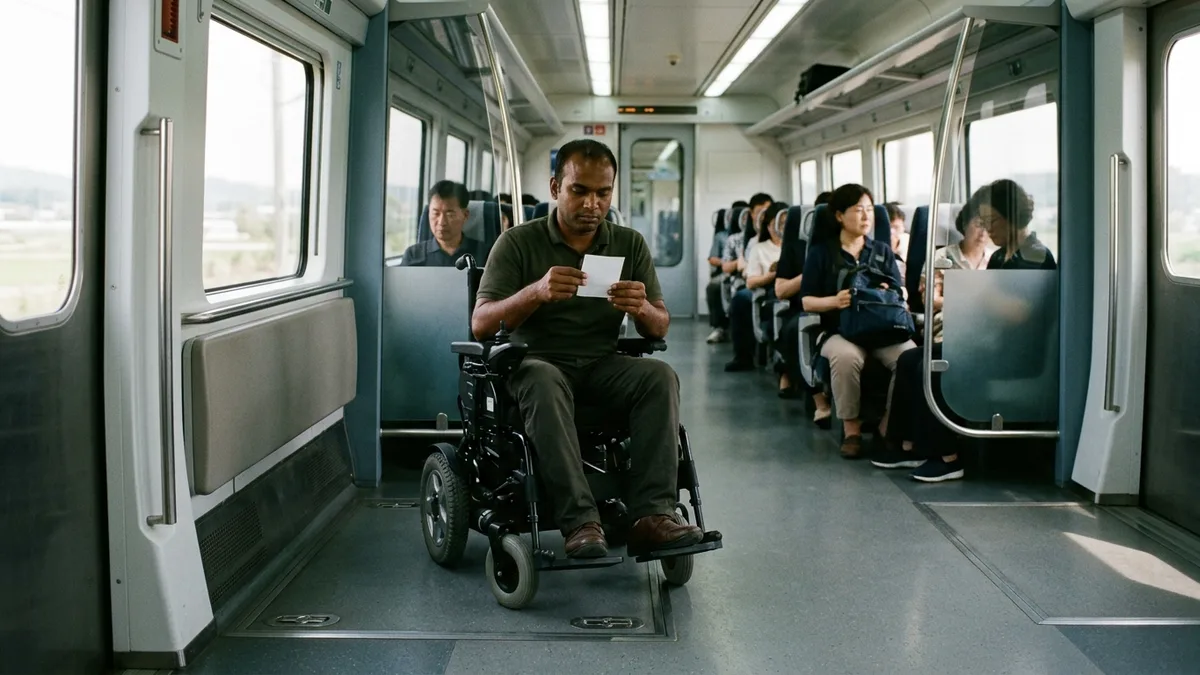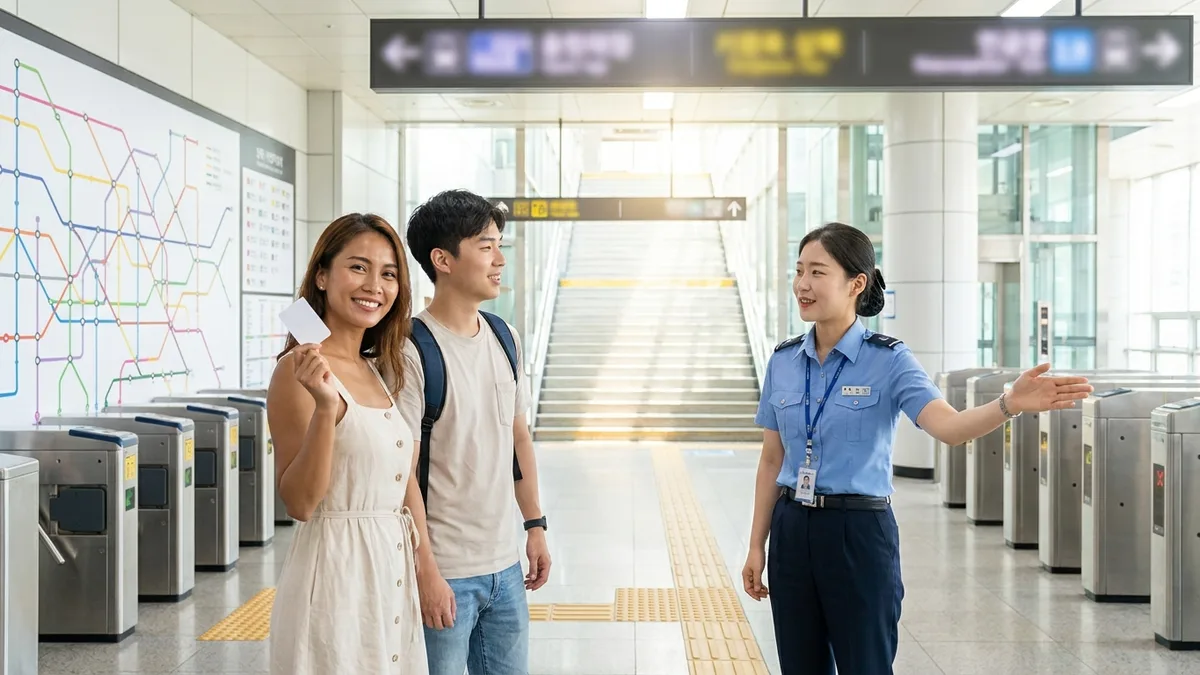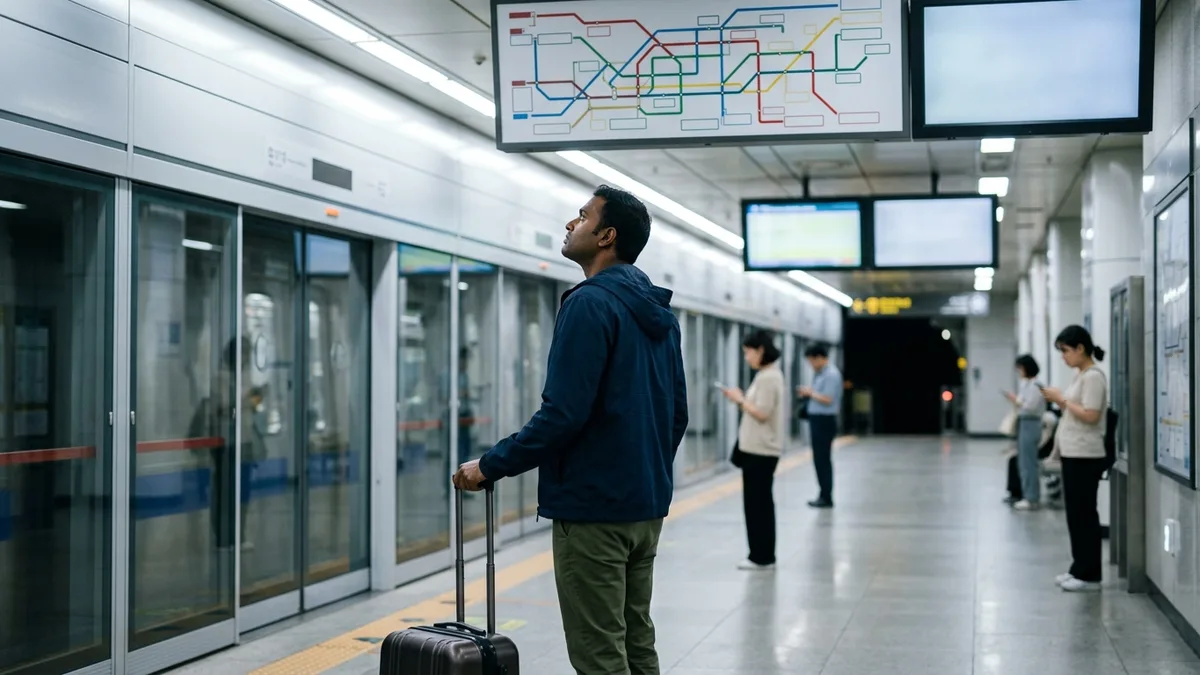
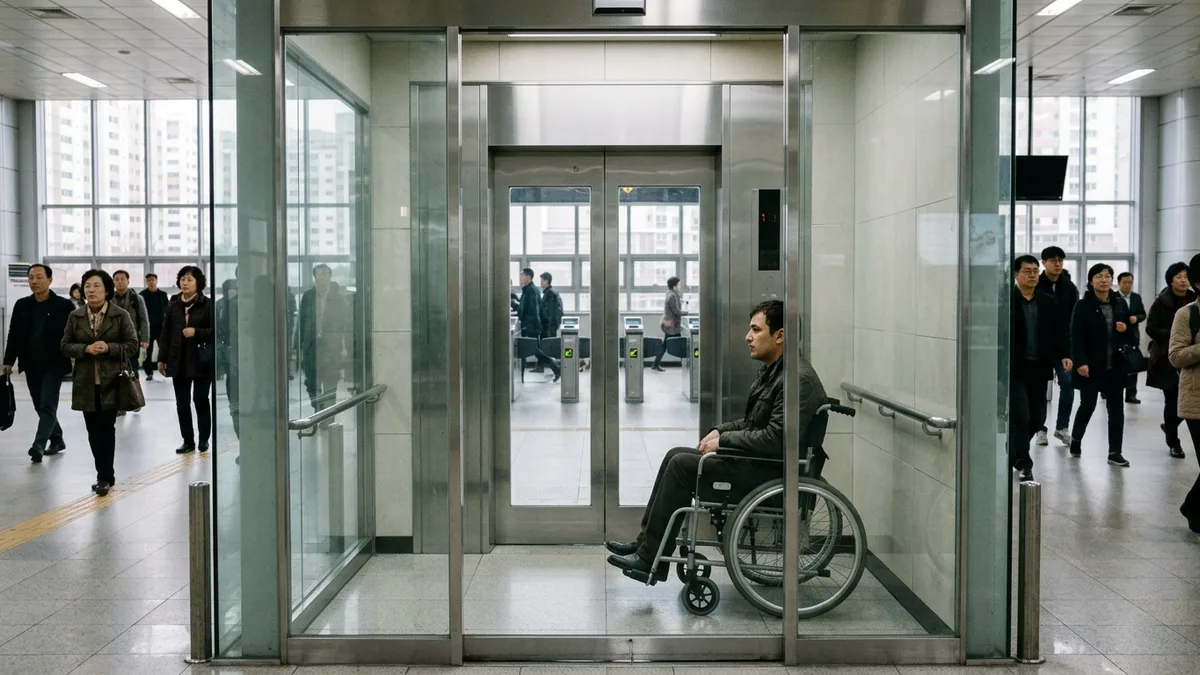
On December 29, 2025, with Kkachisan Station on Line 5 as the final piece, the Seoul city government announced that "one station, one route" accessibility is now secured at all 338 stations across 11 lines. That means you can go from a street-level entrance through the concourse to the platform using elevators alone, without anyone's help. It's the result of roughly 18 years of work at 79 stations since 2008, at a cost of ₩175.1 billion.
Buses are a completely different story. As of January 2026, Seoul's city buses number 7,383 licensed vehicles, of which 5,439 (about 73.7%) are low-floor — but village buses have only 318 low-floor vehicles out of 1,626 (about 19.6%). Accessibility differs by more than a factor of three under the same word, "bus."
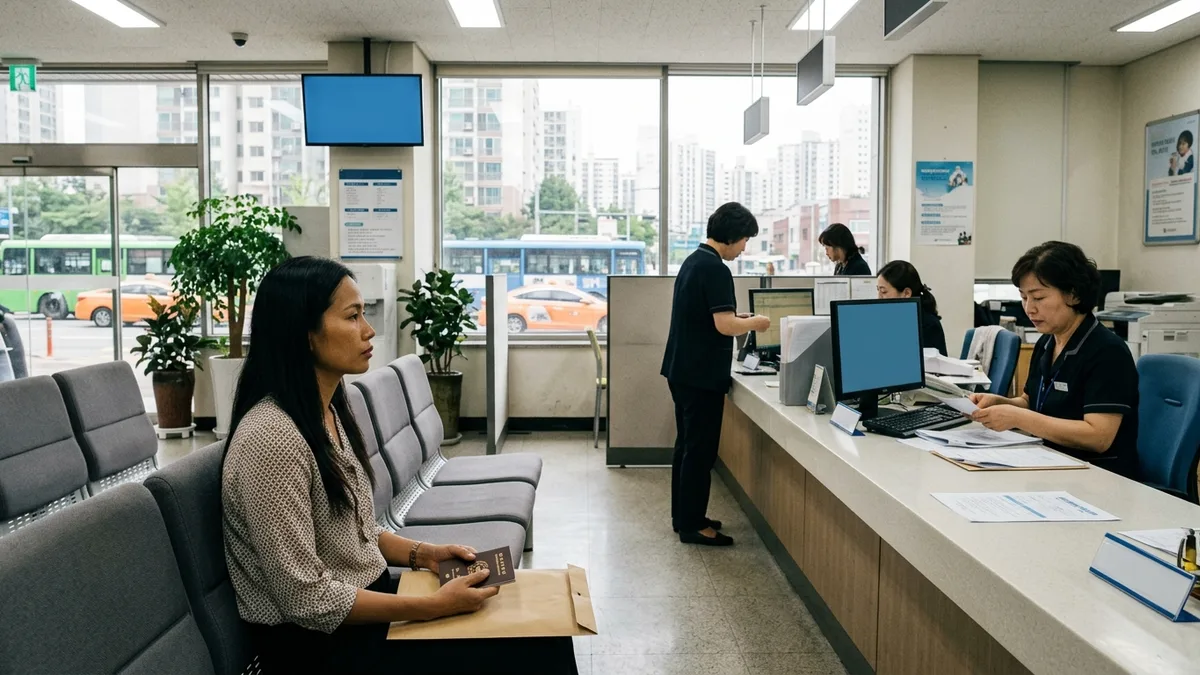
And there's one more door that closes only on foreigners. The widely repeated line that "the subway is free for people with disabilities in Korea" describes a program that assumes you can present a disability registration card (welfare card). But Article 32-2(1) of the Act on Welfare of Persons with Disabilities nails down five categories of overseas Koreans and foreign nationals who may register, and E-9 employment permit workers, D-2 students, and short-term visitors are not on that list. Even if you use a wheelchair, you pay full fare.
Still, there is one window that really is open. The Seoul Facilities Corporation's call taxi service for people with disabilities explicitly lists foreign nationals with a disability who use a wheelchair among its eligible riders, and states that it verifies proof of foreign nationality (such as a passport) before boarding. It's a public transportation option you can use with a passport check alone — no welfare card, no alien registration card.
Note: The figures, fares, and procedures in this article were compiled as of 2026-08 from materials published by the Seoul Metropolitan Government, Seoul Metro, the Seoul Facilities Corporation, the Seoul Tourism Organization, and Incheon International Airport Corporation, plus the text of the relevant laws. Programs for people with reduced mobility change often as budgets and vehicle purchases shift, so please check each agency's official channels again before you travel.
Subway, city bus, and village bus split into three levels of difficulty
The first assumption to drop when moving around Seoul in a wheelchair is "public transit is probably all about the same." The level of accessibility differs by mode, and so does the point where foreigners get stuck.
| Mode | Accessibility as of 2026 | What to know in advance |
|---|---|---|
| Subway (11 lines managed by Seoul) | One barrier-free route secured at all 338 stations (announced 2025-12-29) | Stations operated by KORAIL fall outside the scope of that announcement |
| City buses | 5,439 low-floor out of 7,383 licensed (about 73.7%, 2026-01) | If a bus that isn't low-floor arrives, you wait for the next one |
| Village buses | 318 low-floor out of 1,626 licensed (about 19.6%, 2026-01) | Map apps often recommend routes you can't actually board |
| Call taxi for people with disabilities | 818 vehicles in service, average wait of 33.8 minutes in 2025 | Wheelchair users only, and foreigners need a passport check |
| Seoul Danurim vehicles | 7 lift-equipped vehicles; vehicle, driver, and fuel free of charge | Advance reservation required and intended for tourism in Seoul, but we couldn't confirm whether individuals can apply directly |
Here's the summary. The subway you can essentially plan around, city buses work if you accept some waiting, and village buses are safest to leave out of your route from the start. Wherever the subway and buses fall short, you end up filling the gap with the call taxi service or a Danurim vehicle.
The subway — 338 stations are at 100%, but there's a world outside that number
"One station, one route" doesn't mean a certain number of elevators were installed. It means the elevator path from the street-level entrance to the platform is unbroken. It describes a state where you can get all the way through on your own, without switching to some other device at a staircase or calling a station attendant to operate something for you.
The catch is the scope of those "338 stations." It covers Lines 1 through 8 plus the privately financed Line 9 (38 stations), the Ui-Sinseol Line (13 stations), and the Sillim Line (11 stations). In other words, it's based on the 11 lines the Seoul city government manages. Stations inside Seoul that are operated by Korea Railroad (KORAIL) are not included in that announcement.
There's a reason this is especially risky for foreigners. On the route map, KORAIL sections appear to continue seamlessly in the same color and under the same line number. Parts of Line 1, the Gyeongui-Jungang Line, and the Suin-Bundang Line all look that way. Koreans know from experience that jurisdiction differs, but if you plan from the map alone, you'll mistake "elevators at every station" for the entire line.
Caution: We were not able to verify, from primary sources, the elevator installation status or improvement plans for KORAIL-operated stations within Seoul. Check in advance whether your destination station belongs to Seoul Metro or KORAIL, and if you're unsure, contact that station directly.
Using the subway itself has gotten easier on the app side. Seoul Metro's "Ttota Subway (Seoul Subway)" app added support for four languages — Korean, English, Chinese, and Japanese — in a May 2026 overhaul. It applies automatically based on your phone's language setting, and English is the default for any language not on the list. It went into full operation after roughly a month of pilot operation starting May 15.
If this is your first time riding the subway, we've covered the fare system and how to use the gates separately in the complete Seoul subway guide.
What you actually do at the station — picking an exit, checking for broken elevators, asking for help
"The station has an elevator" and "the exit I want has an elevator" are two different statements. Seoul subway stations commonly have more than 10 exits, and the elevator is usually connected to only one or two specific exits. If you enter through the wrong one from street level, you have to come back up and go around a block.
There are two official tools for checking this in advance.
- Seoul Donghaeng Map (서울동행맵) is a dedicated app for people with reduced mobility, officially launched by the Seoul city government on November 1, 2024. It offers customized routing that avoids steps and slopes and uses elevators, and shows the locations of elevators and escalators at each station.
- Ttota Subway is Seoul Metro's official app, and it applies four languages automatically as of May 2026. It's useful for station information and train operation info.
You can also check whether a lift is out of service. The Seoul Open Data Plaza publishes a dataset called "서울교통공사_교통약자_이용시설_승강기_가동현황" (Seoul Metro accessibility facility lift operation status), updated daily. It includes whether each station's elevators and escalators are operating normally. That said, this is a data portal for developers, so how much of the same information a regular user can see directly on an app screen needs to be verified on an actual device.
Laid out in order, this is how you move.
- Before you leave, search your destination station in Seoul Donghaeng Map and note the exit number connected to the elevator.
- Check whether the lift is running normally that day, and if it's stopped, line up a backup in advance — a station one stop before or after, or a different exit.
- When you arrive, find that exit number from street level and go in. Pick the wrong number and you'll end up at an exit with nothing but stairs.
- At a transfer station, check the route to the platform of your connecting line the same way, in advance.
We couldn't confirm a settled procedure in official guidance for requesting help on site. In practice you end up using the station information desk or the customer service intercom, but how far foreign-language support goes may vary by station. According to the Seoul Transportation Department's 2026 work plan, Seoul Donghaeng Map is scheduled to add AI-based voice guidance in Q3 2026 and indoor positioning and walking-route navigation inside subway stations in Q4, so this part may well change.
Tip: If it's a station you've never been to, write down the exit number connected to the elevator before you set out. The exit number is often more important information than the street address of the building you're headed to.
Buses — how to know in advance whether it's low-floor, and how to reserve a ride
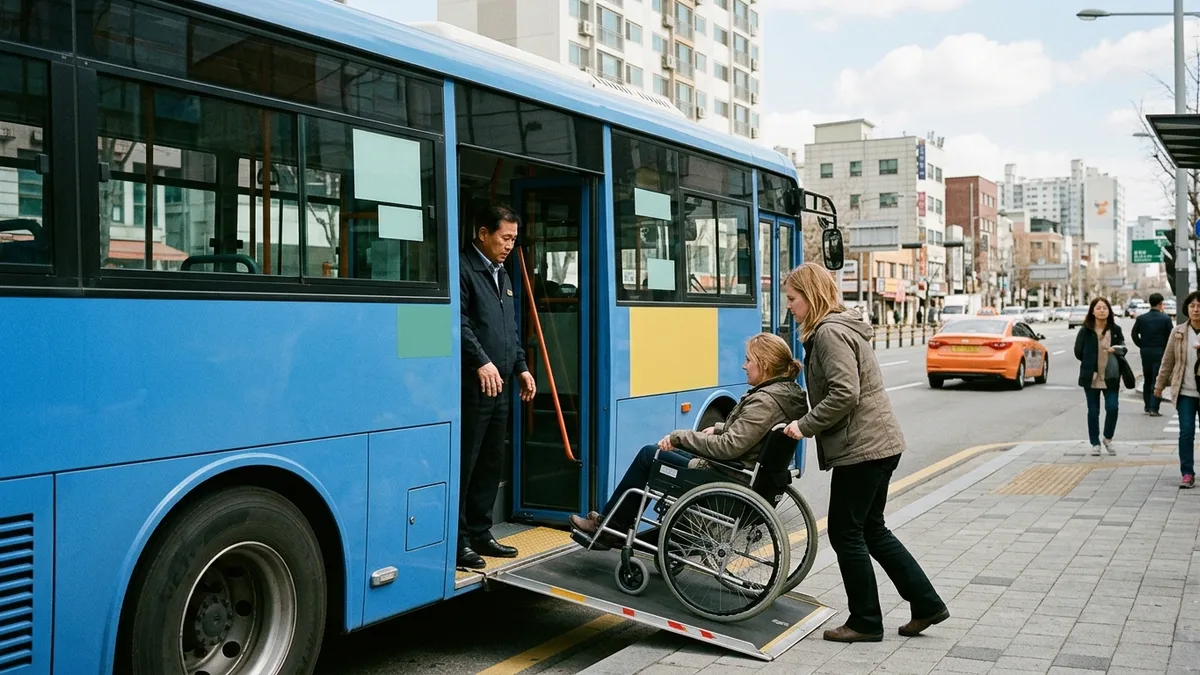
A low-floor bus has no steps at the door, a low chassis floor, and a fitted ramp (slope). Inside, two designated seats are set aside for passengers with reduced mobility. A bus that isn't low-floor, on the other hand, offers no way to board in a wheelchair — so even for the same route number, the outcome depends on which vehicle shows up.
Adoption rates split like this by type.
| Category | Licensed vehicles | Low-floor buses | Share | Source and reference date |
|---|---|---|---|---|
| Seoul city buses | 7,383 | 5,439 | about 73.7% | Seoul bus status (as of 2026-01) |
| Seoul village buses | 1,626 | 318 | about 19.6% | Seoul bus status (as of 2026-01) |
| Adoption rate excluding village buses | — | — | 65.78% | News report citing a Korea Differently Abled Federation survey (2024-12-27) |
| Adoption rate including village buses | — | — | 39% | News report citing a Korea Differently Abled Federation survey (2024-12-27) |
The two sources use different reference dates and different counting scopes, so the numbers look inconsistent with each other. The direction is the same, though. The moment you count village buses, Seoul's low-floor bus adoption rate drops below half. The Ministry of Land, Infrastructure and Transport's 4th Mobility Improvement Plan for People with Reduced Mobility (2022–2026) states a goal of raising village bus low-floor adoption from 3.9% to 49%, but that's a target, not an achievement. Strollers run into the same low-floor bus problem while having no legal provision to stand on at all, and we've covered that separately in taking a stroller on Korean public transit.
There are two routes for reserving a ride.
- Reserving through the Seoul Donghaeng Map app is the current path. It's a real-time, location-based system: once you're within 50 m of the stop, your reservation information is sent to the driver.
- Phone reservation is a system the Seoul city government introduced on April 1, 2019. You arrive at the stop, check which bus is due, and call the bus company's agent; the agent checks the bus's position in the Bus Information System (BIS) and sends the information to the driver's terminal (BMS).
Phone reservations come with time restrictions. You can't reserve during the rush hours of 07:00–09:00 and 18:00–20:00, or after 24:00. You also can't reserve before you get to the stop — you have to call after you've arrived. That said, this guidance is based on a 2019 Seoul city posting, so whether the same procedure is still in place in 2026 needs to be re-confirmed.
This is where the most practical wall stands for foreigners. Phone reservations assume a conversation in Korean, and the alternative route, Seoul Donghaeng Map, bases sign-up on a KakaoTalk, Naver, or Google account. KakaoTalk and Naver often block at Korean mobile number verification, so a Google account effectively becomes the realistic way in. For what you can do without a Korean number, see what works without a Korean phone number.
📌 Important: Seoul Donghaeng Map lists English under "Languages" in its iOS App Store listing (provider: Seoul Metropolitan Government, version 2.2.2, checked 2026-08). However, we couldn't verify on an actual device how far English extends into the menus, the sign-up flow, and the low-floor bus reservation flow. It's safest to set it up once with a friend who reads Korean.
The wall only foreigners hit — registration eligibility, the welfare card, and the free transit card
Every transit fare discount in Korea runs through a single card: the disability registration card (welfare card). The Ministry of Health and Welfare's guide to public utility discounts states that registered persons with disabilities receive a 100% urban railway fare discount (free rides), and nails down that to receive the discount you must present your disability registration card to the facility operator.
But the door to that registration is narrow.
| Category | Details | Basis |
|---|---|---|
| Who can register | Overseas Koreans who have filed a domestic residence report / people with a resident registration as overseas nationals / registered foreign nationals holding a residence status that permits permanent residence / marriage immigrants / recognized refugees | Act on Welfare of Persons with Disabilities Article 32-2(1) |
| Who is not on the list | E-9 employment permit workers, D-2 students, E-7 and most other work and study residence statuses, and short-term visitors | Reading the same provision in reverse |
| Support limitation clause | The state and local governments may limit disability welfare support for these groups in consideration of budget and other factors | Act on Welfare of Persons with Disabilities Article 32-2(2) |
| Condition for free subway rides | 100% urban railway discount for registered persons with disabilities, conditional on presenting the disability registration card | Ministry of Health and Welfare public utility discount guide |
| Buses are separate | Even when the subway is free, city buses are paid | Gwangju Transportation Corporation free transit card guide |
We've covered separately how eligibility splits by residence status in disability registration and transit fare discounts for foreign nationals. Here we'll just draw the transit-side conclusions.
The free transit card works the same way. The Seoul city government's preferential transit card guidance describes eligible recipients as senior citizens aged 65 and over, persons with disabilities, and persons of national merit "residing in Seoul according to their resident registration." Nowhere in the guidance does it say how registered foreign nationals are handled. So whether a foreign national who has completed disability registration in Korea can actually receive this card cannot be determined from the public guidance alone. Confirm whether it can be issued with the Dasan Call Center (120) or your local community service center (주민센터) before you make plans around it.
Even with the card, the scope of application is fixed. Free rides apply only to Seoul metropolitan area urban railways, and if you ride the subway free and then transfer to a bus, the full bus fare is charged.
Caution: We could not find any basis for the claim that a disability certificate issued in your home country gets you free subway rides or rail discounts in Korea. The discount guidance is all written around Korea's disability registration card. Whether there's an exception for short-term visitors has not been confirmed, so it's safer to plan on paying the normal fare than to argue at the fare gate. For high-speed rail, see how to book a KTX wheelchair seat.
When those don't work — the call taxi, Seoul Danurim vehicles, and regular taxis
This is the most practical part of the article. There are public options that fill the gaps where the subway and buses don't work, but the fact that foreigners can use the call taxi service is written only in the Korean-language guidance, and Seoul Danurim vehicles barely reach foreigners even though English guidance exists.
The Seoul Facilities Corporation's call taxi for people with disabilities explicitly lists "foreign nationals with a disability who use a wheelchair" among eligible riders, and states that it verifies proof of foreign nationality (such as a passport) before boarding. That means you can use it with a passport even without a welfare card, and even if your alien registration card hasn't come through yet. The fare is ₩1,500 for up to 5 km, then ₩280 per km for the 5–10 km stretch and ₩70 per km beyond 10 km. There are no time-of-day or zone surcharges, and wheelchair users may bring up to three companions.
There are three things to have ready when you book.
- Your original passport. Since proof of foreign nationality is checked on the spot, a copy or a photo may not be enough.
- Your origin and destination addresses. Writing the Korean addresses down in advance makes the call or app entry much faster.
- The number of people riding with you. Wheelchair users can bring up to three companions, so mention it when you book.
That said, if you think of it as "a taxi that comes right when you call," your schedule will fall apart. Per the Seoul Transportation Department's 2026 work plan, there are 818 call taxis (including 36 added corporate specialized vehicles) and 8,600 voucher taxis for non-wheelchair users with disabilities. The average wait time is trending down — 47.0 minutes in 2023 → 40.8 minutes in 2024 → 33.8 minutes in 2025 — but it's still in the 30-minute range. Plan on booking at least an hour ahead of your appointment time.
The Seoul Tourism Organization's "Seoul Danurim vehicles" are free lift-equipped vehicles for tourism use. Service began on May 26, 2026, with one 29-seat bus (8 wheelchair spaces, 21 regular seats) and six 9-seat minivans (2 wheelchair spaces, 7 regular seats) provided free of charge including driver, fuel, and parking. You sign up on the Seoul Danurim Tourism website and reserve in advance; inquiries go to the Seoul Danurim Tourism Center at 1670-0880. However, we could not confirm from official guidance who is eligible to apply — that is, whether an individual foreign national can book one of these vehicles. The press release lists only vehicle specifications, the scope of free support, the service start date, and the reservation channel, with no eligibility rules. Before you build a schedule around these vehicles, check first at the Seoul Danurim Tourism Center, 1670-0880, or danurim@seouldanurim.net.
| Option | Who can use it | Cost | How to book |
|---|---|---|---|
| Call taxi for people with disabilities | People with a disability who use a wheelchair (foreigners: proof such as a passport verified on the spot) | ₩1,500 up to 5 km, distance-based fare beyond | 1588-4388 / 02-2024-4200, website and mobile app |
| Seoul Danurim vehicles | Eligibility (whether individuals can apply) could not be confirmed from official guidance — check first at 1670-0880 or danurim@seouldanurim.net | Vehicle, driver, fuel, and parking free | seouldanurim.net advance reservation, 1670-0880 |
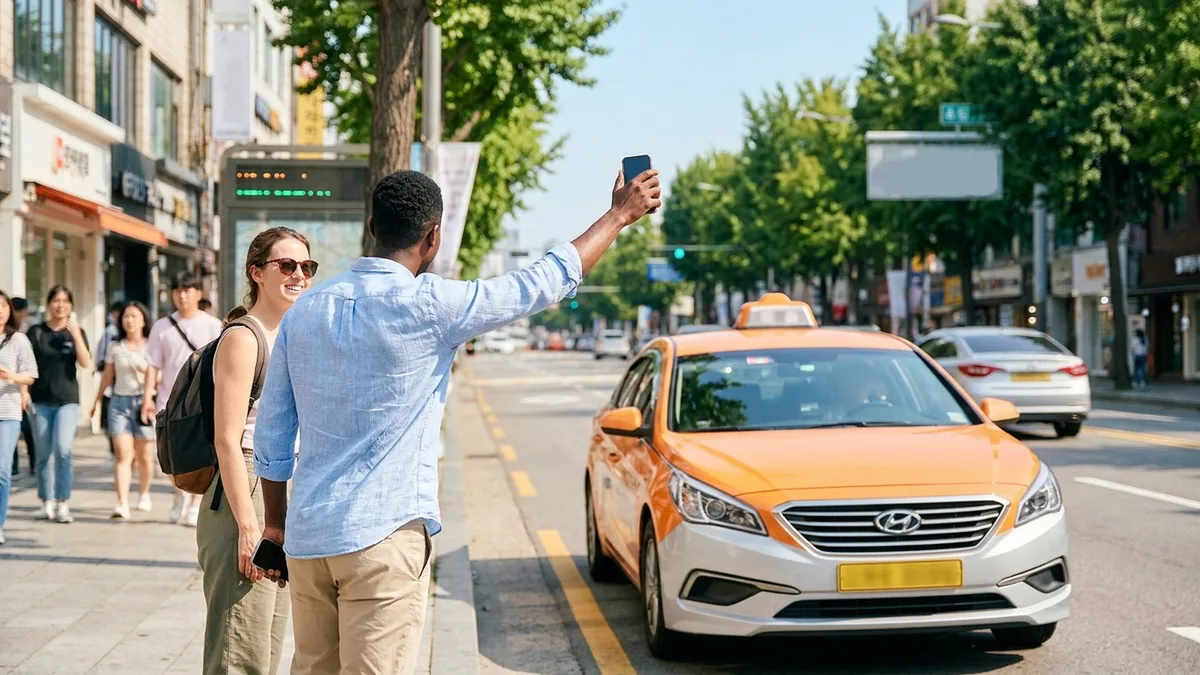
| Regular and large taxis | When a folding manual wheelchair fits in the trunk | Standard taxi fare | Hailing apps such as Kakao T, or hailing on the street |
| LACHA | Taxi and van (5- or 6-seat) hailing under the same conditions, plus transit cards and the Airport Railroad | Standard fares | App, start without identity verification |
Don't misread the third and fourth rows of that table. General hailing apps do not dispatch vehicles with a wheelchair lift. If you need to travel while seated in a power wheelchair, the call taxi and Danurim vehicles are the realistic routes. Taxis become an option only when a folding manual wheelchair can be folded and loaded. For what to do when hailing a taxi itself fails, see calling a taxi without a Korean phone number.
Tip: Seoul Danurim Tourism runs an English site (seouldanurim.net/en) and its reservation categories include a "FOREIGNER" option. Minivan airport pickup, travel mobility equipment rental, and accessibility information for tourist sites are also available in English. The inquiry email is danurim@seouldanurim.net, and responses come on weekdays 09:00–18:00 (KST). 1670-0880 is a domestic-only line and won't connect from abroad, so email before you arrive in Korea.
Bringing or renting a power wheelchair — how the law treats it, and getting from the airport into the city
The thing people bringing a power wheelchair worry about most is "won't it be treated like an electric scooter in Korea?" The short answer is no, it's treated differently.
Article 2, subparagraph 17(a) of the Road Traffic Act excludes strollers, walking-aid wheelchairs, and walkers for the elderly from the definition of a "vehicle." And subparagraph 10 of the same article includes a person traveling by means of a walking-aid wheelchair within the definition of "pedestrian." Article 2 of the Enforcement Rule of the Road Traffic Act defines those walking-aid wheelchairs as manual wheelchairs, power wheelchairs, and medical scooters meeting specifications set by the Commissioner of the Ministry of Food and Drug Safety. In other words, a power wheelchair is legally a pedestrian.
Electric scooters are classified separately as personal mobility devices under subparagraph 19-2 of the same article. Since the two sit under different provisions, there's no need to apply the rules attached to personal mobility devices to power wheelchairs. That said, aviation rules such as battery carriage are a separate matter, so check with your airline before you fly.
Your first day after arrival is actually the riskiest one. Incheon International Airport lends wheelchairs free of charge at every information desk in Terminal 1, Terminal 2, and the Concourse. Electric cart and wheelchair transport services are accepted from 07:00 to 22:00 via the help desk (1577-2600), on-site information desks, and help phones. On departure, if you get a priority card for passengers with reduced mobility at your airline's check-in counter, you can use the dedicated departure area. We've gathered the proof requirements and procedures by category, and what actually works on the arrivals level, in Incheon Airport services for passengers with reduced mobility.
The airport's guidance page also lists call taxi contact numbers: Incheon Transit Corporation 1577-0320, Seoul Facilities Corporation 1588-4388, and Gyeonggi Transportation Corporation 1666-0420. If Seoul is your destination, book through the Seoul Facilities Corporation number — but given that the average wait is in the 30-minute range, allow generous time for immigration and baggage claim when deciding when to book.
Here's an arrival-day sequence that won't strain anything.
- When you come out into the arrivals hall, ask at the nearest information desk for a wheelchair loan or transport assistance. Between 07:00 and 22:00 you can also request it through the help desk (1577-2600).
- After collecting your baggage, decide how you're getting to Seoul. If you want a step-free route, the Airport Railroad is a solid choice; if you need to go door to door while seated in a power wheelchair, book the call taxi.
- If you're going to use the call taxi, it's better to book while you're waiting for your baggage, to absorb the wait time.
Foreigners without a welfare card pay full fare on both the subway and buses. So regardless of discount programs, you still need a transit card and a payment method. From the airport to central Seoul, the Airport Railroad gives you a step-free route and is genuinely useful on your first day, and if a folding manual wheelchair can be folded and loaded, a taxi or a 5- or 6-seat van becomes an option too. LACHA is a transportation and payment super app for foreigners that you can start using right away without identity verification. You can begin with just your passport — no Korean bank account or phone number — and handle KTX, express buses, taxis, vans, the Airport Railroad, and transit cards in one place. That said, dispatching wheelchair lift vehicles and requesting station assistance are not LACHA features; those belong to the public channels described above.
Want to search and book KTX and express buses in one app? Check out LACHA.
Built to work without a Korean phone number or bank account, with overseas payment methods like Alipay, WeChat Pay, and Apple Pay. Taxi hailing plus KTX, express bus, and airport railroad (AREX) booking — all in one app.
Up to 60% off Korea transit with a coupon (max ₩3,000): enter code at sign-up. KTX gets up to 18% off on top
Download now


Frequently Asked Questions (FAQ)
Q1. Does the Seoul subway really have elevators at every station? For the 338 stations on the 11 lines the Seoul city government manages, yes. The city announced that "one station, one route" accessibility was secured on December 29, 2025, with Kkachisan Station on Line 5 as the last one. But that number combines Lines 1 through 8 with the privately financed Line 9, the Ui-Sinseol Line, and the Sillim Line, and stations inside Seoul that are operated by KORAIL fall outside the scope. They look continuous in the same color on the route map, so check which agency operates your destination station in advance.
Q2. I use a wheelchair — can I ride the subway free? The 100% urban railway discount for registered persons with disabilities is conditional on presenting a disability registration card (welfare card). But Article 32-2(1) of the Act on Welfare of Persons with Disabilities limits the foreign nationals who may register to five categories: overseas Koreans who have filed a domestic residence report, overseas nationals with a resident registration, registered foreign nationals holding a residence status that permits permanent residence, marriage immigrants, and recognized refugees. Statuses like E-9, D-2, and E-7, along with short-term visitors, aren't on that list, so even wheelchair users pay the normal fare. We found no basis for substituting a disability certificate from your home country.
Q3. Can foreigners call the disability call taxi? Yes. The Seoul Facilities Corporation explicitly lists "foreign nationals with a disability who use a wheelchair" among eligible riders and states that it verifies proof of foreign nationality, such as a passport, before boarding. The fare is ₩1,500 for up to 5 km, then ₩280 per km for 5–10 km and ₩70 per km beyond 10 km, with no time-of-day or zone surcharges. You book at 1588-4388 (or 02-2024-4200) or through the website or mobile app, and up to three companions may ride along. Note that the 2025 average wait time was 33.8 minutes, so book with time to spare. We couldn't confirm whether foreign-language support is available at the booking line, so ask in advance.
Q4. Can I reserve a low-floor bus in advance? Real-time reservation is possible through the Seoul Donghaeng Map app. Once you're within 50 m of the stop, your reservation information is sent to the driver. There's also phone reservation, introduced in April 2019, but you have to call the bus company's agent after arriving at the stop, and you can't reserve during 07:00–09:00, 18:00–20:00, or after 24:00. Phone reservation assumes a conversation in Korean, and whether this procedure is still identical in 2026 needs to be re-confirmed. Village buses are under 20% low-floor, so it's safest to leave them out of your route from the start.
Q5. Can I bring a power wheelchair to Korea? Do I need a license or a helmet? Article 2, subparagraph 17(a) of the Road Traffic Act excludes walking-aid wheelchairs from the definition of a "vehicle," and subparagraph 10 of the same article includes a person traveling by one within the definition of "pedestrian." Article 2 of the Enforcement Rule places power wheelchairs within walking-aid wheelchairs, so they're handled under a different provision than personal mobility devices such as electric scooters (Article 2, subparagraph 19-2). At Incheon Airport you can borrow a wheelchair free of charge at the information desks in Terminal 1, Terminal 2, and the Concourse, and from 07:00 to 22:00 you can request transport assistance through the help desk (1577-2600).
Note: This article is intended as general information and is not legal advice. The station counts, low-floor bus counts, fares, wait times, and contact numbers in the text are values verified as of 2026-08 from the Seoul Metropolitan Government (bus status, preferential transit card, Transportation Department 2026 work plan), Seoul Metro, the Seoul Facilities Corporation, the Seoul Tourism Organization, Incheon International Airport Corporation, and Ministry of Health and Welfare guidance, along with the text of the Act on Welfare of Persons with Disabilities and the Road Traffic Act. The low-floor bus phone reservation procedure is based on a 2019 Seoul city posting, and we hedged on the actual scope of foreign-language support in Seoul Donghaeng Map, whether a foreign national who has completed registration can be issued a preferential transit card, whether individuals can apply for Seoul Danurim vehicles, and the elevator status at KORAIL-operated stations, because we could not confirm them. Programs for people with reduced mobility change often with vehicle purchases and budgets, so please check each agency's official channels again before you travel. LACHA does not operate wheelchair lift vehicles or special transportation services.