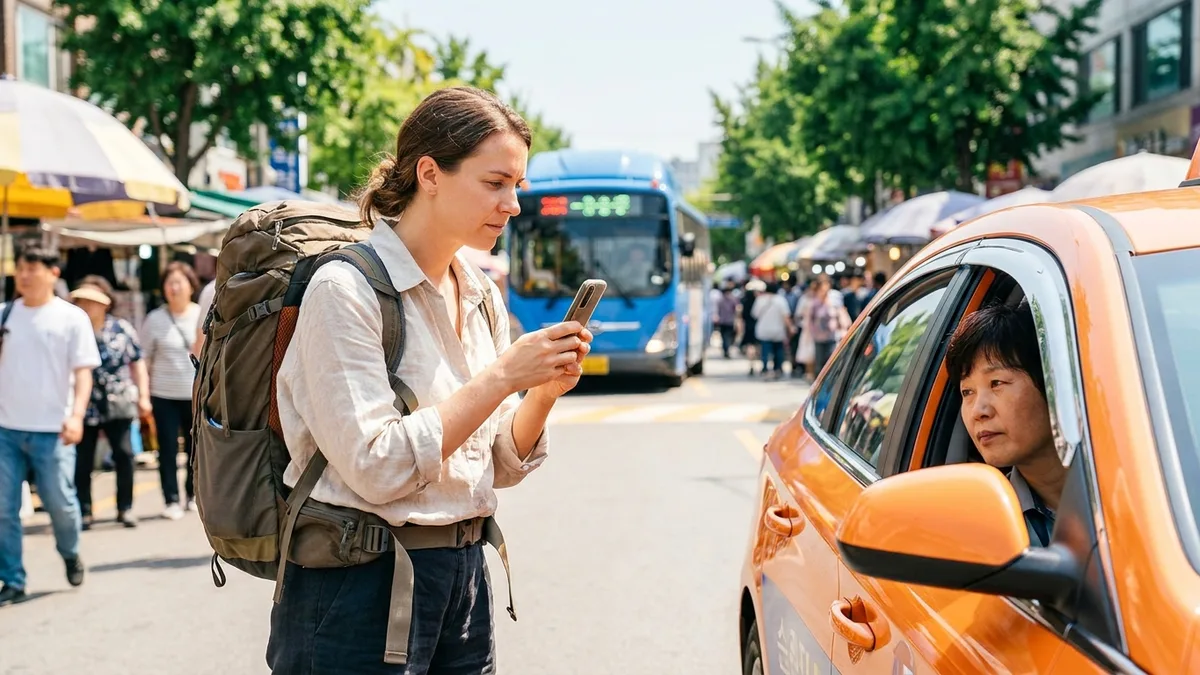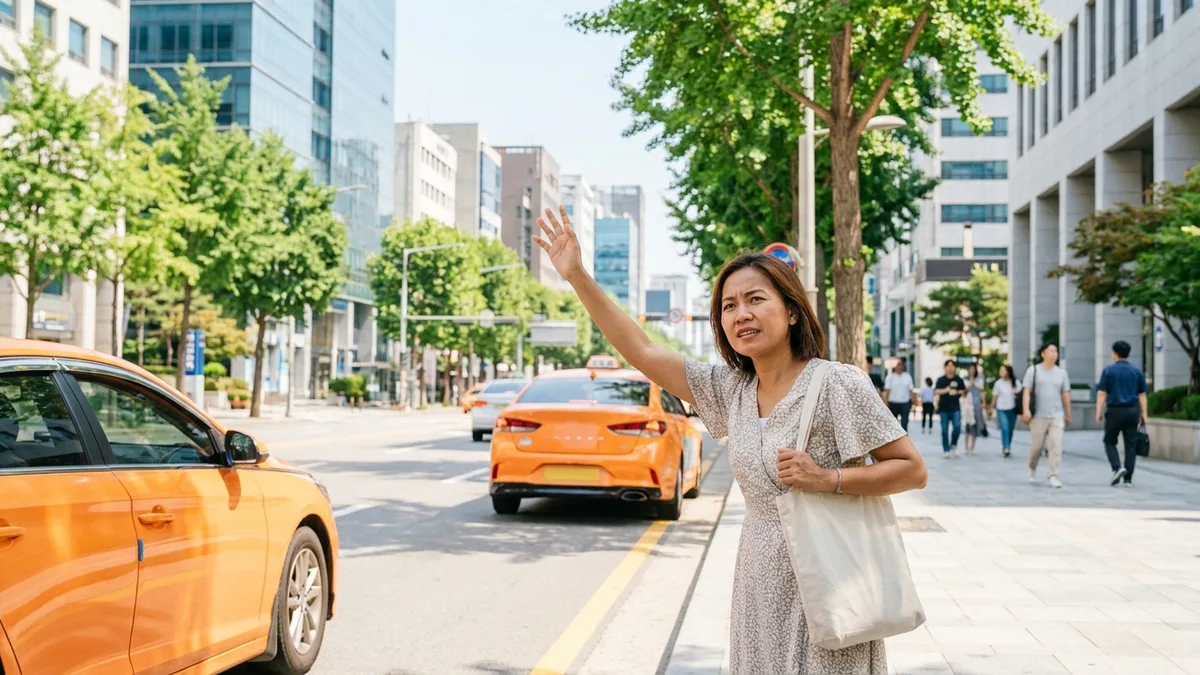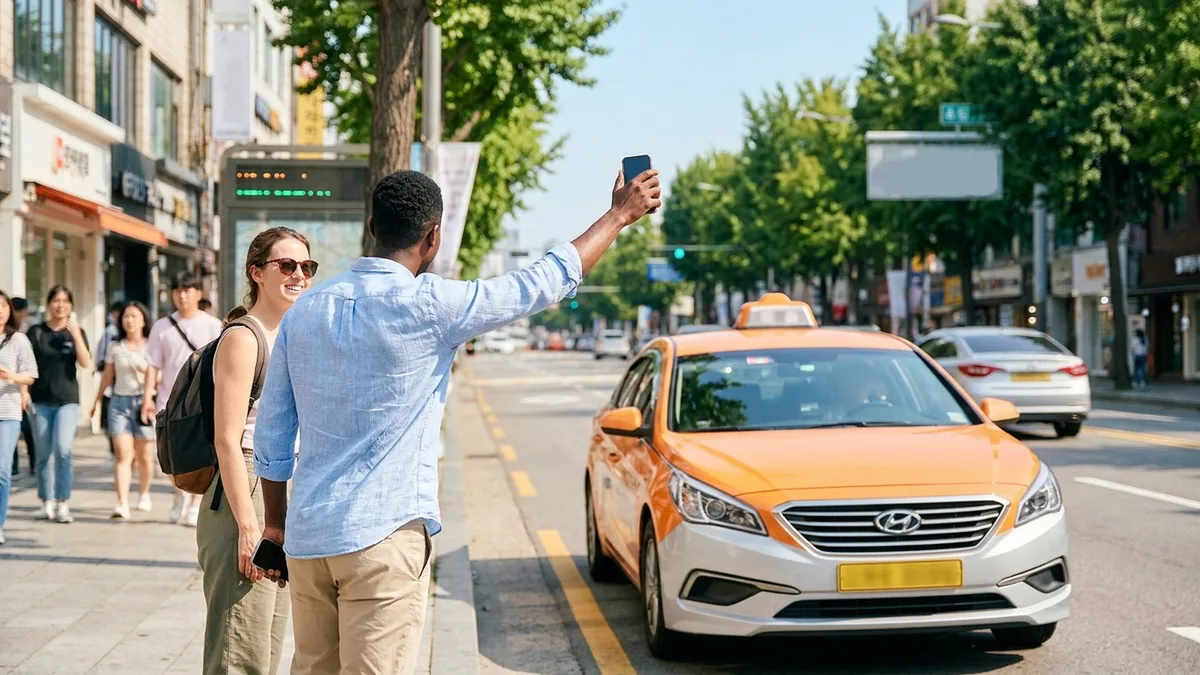
You raise your hand and a taxi pulls over. The driver lowers the window a little, asks where you're going, and then just drives off without a word. Sometimes the doors stay locked and all you get is a wave of the hand. People who haven't been in Korea long often shrug this off as "bad luck today" or "maybe my pronunciation was off."
But this isn't a matter of luck. A taxi refusing to take a passenger without justifiable cause is something the law prohibits. The basis is Article 16(1)1 of the Act on the Development of Taxi Transportation Business (택시운송사업의 발전에 관한 법률, the "Taxi Development Act" for short), which states that taxi drivers must not engage in "refusing a passenger's boarding or making a passenger get off partway without justifiable cause."
This article covers ride refusal only. Being overcharged is a different kind of case altogether. It falls under a different subparagraph of the law, the penalties are different, and the evidence you need is different. For ride refusal, the evidence is the plate number and the circumstances of the refusal; for overcharging, it's the meter, the receipt, and your payment record. If your problem is about the fare, How to avoid taxi scams and disputes in Korea is the right guide.
One thing to say up front. Seoul has stated that among the reports it receives, "cases where an administrative penalty is impossible due to insufficient evidence and similar reasons exceed 90%." What carries a report all the way to a penalty isn't how angry you are but a single line: the plate number. That's why this article spends more space on what to record on the spot when you're refused than on explaining the law.
Note: The laws, penalty criteria, and reporting channels below are summarized as of 2026-09 from the statutory texts on the National Law Information Center and from materials published by the Seoul Metropolitan Government, Incheon Metropolitan City, the 120 Dasan Call Foundation, and the Korea Tourism Organization. Counters and hours can change, so check again on each agency's official page before you report.
The Legal Basis for Ride Refusal Isn't the Passenger Transport Service Act
If you look through Korean-language guidance, quite a few articles cite Article 26(1)1 of the Passenger Transport Service Act (여객자동차 운수사업법) as the basis for ride refusal. But Article 16-3 of that Act's Enforcement Decree explicitly excludes the general taxi transport business (company-run taxis) and the individual taxi transport business (owner-driver taxis) from that provision. Nearly every taxi you catch on the street is one of these two.
So the provision that actually applies is Article 16(1)1 of the Taxi Development Act. Knowing the exact provision keeps you from citing the wrong law in your report, and from wandering onto the wrong statute's page when you look up the original text. The original text is at law.go.kr/법령/택시운송사업의 발전에 관한 법률.
Along with ride refusal, the provision also covers "making a passenger get off partway," in other words being dropped off partway through the ride (도중하차). Being told to get out after you've boarded because "it's not my direction" falls under the same provision and the same penalty criteria. You don't have to let it go just because they let you ride for a bit.
The power to impose penalties lies with the Minister of Land, Infrastructure and Transport and with metropolitan mayors and provincial governors. Article 16(2) of the Taxi Development Act provides that a driver who violates it can have their qualification to engage in driving work revoked, or suspended for a set period of up to 6 months. For a company taxi, under Article 18(1)4 of the same Act, the operator can also face orders such as revocation of its business license, a business suspension of up to 6 months, or a reduction in its number of vehicles (an operator that did not neglect due care and supervision is excluded).
Caution: Ride refusal is not something you report to 112 (police) or 119. It isn't a criminal case but an administrative violation that local governments act on, so the authority over these reports lies with metropolitan mayors and provincial governors and with city mayors, county heads, and district heads. If a separate crime such as assault, confinement, or coercion happened along with it, then 112 is the right number.
What Counts as Ride Refusal, and What Counts as a Legitimate Refusal?
In its guidance on taxi complaints, Incheon Metropolitan City lists the following as acts treated as ride refusal.
- The driver asks where you're going, then refuses to let you in and drives off
- The driver keeps the doors locked and waves you off, or won't open the door
- You tell an empty taxi your destination and it speeds off without responding
- After you've boarded, the driver makes you get out, saying it's not their direction
- The driver picks only passengers headed to destinations they prefer
- After a call-taxi dispatch, the taxi doesn't show up or the driver makes one excuse after another
- The driver demands charges on top of the meter fare and makes you get out
On the other hand, there are also legitimate refusals that the law recognizes. These are the seven listed in both Seoul's and Incheon's guidance.
| Situations treated as a legitimate refusal | Conditions and points to watch |
|---|---|
| A passenger so drunk they can't say where they're going | Doesn't apply if the passenger can still express themselves |
| A trip going outside that taxi's business zone | The legal refusal foreigners run into most often |
| Driving with the taxi roof light off after finishing work for the day | If the vacancy light is on, the taxi is treated as in service |
| Shift change | A sign must be displayed so it's easy to recognize from outside, and the shift change must take no more than 1 hour |
| Waiting for a booked passenger with the call reservation light on | The reservation light display is the basis |
| Boarding with a pet, or with an object that is dangerous or offensive | Judgments differ on things like whether a pet carrier is used |
| Boarding in a traffic lane where there's a risk of an accident | This means stopping the taxi in the middle of the roadway |
The fourth row is the most confusing. Just saying "It's my shift change, I can't go" doesn't count as justifiable cause on its own. It's recognized only when a shift-change sign is displayed so it can be seen from outside, and the shift change takes no more than 1 hour. Knowing about the second row, trips outside the business zone, also saves you some frustration. A Seoul taxi turning down a trip toward Gyeonggi, or a taxi in another region turning down a trip toward a different city or county, is a case the system allows.
And one thing is certain. "Because you're a foreigner" or "because we can't communicate" appears nowhere among those seven. Refusing to take someone because of a language barrier is not justifiable cause, yet many people blame themselves and let it go.
📌 Note: The lists above are the criteria published by Seoul and Incheon. The final call on whether a refusal was actually legitimate is made by the authority that issues the penalty (the local government). Even if your case feels borderline, all you need to do is keep a record, so don't give up in advance.
Penalties Come in Two Tracks — an Administrative Fine and the Driver's Qualification
This is the most misunderstood part. Ride refusal brings two penalties of different kinds, each imposed separately. One doesn't replace the other, and the two aren't added together and treated as one.
The first is an administrative fine (과태료). Article 23(2)1 of the Taxi Development Act provides for an administrative fine of up to 1,000,000 KRW for violating Article 16(1). That 1,000,000 KRW is the ceiling set by law, not the amount actually charged. The actual amount, under the imposition criteria in Attached Table 3 of the Act's Enforcement Decree, is 200,000 KRW for a first violation, 400,000 KRW for a second, and 600,000 KRW for a third or subsequent violation.
An administrative fine is a different system from a criminal fine (벌금), which is a criminal punishment. It's an administrative penalty for public-order violations governed by the Act on the Regulation of Violations of Public Order (질서위반행위규제법), so it leaves no criminal record. Under Article 19(1) of that Act, it can no longer be imposed once 5 years have passed from the day the violation ended, and under Article 18, it can be reduced if paid voluntarily within the deadline for submitting an opinion (by up to 20%, according to Seoul's guidance).
The second is a penalty on the driver's qualification. The "criteria for revocation, etc., of the qualification to engage in driving work" in an attached table of the Taxi Development Act's Enforcement Rule set, for ride refusal, a warning for a first violation, a 30-day qualification suspension for a second, and revocation of the qualification for a third or subsequent violation. This penalty isn't about money but about the driver's very right to drive a taxi.
| Violations within the last 2 years | Administrative fine (public-order penalty) | Driver's qualification penalty (administrative disposition) |
|---|---|---|
| 1st | 200,000 KRW | Warning |
| 2nd | 400,000 KRW | 30-day qualification suspension |
| 3rd or more | 600,000 KRW | Qualification revoked |
Being on the same row doesn't make them one penalty. The two columns are separate tracks drawn from different attached tables, which means a single ride refusal can bring both penalties at once. Seoul presents them side by side too, as in "first violation: 200,000 KRW administrative fine and a warning."
It also helps to know how violations are counted. The counting period is the last 2 years (for other violation types it's often 1 year), and the count is based on "the date the first administrative disposition was made" and "the date the driver was caught committing the same violation again after that disposition date." Being caught several times before any penalty is issued doesn't automatically make it a second or third violation. On top of that, the attached table in the Enforcement Rule includes grounds for reduction. If it was minor carelessness, the harm was slight, or it's a first offense by someone who has worked as a model driver for the most recent 5 years or more, the penalty can be reduced by up to one half; if it was intentional or gross negligence, it's increased within the same range. So you can't say for certain that "three violations always means revocation."
For reference, overcharging (부당요금) is a different item in the same attached table, and it's set more heavily than ride refusal: a 30-day qualification suspension from the first violation, 60 days for the second, and revocation for a third or subsequent violation.
Needs confirmation: Seoul's guidance page groups ride refusal, being dropped off partway, and overcharging into one table as "first violation: 200,000 KRW administrative fine and a warning," but the original attached table in the Enforcement Rule sets a 30-day qualification suspension for a first overcharging violation. It looks like Seoul simplified its table, but we couldn't confirm which one reflects current practice. If the penalty level for overcharging matters in your situation, check directly with the local government that has jurisdiction.
What Turns a Report Into a Penalty Is the Plate Number
This is where the 90% mentioned earlier falls through. You call in angry, the agent asks, "What was the vehicle number?", and the conversation ends right there.
Here are the items Seoul's report form asks for. If even one is missing, the report may still be accepted, but it's hard for it to lead to a penalty.
| Item | How to record it |
|---|---|
| Vehicle number (in full, including the region name) | You need everything down to the region name at the front, like 서울 12가 3456. A photo is the surest way |
| Date and time of the violation | The timestamp on your photo or video serves as the record |
| Location of the violation | If you screenshot a map app, you don't need to know the address |
| What happened | Briefly, what was said and how you were refused |
| Company name and driver's name | Check the markings on the outside of the taxi and inside the car |
| Your name, gender, address, and phone number | Anonymous reports aren't accepted |
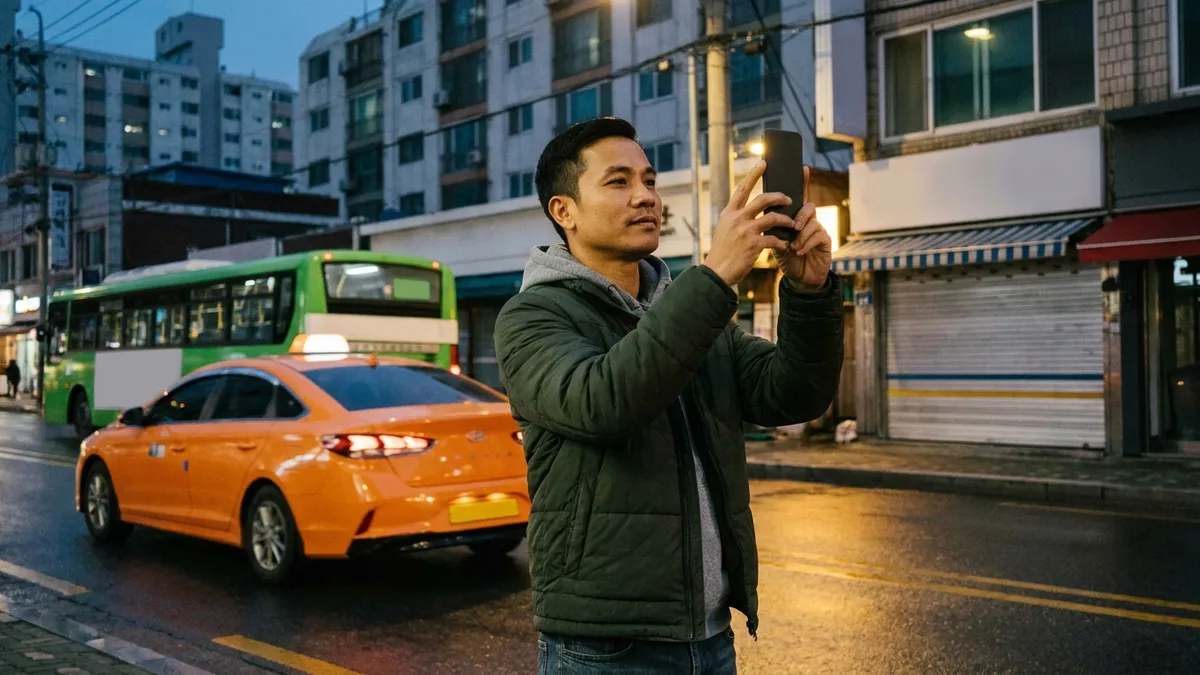
Korean license plates mix a region name with Hangul letters, so they're hard to copy down if you don't read Hangul. Instead of trying to write it down by hand, taking a photo first is much faster. The taxi that refused you has often already pulled away, so the few seconds you spend frozen in surprise are decisive.
- Open your phone camera first. Shoot so that the rear license plate is in the frame, and if you have time, record video. If the driver's words and gestures of refusal are captured too, that's the strongest evidence
- After the car leaves, take one more shot showing nearby buildings or signs. It helps pin down the location
- Open a map app and screenshot your current location. That way you won't need to write the address in Korean
- While your memory is fresh, note down what was said. After a few days, the order of events gets blurry
If you had already boarded and were made to get out, there's one more piece of evidence. Taxi drivers must post their driver qualification certificate where passengers can easily see it (Article 57(1) of the Enforcement Rule of the Passenger Transport Service Act). It shows the company name, the driver's name, the certificate number, and a photo, so you can identify the driver. But if you never got into the car, there's no way to see it, so this only works when you had already boarded, as when you're dropped off partway.
In Seoul, evidence such as video or audio recordings is sent to taxi120@seoul.go.kr after you report to 120. You can't hand over files over the phone, so it's easiest to think of filing the report and submitting the evidence as two separate steps.
📌 Note: We couldn't confirm from primary sources how many days you have to report. The only period set in law is the 5-year limitation period for imposing the administrative fine (Article 19(1) of the Act on the Regulation of Violations of Public Order), and whether local governments have a separate filing deadline in practice needs confirmation. Still, you're better off while the evidence and your memory are fresh, so we recommend filing on the same day or the next day.
Where to Report — Seoul, Outside Seoul, and e-People
The counter is where things most often go wrong. 120 is Seoul City's line, so if you report something that happened in Busan or Daegu to Seoul's 120, it won't get handled.
If it happened in Seoul, go to 120 Dasan Call. It takes reports 24 hours a day, 365 days a year in Korean (the foreign-language line keeps shorter hours; see the table below), and besides phone calls there's the app 서울스마트 불편신고 (Seoul's smart complaint-report app), the chatbot on the KakaoTalk channel 서울톡 (Seoul Talk), live chat, and text-message consultation. If a phone call in Korean feels daunting, the app or chatbot is the better bet, but the screens may be in Korean only, so keep a translation feature turned on as you use them.
Outside Seoul, you need to go to the responsible department at that area's city hall, county office, or district office. In Incheon, it's the Taxi Transportation Division (택시운수과, 032-440-3825). Department names differ from city to city, so the quickest way is to search in Korean for "○○시청 택시 불편신고" (replace ○○ with the city name; it means "[city] city hall taxi complaint"), or you can call the main number and ask to be put through to the department in charge of taxis.
You can also file a complaint with a local government's transportation department through e-People (국민신문고, epeople.go.kr). Its advantage is that it accepts cases from anywhere in the country. However, it requires either a member login or real-name verification for non-members (such as mobile phone identity verification), so you may get stuck without a Korean mobile phone (inquiries: 1600-8172). We couldn't confirm whether you can pass that verification with an alien registration number or a mobile phone registered in a foreigner's name. If you don't have a Korean number yet, the phone and tourist-complaint routes below are the reliable ones. What does and doesn't work without a number is covered in Services you can use without a Korean phone number.
Needs confirmation: We couldn't confirm from each local government's own sources any dedicated taxi-complaint numbers or email addresses for metropolitan cities other than Seoul. What's confirmed goes only as far as the principle of "the responsible department at the relevant city, county, or district office." The same goes for whether Seoul's Eungdapso (응답소) online reporting requires identity verification or offers foreign-language screens.
You Can Report Even If You Don't Speak Korean
There are counters you can reach in a foreign language. The catch is that each one can do different things and keeps different hours.
| Channel | Languages | Hours (as of 2026-09) | What it can do |
|---|---|---|---|
| 120 Dasan Call foreign-language line | English, Chinese, Japanese, Vietnamese, Mongolian | Weekdays 09:00–18:00 | Consultation on Seoul City complaints, three-way interpretation |
| 1330 Korea Travel Hotline | Korean, English, Japanese, Chinese, Russian, Vietnamese, Thai, Malay/Indonesian | Open all year. Many sources list Korean, English, Japanese, and Chinese as 24 hours and the other languages as 08:00–19:00, but some list all 8 languages as 07:00–24:00 | Phone interpretation, consultation on tourist complaints |
| Tourist Complaint Center | Multilingual online filing | Online, any time | Receives reports and forwards them to the handling agency |
| Seoul Tourist Complaint Center | Korean, English, Japanese, Simplified Chinese | 09:00–18:00 | Filing by phone, email, or online |
For 120 Dasan Call's foreign-language consultation, dial (02)120, press 9 in the automated menu, then choose your language (1 English, 2 Chinese, 3 Japanese, 4 Vietnamese, 5 Mongolian). From overseas, it's +82-2-731-2120. Three-way interpretation is also available if needed. However, we couldn't confirm whether this consultation actually files the report for you, or whether it's interpretation that helps connect you with a Korean-speaking agent. Once connected, it's best to state your purpose first: "I want to report a taxi ride refusal."
The 1330 Korea Travel Hotline (관광통역안내전화) is run by the Korea Tourism Organization (1330 within Korea, +82-2-1330 from overseas). One thing needs to be made clear here. 1330 helps with interpretation and consultation; it isn't a place with the power to impose penalties. If you think "I called 1330, so my report is done," the actual report never gets filed. What 1330 is useful for is interpreting that call when you file your report with the local government.
The Tourist Complaint Center (관광불편신고센터; touristcomplaint.or.kr, tourcom@knto.or.kr, phone 1330) accepts online reports in the transportation category, including taxis. Reports filed in a foreign language are translated and forwarded to the handling agency within 8 working hours, and the handling agency is supposed to reply in English or in the reporter's native language. When you're not confident filling out a Korean form, it's the most realistic route. For cases in Seoul, there's also the Seoul Tourist Complaint Center (서울관광불편신고센터, 1800-9008, tcc@sta.or.kr).
There's also one more: the airport QR survey. Since June 19, 2025, Seoul has been handing out business-card-size survey cards printed with QR codes in English, Chinese, and Japanese at places such as the departure halls of Incheon and Gimpo airports, and it checks the vehicle number, time, and whether you were overcharged, as written in your responses, against vehicle records. However, we couldn't confirm whether it's still running as of September 2026, or whether the cards are still handed out at the same places.
The most important thing in this table is the hours. Korean-language 120 consultation runs 24 hours, but the foreign-language line runs only on weekdays, 09:00–18:00 (closed on weekends and public holidays). Yet ride refusals cluster late at night and on weekends. At 2 a.m. the only place you might reach by phone in a foreign language is 1330, but while Government24 (정부24) and many other sources list English, Japanese, and Chinese as 24 hours, some, such as the Gimhae City tourism portal (김해관광포털), list all 8 languages as 07:00–24:00, so you may not get through in the middle of the night. For Russian, Vietnamese, Thai, and Malay/Indonesian, some sources list even shorter hours of 08:00–19:00. On top of that, 1330 has no power to impose penalties. The route that isn't tied to phone hours is filing online with the Tourist Complaint Center, but even there it can take up to 8 working hours for your report to be translated and passed to the handling agency.
📌 So here's the order to follow: on the spot, only collect evidence, and file the report during the daytime on a weekday. If the next day falls on a weekend or a public holiday, 120's foreign-language line is closed too, so file online with the Tourist Complaint Center, or, if it happened in Seoul, file with the Korean-language 120 line, which is open 24 hours, using interpretation from 1330. Your photos and videos carry timestamps, so filing later doesn't reduce the value of the evidence. For alternatives when you're stranded late at night, see What to do when you miss the last train in Seoul.
For reference, Seoul also runs on-site enforcement focused on foreign visitors. In 2024, 7,435 interviews turned up 345 violations, and through the end of May 2025, 2,901 interviews led to 143 violations caught (the main types were overcharging, not using the meter, and operating outside the business zone). These are enforcement figures released by Seoul, not nationwide statistics.
What Happens After You Report
After you file, things go quiet and it's easy to get anxious, but there is a set procedure. In Seoul, the order is report received by 120 → transferred to the district office's Transportation Administration Division or Traffic Guidance Division → traffic review → administrative disposition. Along the way, there's a step where the district office confirms the facts with the driver.
How long it takes depends on whether the driver admits the violation.
- If the driver admits the violation: closed within 10 days
- If the driver doesn't admit it: 30–60 days, after going through a hearing and a review committee
- The result is sent by text message or by mail (another Seoul guidance page also says within 15–30 days after the report is received)
There are two things to know in advance. First, the reporter's personal details are required, so anonymous reports aren't possible, and the result is sent to the Korean address or number you gave when reporting. If you're leaving Korea soon, you may not receive the result.
Second, reporting doesn't guarantee a penalty. If the driver denies it, the case goes through review, and if the evidence is insufficient, it can end with no penalty. What decides the outcome isn't how forcefully you report but the record you made on the spot.
Needs confirmation: We couldn't confirm from official documents whether an in-app report on a hailing app like Kakao T leads to an administrative penalty from the local government. Even if you've reported it in the app, it's safer to also file separately with the local government.
Better Yet, Avoid Being Refused in the First Place
Reporting is a response to something that has already happened. Better still is cutting down the situations where you can be refused at all.
Flagging a taxi on the street puts you at a structural disadvantage. The driver can hear your destination through the window and then decide whether to go. According to Kakao Mobility's official explanation, a regular taxi call on Kakao T uses "destination-shown selective dispatch," where the driver sees both the pickup point and the destination. Kakao T Blue, by contrast, uses "destination-hidden automatic dispatch," where only the pickup point is shown and the call is automatically accepted if there's no response within the time limit. That's why short trips and unpopular directions get passed over under selective dispatch.
Why your calls keep failing is covered in Top 10 reasons foreigners fail to hail a taxi in Korea, and getting stuck at sign-up or payment is covered in Kakao T for foreigners. There are also ways to improve your odds on the spot.
- Get in at a taxi stand or on a main road. Deep in side streets, taxis have trouble stopping and drivers have trouble finding you
- Screenshot your destination in Korean and show it on your screen. It cuts down the back-and-forth
- Late at night, know the fare structure before you ride. Surcharges by time of day are covered in Korea taxi late-night surcharges explained
- If you can't take calls from the driver because you don't have a Korean number, read How to call a taxi in Korea without a Korean phone first
- For special mobility needs such as using a wheelchair, there's a separate guide: How foreigners can use Seoul's disabled call taxi
Having several ways to call a ride is another option. LACHA is a transport and payment app built for foreign users, so you can start without identity verification through a Korean bank account or phone number, and you can pay fares with overseas easy-pay services like Alipay and WeChat Pay or with an overseas card. Because the destination and payment method are already set at the calling stage, you tend to run into fewer situations where you're refused while telling a driver your destination on the street. The ride record left in the app helps too. If you were made to get out partway, you can copy the date, time, place, and route for your report straight from that record. LACHA covers five services: taxis, KTX, express buses, VANs (5- and 6-seaters), and the Airport Railroad (AREX). Receiving reports and imposing administrative penalties are the job of 120 and local governments, so LACHA doesn't handle them for you.
Want to get a taxi without a Korean phone number? Check out LACHA.
Built to work without a Korean phone number or bank account, with overseas payment methods like Alipay, WeChat Pay, and Apple Pay. Taxi hailing plus KTX, express bus, and airport railroad (AREX) booking — all in one app.
KTX now up to ₩10,000 off. Enter code at sign-up for 3,000P on top
Download now


Frequently Asked Questions (FAQ)
Q1. The driver said "It's my shift change, I can't go" and wouldn't take me. Can I report it? A. It depends on the situation. For a refusal over a shift change to be legitimate, a shift-change sign must be displayed so it's easy to recognize from outside, and the shift change must take no more than 1 hour. A refusal given only verbally, with no sign, is hard to treat as justifiable cause. If you're not sure what you saw, just keep the plate number and the time, and file the report. The final decision is made by the local government that receives the report.
Q2. I didn't see the plate number. Can I still report it? A. You can try to file it, but it's unlikely to lead to a penalty. A required item on Seoul's report form is the full vehicle number, including the region name, and Seoul has said that "cases where an administrative penalty is impossible due to insufficient evidence and similar reasons exceed 90%." Next time, don't try to write it down by hand; turn on your phone camera first. One photo showing the rear plate is decisive.
Q3. If I report a ride refusal, will the driver end up with a criminal record? A. No. What's imposed for ride refusal is an administrative fine (과태료), an administrative penalty for public-order violations governed by the Act on the Regulation of Violations of Public Order, which is a different system from a criminal fine (a criminal punishment). The actual amounts are 200,000 KRW for a first violation, 400,000 KRW for a second, and 600,000 KRW for a third or subsequent violation (the legal ceiling is 1,000,000 KRW). Separately, a penalty on the driver's qualification is imposed on its own track: a warning for a first violation, a 30-day qualification suspension for a second, and revocation for a third or subsequent violation. The two penalties are different tracks, so don't read them as adding up to one.
Q4. Can I report without a Korean mobile phone? A. The phone and tourist-complaint routes are still open to you. e-People requires a login or real-name verification for non-members, so you may get stuck there. Instead, you can get interpretation through 1330 (1330 within Korea, +82-2-1330 from overseas) and report to the local government, or file online with the Tourist Complaint Center (touristcomplaint.or.kr), which translates your report and sends it to the handling agency within 8 working hours. However, we couldn't confirm whether e-People's real-name verification works with an alien registration number or a mobile phone registered in a foreigner's name.
Q5. It happened outside Seoul. Can I report it to 120? A. No. 120 Dasan Call is Seoul City's line, and the evidence email address (taxi120@seoul.go.kr) and the airport QR survey are Seoul City programs too. Something that happened in Busan, Daegu, or elsewhere only gets handled if you report it to the responsible department at that area's city hall, county office, or district office. In Incheon, the Taxi Transportation Division (택시운수과, 032-440-3825) handles it. If you can't find the right department, filing through e-People gets your complaint forwarded to the local government with jurisdiction.
Note: This article is for general information. The laws, penalty criteria, and reporting channels in the text are values we confirmed as of 2026-09 from the original texts, on the National Law Information Center, of the Act on the Development of Taxi Transportation Business and its Enforcement Decree and Enforcement Rule, the Enforcement Rule of the Passenger Transport Service Act, and the Act on the Regulation of Violations of Public Order, and from public guidance by the Seoul Metropolitan Government, Incheon Metropolitan City, the 120 Dasan Call Foundation, the Korea Tourism Organization (1330, Tourist Complaint Center), and e-People. Local governments' filing deadlines in practice, whether Seoul's Eungdapso online reporting requires identity verification or supports foreign languages, whether foreigners can use e-People's real-name verification for non-members, whether the airport QR survey is currently running, how far 120's foreign-language consultation goes in filing reports, dedicated contacts for metropolitan cities other than Seoul, and whether in-app reports on hailing apps lead to administrative penalties could not be confirmed from primary sources, so we have not stated them definitively. Laws and penalty criteria get amended, and counters and hours change too, so before you report, check again on the National Law Information Center and the official channels of the local government with jurisdiction, 120 Dasan Call, and 1330. This article is not legal advice. LACHA does not receive ride-refusal reports or impose administrative penalties, and it does not handle complaints on your behalf.