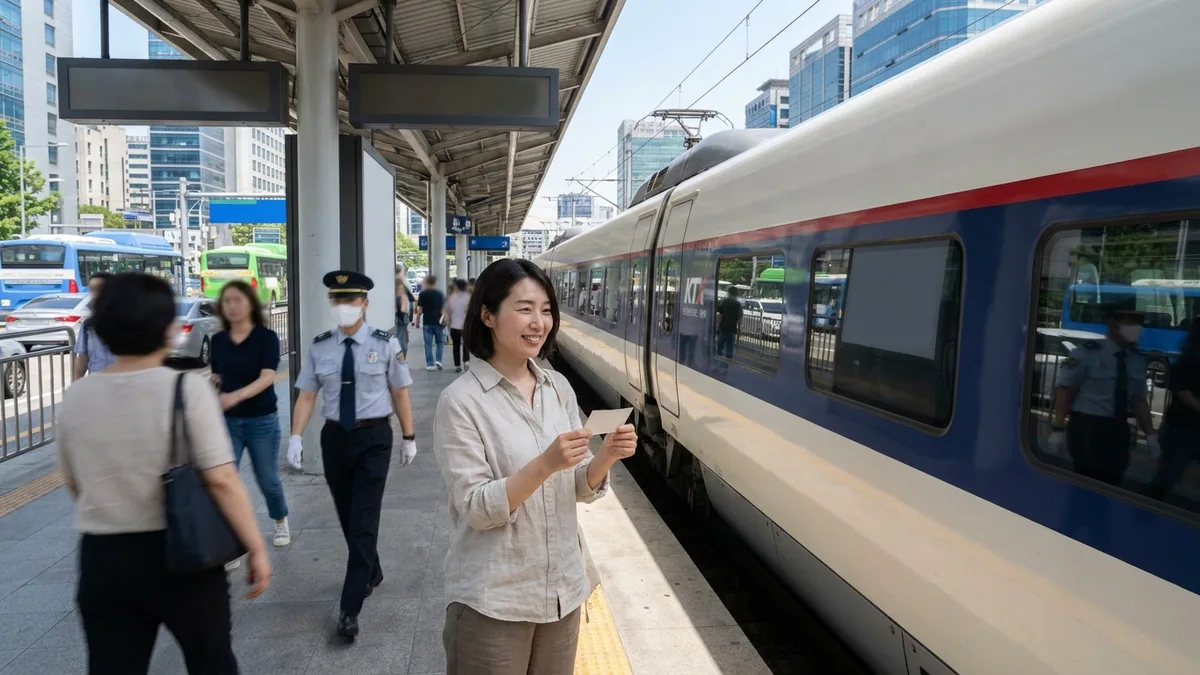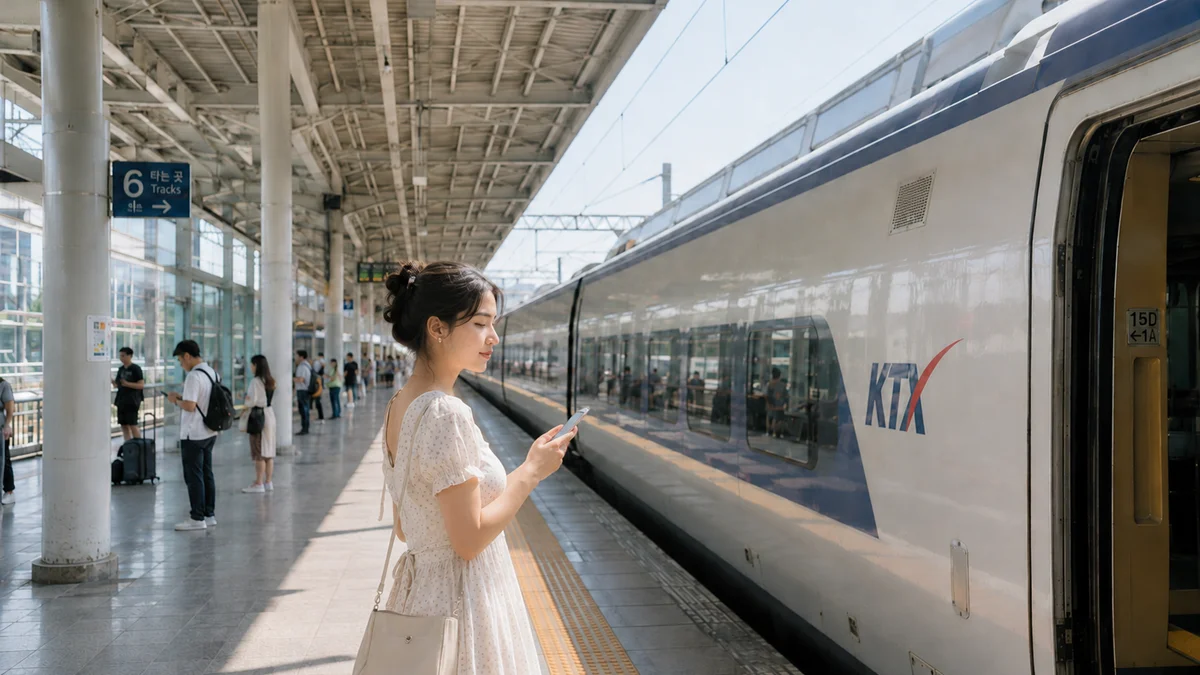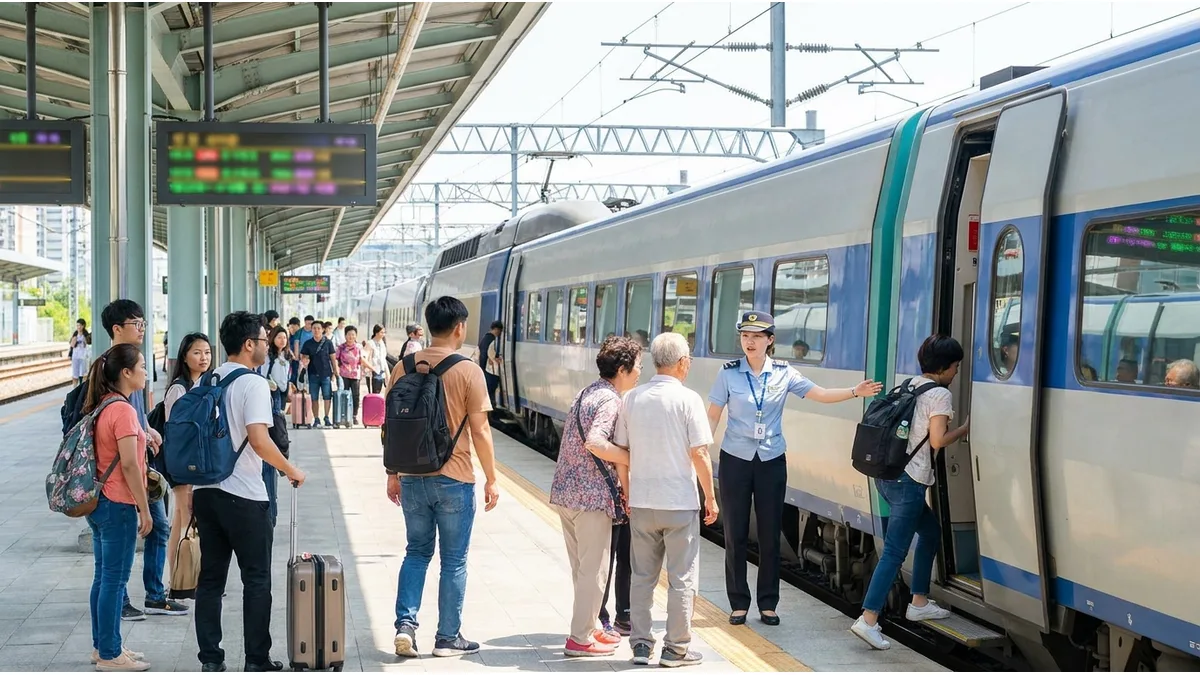
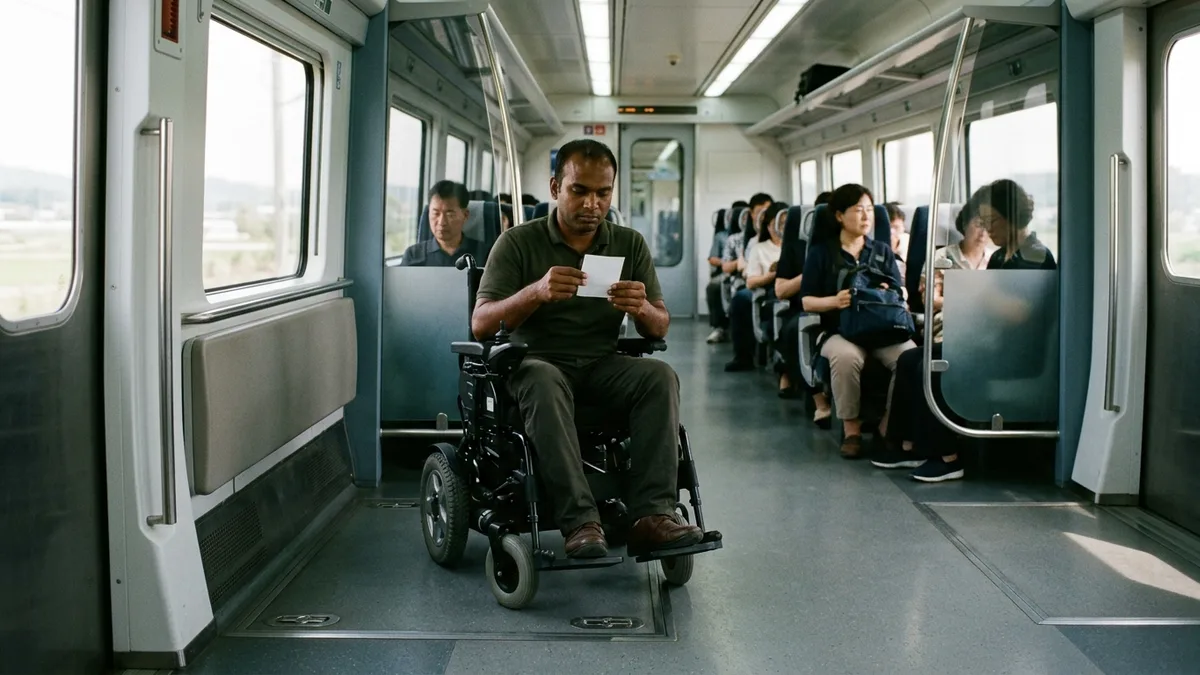
KTX wheelchair spaces sit in a different car depending on the train's name. Trains simply labeled "KTX" put them in Car 2, KTX-Sancheon in Car 1, and KTX-Eum and KTX-Cheongryong in Car 3. Moving between cars on the platform right before departure is essentially impossible in a powered wheelchair, so this single line is the first thing to check before you buy a ticket.
Seat types split in two as well. Korail operates wheelchair seating in two forms — powered-wheelchair spaces and designated wheelchair seats. The first isn't a spot with a chair; it's an area where your wheelchair is secured directly to anchors in the car floor. The seat numbers are different for each type, too.
The fare side is blunter. Railway disability discounts require you to present a Disability Registration Card (welfare card), and Article 32-2 of the Act on Welfare of Persons with Disabilities pins down exactly five categories of foreign nationals who can register: overseas Koreans who have filed a domestic residence report, overseas nationals registered on the resident registry, registered foreign nationals holding permanent-residency status, marriage immigrants, and recognized refugees. If you're not on that list — E-9 workers, D-2 students, short-term visitors — there is simply no institutional path to a discount.
But even getting to that fact is hard. Korail's Korean site has a "Transportation Vulnerable Support Service" page, yet there's no equivalent page on the English site (verified 2026-08-25). Readers who only read English can easily conclude "Korean high-speed rail can't accommodate wheelchairs" without ever learning that wheelchair spaces exist on KTX at all.
Note: The seat locations, discount rates, request deadlines, and legal provisions in this article were verified as of 2026-08 against Korail's (korail.com) Transportation Vulnerable Support Service and discount program pages, SR (etk.srail.kr) notices, and the original statutes on the Korean Law Information Center (law.go.kr). Seat layouts and policies can change depending on the rolling stock assigned and new notices, so double-check with Korail and SR official channels before booking.
There Are Two Kinds of Wheelchair Seating — And the Names Are Confusingly Similar
Korail runs two different types of seating for wheelchair users. The names sound alike, but they work completely differently.
A powered-wheelchair space is not a seat. It's an open area with no chair, fitted with floor anchors, so you roll in and lock your powered wheelchair in place. It has a seat number, but there's no chair to sit on.
A designated wheelchair seat is the opposite. It's a regular seat, meant for people who transfer out of their wheelchair and into the seat.
So the choice is simple. If you need to travel while remaining in your powered wheelchair, take a powered-wheelchair space. If you can transfer into a seat, take a designated wheelchair seat. The two types have entirely different seat numbers, so picking the wrong one means switching on the spot — and moving between cars within a high-speed train's brief station stop isn't realistic.
Which Car Is My Train's? — Locations by Train Type
Which car holds the wheelchair seating depends on the train type. Korean passengers can correct course using station announcements and platform signage, but navigating a platform in a powered wheelchair when you can't understand the Korean announcements is another story entirely. Check the train name before you buy.
| Train | Powered-wheelchair space | Designated wheelchair seat |
|---|---|---|
| KTX | Car 2, 1A·1C | Car 2, 2A·2B·2C |
| KTX-Sancheon | Car 1, 12A·12D | Car 1, 11A·11C·11D |
| KTX-Eum | Car 3, 1D·2A | Car 3, 2D·3A·3B |
| KTX-Cheongryong | Car 3, 1D·2A | Car 3, 2D·3A·3B |
| ITX-Cheongchun | Car 3, 1A | Car 3, 1D·2A·2D·3A |
| ITX-Saemaeul | Car 3, 1A·2D | Car 3, 2A·3D |
| Nuriro | Car 2, 1D·2D | Car 2, 1A·2A·3A·3B·3D |
| Mugunghwa-ho | Car 3, 67·68 | Car 3, 65·66 |
| Saemaeul-ho·Commuter train | None | None |
The train name appears right next to the departure time on the booking screen. Even on the same route, "KTX" and "KTX-Sancheon" run mixed together, and KTX-Eum serves the Gangneung and Jungang Line directions. One word of difference in the name means a two-car difference in location.
Heads up: KTX-Cheongryong appears as Car 3 (powered-wheelchair spaces 1D·2A / wheelchair seats 2D·3A·3B) on Korail's seat maps, but the "wheelchair seat operations" table on the same site doesn't list it yet (verified 2026-08-25). This may just be an update lag between two pages, so if you book Cheongryong, treat the car and seat numbers printed on your ticket as final and confirm once more at the station.
Saemaeul-ho and commuter trains have no powered-wheelchair spaces or designated wheelchair seats at all. If you need to travel that route, first check whether another train type runs on the same line.
Where Can You Book? — App, Web, and Station Counters
Wheelchair seating may not be selectable straight from the screen the way regular seats are. We were not able to verify on the live screens whether you can directly pick a wheelchair seat in Korail's booking flow (web or app). The reliable paths are the station counter and the rail customer center (1588-7788).
| Channel | Wheelchair seat booking | Boarding assistance request | Where foreigners get stuck |
|---|---|---|---|
| Station counter | Staff assign the seat directly | Filed on the spot at the same time | In-person Korean. Counter operations may differ during holiday booking periods |
| Korail+ app (formerly Korail Talk) | Whether you can select it directly on screen needs verification | "Boarding assistance request" on the ticket confirmation screen | Many people get blocked at sign-up, identity verification, or overseas card payment |
| Rail customer center 1588-7788 | An agent assigns it | Filed by phone | Korean-language calls only |
| Korail English site | There's no accessibility information page at all (verified 2026-08-25) | No information | No way to even learn wheelchair seating exists |
| LACHA | Not confirmed (general KTX, express bus, and taxi booking/payment do work) | Not confirmed | For wheelchair seat assignment and assistance requests, Korail/SR official channels are the sure bet |
Korail's website supports eight languages: Korean, English, Japanese, Chinese (Simplified and Traditional), Vietnamese, Thai, and Indonesian. Yet the page corresponding to the Korean "Transportation Vulnerable Support Service" doesn't exist in English. In other words, switching languages doesn't bring the wheelchair seating information along with it.
Heads up: Korail's official guidance doesn't state whether a foreign national without a welfare card can book a wheelchair seat or powered-wheelchair space at the regular, undiscounted fare. It reads as though anyone who actually uses a wheelchair qualifies for the seating, but this needs a definitive answer, so we recommend confirming once with 1588-7788 or at a large station counter like Seoul Station before booking. (Needs verification)
Getting stuck in the app isn't a wheelchair-specific problem. The points where Korail+ sign-up and payment break down are covered separately in Korail+ Problems for Foreigners and Alternatives, and workarounds for when your overseas card is declined are in KTX Booking — Without a Korean Card or Identity Verification.
Tip: To sit next to your companion, request the wheelchair seat and the companion's seat together at one counter. Booking them separately can leave you split apart depending on what's left.
Fares and Discounts — Why Foreigners Get Stuck at the Welfare Card
Rail fare discounts for people with disabilities are grounded in Article 30 of the Act on Welfare of Persons with Disabilities and Article 17(1) plus Appendix 2 of its Enforcement Decree. The discount rate depends on the degree of disability.
| Category | KTX·ITX-Saemaeul | Mugunghwa-ho (Nuriro) and below | Conditions |
|---|---|---|---|
| Severe (person with a severe disability) | 50% | 50% | Includes one accompanying caregiver |
| Mild (person with a disability that is not severe) | 30% | 50% (per Ministry of Health and Welfare / Ministry of Government Legislation) | For KTX and Saemaeul-ho, excludes Saturdays, Sundays, and public holidays |
Two things worth noting here.
- The disability grading system was abolished in 2019, so the current standard is "severe disability / non-severe disability." Plenty of blogs and institutional pages still say "Grades 1–3: 50%, Grades 4–6: 30%," but that's no longer the terminology.
- Public discounts (disability, national merit, senior, etc.) cannot be combined with commercial discounts such as internet special fares. You calculate which is cheaper and pick just one.
To actually receive the discount, you need documentation. Article 17(2) of the same Enforcement Decree requires the person seeking the discount to present a Disability Registration Card or mobile registration card to the facility operator (unless the operator verifies the registration information directly).
And this is exactly where foreign nationals hit the wall. To get the card, you must be registered as a person with a disability — but Article 32-2 of the Act limits eligible foreign nationals to five categories.
| Foreign nationals eligible for disability registration (Act on Welfare of Persons with Disabilities, Art. 32-2) | Legal basis and typical status |
|---|---|
| Overseas Koreans who have filed a domestic residence report | Overseas Koreans Act Art. 6 — usually F-4 |
| Overseas nationals registered on the resident registry | Resident Registration Act Art. 6 |
| Registered foreign nationals with permanent-residency status | Immigration Act Art. 31 — usually F-5 |
| Marriage immigrants | Framework Act on Treatment of Foreigners Residing in Korea, Art. 2(3) |
| Recognized refugees | Refugee Act Art. 2(2) |
| All other statuses | E-9, E-7, D-2, B-2, C-3 and others are not eligible for registration |
To sum up: E-9 Employment Permit System workers, E-7 skilled professionals, D-2 students, and short-term visitors (B-2, C-3) have no path to Korean rail disability discounts. No original source — Korail, the Ministry of Health and Welfare, or the Ministry of Government Legislation — states that a disability certificate issued in your home country or a foreign disability card qualifies for a discount. Getting turned down at the counter means missing your train, so it's safer to budget from the start for the full undiscounted fare.
Even if you fall into an eligible category, there's one more thing to know. Article 32-2(2) of the Act provides that the national and local governments may limit support for disability welfare programs in consideration of budget and other factors. We couldn't confirm through actual cases how this applies to rail discounts in practice (needs verification), so after you receive your card, check at the counter on your first trip before boarding.
Requesting Boarding Assistance — 30 Minutes Before Departure Is the Cutoff
If you need to travel without a companion, you can request the "assistance service for passengers with disabilities and elderly passengers." It's for wheelchair users, blind passengers, and others with mobility difficulties who are traveling without a caregiver.
It works like a relay. Staff at the departure station guide you to the train and get you aboard, hand you off to the onboard crew, and staff at the arrival station receive you and guide you to the exit.
Start with the deadline. Both Korail and SR say up to 30 minutes before the train departs. SR spells out "arrive at the departure station at least 30 minutes before departure and apply at the accessibility information desk," making clear it's an on-site application; Korail's wording is just "30 minutes before train use," which leaves it unstated whether that refers only to on-site applications or includes online ones as well (needs verification).
There's an online option too. According to Korail, after purchasing a wheelchair-seat ticket you apply via the "boarding assistance request" icon on the "ticket confirmation" screen, and the departure station, train number, meeting point, and time are sent by SMS or KakaoTalk alert immediately after applying and again two hours before departure. That said, this guidance dates from the 2021 launch, so whether the menu name and location are the same in 2026 needs to be checked on the app itself.
The online deadline needs separate verification. A 2021 press release includes a passage instructing that online applications be made by the day before departure (D-1), so whether the current online cutoff matches the 30-minute on-site window isn't laid out in any official document (needs verification). Your same-day app request might not go through, so if you're pressed for time, it's safer to apply at a station counter or by phone (1588-7788 / 1800-1472).
Heads up: Requesting assistance doesn't guarantee it will be assigned. SR states that when requests cluster in the same time slot, service is provided in order of application, but with top priority given to holders of a disability welfare card — blind or physically disabled passengers who cannot board or move through the station without staff help. It's not stated where a foreign national without a welfare card falls in that order (needs verification). Don't cut your train time close; leave yourself a buffer.
There's also a program called the "Customized Priority Reservation Service (One-Call Service)." It covers seniors aged 65 and over, people with disabilities, and persons of national merit with a disability rating; enrolling gets you priority connection to an agent when you call the rail customer center, plus phone payment and ticketing. However, to enroll you must go to a station in person, have your eligibility verified with a resident registration card, welfare card, or national merit card, and submit an application form. And the service itself is Korean-language phone support — so a program designed to help people who struggle with online booking is, in practice, hard for foreigners who can't read Korean screens to enter at all.
What Changes on Suseo-Departing Trains (Formerly SRT) — Car 1, and Wheelchair Dimensions
Trains departing from Suseo (formerly SRT, and KTX-Sancheon as of 2026-09-01) put their wheelchair seating in a different spot: Car 1. When two trainsets run coupled together, there are two locations — Car 1 and Car 11. That's why you shouldn't be standing on the platform looking for Car 2 on KTX logic.
Eligibility widened for trips on or after November 1, 2022. Even without a wheelchair, passengers who have been assessed as having a walking disability and who carry a mobility aid such as a walker or rollator can use these spaces.
Size limits are published only for the Suseo-departing trains. SR's accessibility assistance service is provided only for wheelchairs measuring 700mm × 1,212mm or smaller, per the SRT accessible-seating specifications. Large powered wheelchairs used overseas may exceed this, so measure your wheelchair's width and length before you come to Korea. Korail doesn't publish wheelchair dimension or weight standards, so you can't assume the same limits apply to KTX (needs verification). For SR inquiries, call 1800-1472.
The discount structure is similar to KTX: 50% for severe disability (including one accompanying caregiver) and 30% for mild disability, with the mild-disability discount not applying on weekends and public holidays. However, discounted tickets can only be purchased by members who have completed discount-eligibility registration and verification — so if you're blocked at the membership step, you can't access the discount at all. This reflects SR's pre-integration guidance, so how the process is reorganized within Korail+ after the 2026-09-01 integration needs to be checked in official notices (needs verification).
There's one big variable. As of September 1, 2026, KTX and SRT have been integrated, and the former SRT was absorbed into KTX-Sancheon. Even with a shared name, the actual rolling stock differs, so which standard governs wheelchair car and seat numbers has to be confirmed in Korail's post-integration guidance (needs verification). Until then, treat the car and seat numbers printed on your ticket as final. What the integration changed is covered in The KTX·SRT Integration Explained, and the differences between the two trains are in SRT vs. KTX Differences.
What Happens if You Book Without Qualifying — The Line on Surcharges
Wheelchair seating isn't the kind of seat where "I'll just tap it and cancel if it doesn't work out" applies.
Article 10(1) of the Railroad Business Act provides that when someone uses a train without paying the proper fare or charge, a surcharge of up to 30 times the fare for the ridden section may be collected on top of that fare. SR likewise states that if someone who is not an eligible wheelchair-seat user occupies a wheelchair seat, a surcharge is imposed on top of the standard fare under this provision.
Here's where the line falls. If you actually use a wheelchair or a mobility aid, it's legitimate use; if you picked it because it looked roomier, that's fare evasion. It reads as though actual use — not possession of a welfare card — is the standard, but official documents don't spell out how this is verified on the ground (needs verification).
Fees for changing seat class or refunding a ticket are covered separately in KTX Seat Classes and Refund Rules.
Priority Booking for Passengers With Reduced Mobility During Holidays and Peak Season
During major holidays, the whole booking structure changes. Before general booking opens, there's a separate priority booking period for passengers with reduced mobility. That means you don't have to compete on refresh with everyone else at the same moment — so if you have to travel over a holiday, don't miss this window.
That said, you need to check that year's notice for the dates and times. Korail announces the booking schedule with a separate notice for each Chuseok and Seollal, and application days are sometimes split by route. Printing a specific year's dates here would only be right for that year and wrong the next, so check Korail's notice for the year you're booking.
What matters most for wheelchair users is the sales channel. During holiday booking periods, counter operations may work differently than usual. Counters are normally the most reliable route, so if that route closes, anyone who gets stuck in the app is left stranded — check that year's notice first for whether counters and ticket machines are operating (needs verification).
The full holiday booking flow is covered in Chuseok and Seollal Train Ticket Booking Guide.
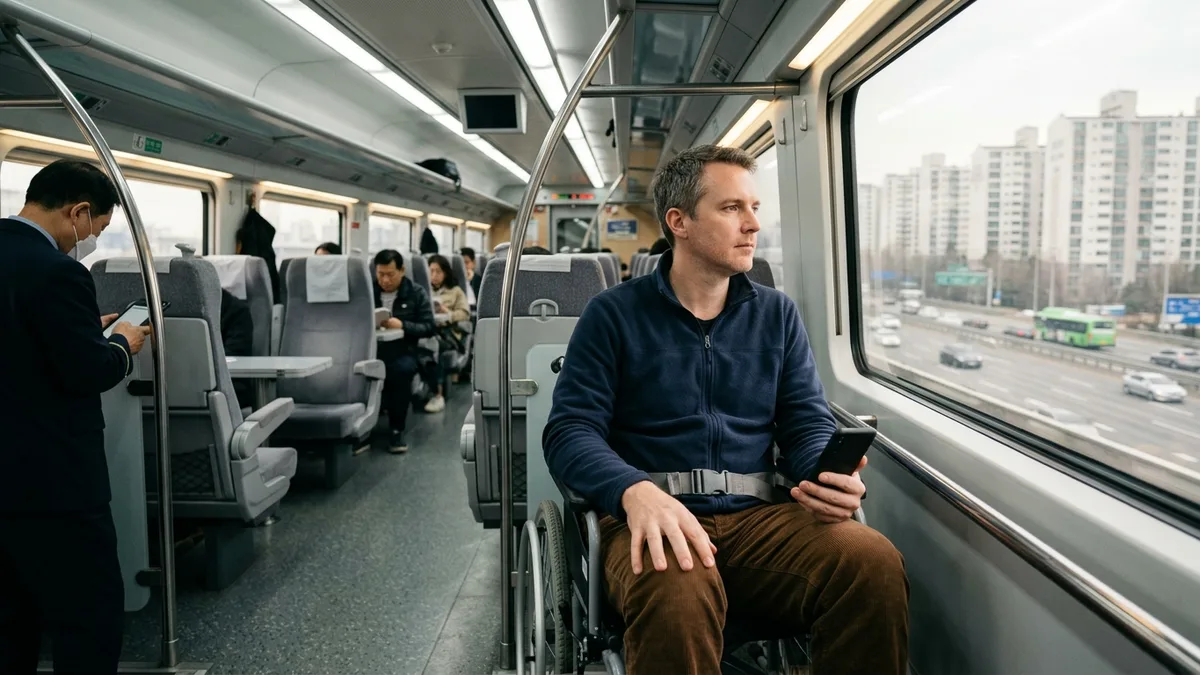
Whether the LACHA app can assign wheelchair seats or file boarding assistance requests hasn't been confirmed. What's certain is Korail and SR official channels (the Korail+ app, station counters, 1588-7788, 1800-1472), so handle those two things through official channels and request the seat and the assistance together at one counter. What you can bundle in one place is the taxi to the station or KTX and express bus tickets for other legs. LACHA is a transport-and-payment super app for foreign travelers that you can use immediately without Korean identity verification. You can start with just your passport — no Korean bank account or phone number — and pay with overseas simple-payment services like Alipay and WeChat Pay or with foreign cards, so you get blocked less often at checkout. Note, though, that LACHA's taxi hailing does not guarantee a wheelchair-lift vehicle. If you need to travel while remaining in your wheelchair, check first with the relevant city or province about whether foreign nationals are eligible for their special transportation services (needs verification).
Want to search and book KTX and express buses in one app? Check out LACHA.
Built to work without a Korean phone number or bank account, with overseas payment methods like Alipay, WeChat Pay, and Apple Pay. Taxi hailing plus KTX, express bus, and airport railroad (AREX) booking — all in one app.
Up to 60% off Korea transit with a coupon (max ₩3,000): enter code at sign-up. KTX gets up to 18% off on top
Download now


Frequently Asked Questions (FAQ)
Q1. I have an alien registration card but no welfare card. Can I get the KTX disability discount? It's unlikely. Article 17(2) of the Enforcement Decree of the Act on Welfare of Persons with Disabilities requires anyone seeking the discount to present a Disability Registration Card (or mobile registration card), and Article 32-2 of the Act limits eligible foreign nationals to five categories: overseas Koreans who have filed a domestic residence report, overseas nationals on the resident registry, permanent-residency status holders, marriage immigrants, and recognized refugees. E-9, E-7, D-2, and short-term visitors aren't eligible to register, so there's no discount path. There's also no basis in any official source for a discount using a home-country disability certificate, so it's safer to budget the full fare.
Q2. Which car has the wheelchair seating on my train? It depends on the train name. KTX is Car 2, KTX-Sancheon is Car 1, and KTX-Eum and KTX-Cheongryong are Car 3. The former SRT departing from Suseo (KTX-Sancheon as of 2026-09-01) is also Car 1, with two locations — Cars 1 and 11 — when running coupled. ITX-Cheongchun and ITX-Saemaeul are Car 3, Nuriro is Car 2, and Mugunghwa-ho is Car 3; Saemaeul-ho and commuter trains have no wheelchair seating. Check the train name next to the departure time on the booking screen first, and treat the car and seat numbers printed on your ticket as the final word. In particular, KTX-Cheongryong's Car 3 is based on Korail's seat map (the "wheelchair seat operations" table on the same site doesn't list it yet, verified 2026-08-25), so go by the car number printed on your ticket and confirm once more at the station.
Q3. By when do I need to request boarding assistance? Both Korail and SR say up to 30 minutes before the train departs. SR specifies "arrive at the departure station and apply at the accessibility information desk," making clear it's on-site, but Korail only says "30 minutes before train use," leaving it unstated whether that refers only to on-site applications (needs verification). Online, you apply after buying the ticket via the boarding assistance request on the "ticket confirmation" screen — but a 2021 press release includes a passage setting the online deadline at the day before departure (D-1), so whether the current online cutoff matches the 30-minute rule needs verification (needs verification). The menu location also reflects 2021 launch guidance and needs to be checked in the app. And note that applying isn't the same as being assigned. SR says that when requests cluster, service is provided in order of application with top priority to disability welfare card holders — so arrive at the station with time to spare.
Q4. I don't use a wheelchair, but the space looks roomier. Can I book a wheelchair seat? No. Article 10(1) of the Railroad Business Act provides that when someone uses a train without paying the proper fare or charge, a surcharge of up to 30 times the fare for the ridden section may be collected on top of that fare, and SR states that anyone who isn't an eligible wheelchair-seat user will be charged a surcharge under this provision. Even if the seat looks empty, pick a different one.
Q5. Is there a size limit for powered wheelchairs? It's published for the Suseo-departing trains (formerly SRT). SR's accessibility assistance service is provided only for wheelchairs measuring 700mm × 1,212mm or smaller, per the SRT accessible-seating specifications. Korail doesn't publish wheelchair dimension or weight standards, so whether the same figures apply to KTX needs verification. If you use a large powered wheelchair from overseas, measure its width and length before you travel, and if you plan to take KTX, call 1588-7788 in advance. We couldn't find published rail-side material on battery carriage rules, so don't simply apply airline regulations — check directly with Korail or SR.
Note: The seat locations, discount rates, request deadlines, and legal provisions in this article were verified as of 2026-08 against Korail's Transportation Vulnerable Support Service and discount program pages (korail.com), SR's accessibility assistance service and notices (etk.srail.kr), the Ministry of Health and Welfare's public utility discount guidance, and the original texts of the Act on Welfare of Persons with Disabilities, its Enforcement Decree, and the Railroad Business Act on the Korean Law Information Center (law.go.kr). Seat numbers and trainset configurations can vary with the rolling stock assigned, and operating standards may change following the KTX·SRT integration that took effect on 2026-09-01. Some items (the location of the assistance request menu in the Korail app and the online application deadline, whether counters operate during holiday booking periods, whether foreigners without a welfare card can book wheelchair seats and where they fall in assistance priority, and Korail's wheelchair dimension standards) are not stated in official guidance and are marked "needs verification." Holiday booking schedules are set by notice each year, so check Korail's notice for that year. Please re-confirm with Korail (1588-7788) and SR (1800-1472) official channels before booking and boarding. Whether wheelchair seat assignment and boarding assistance requests are possible in the LACHA app hasn't been confirmed, so handle those two through official channels.