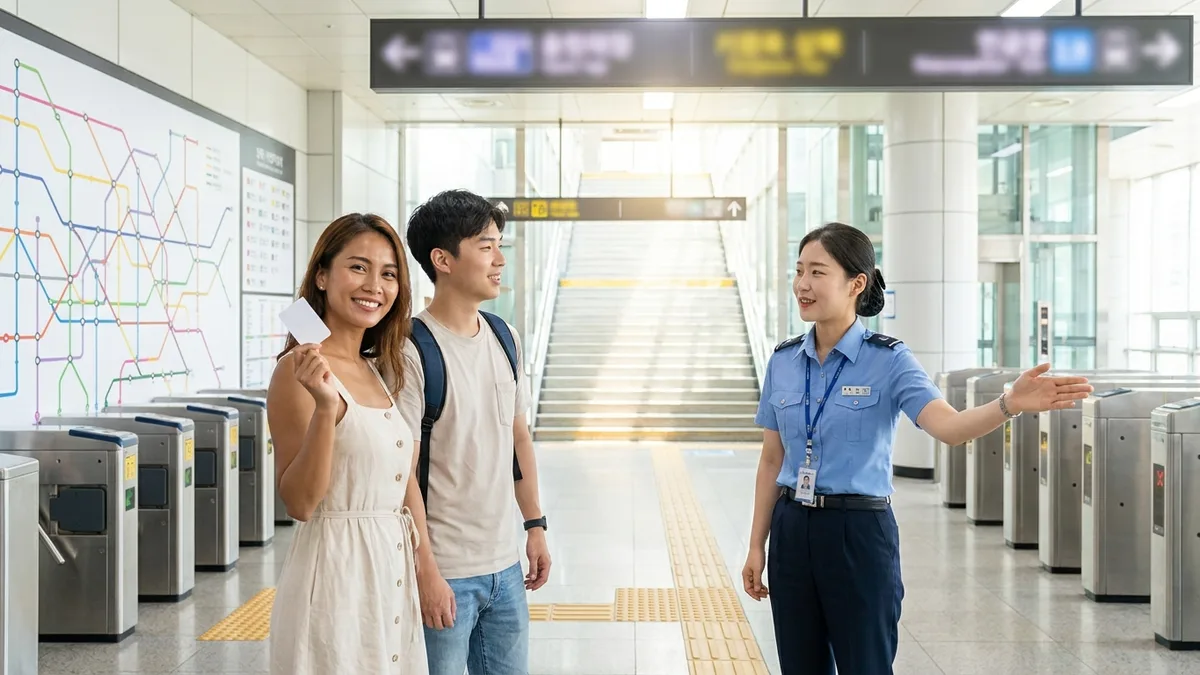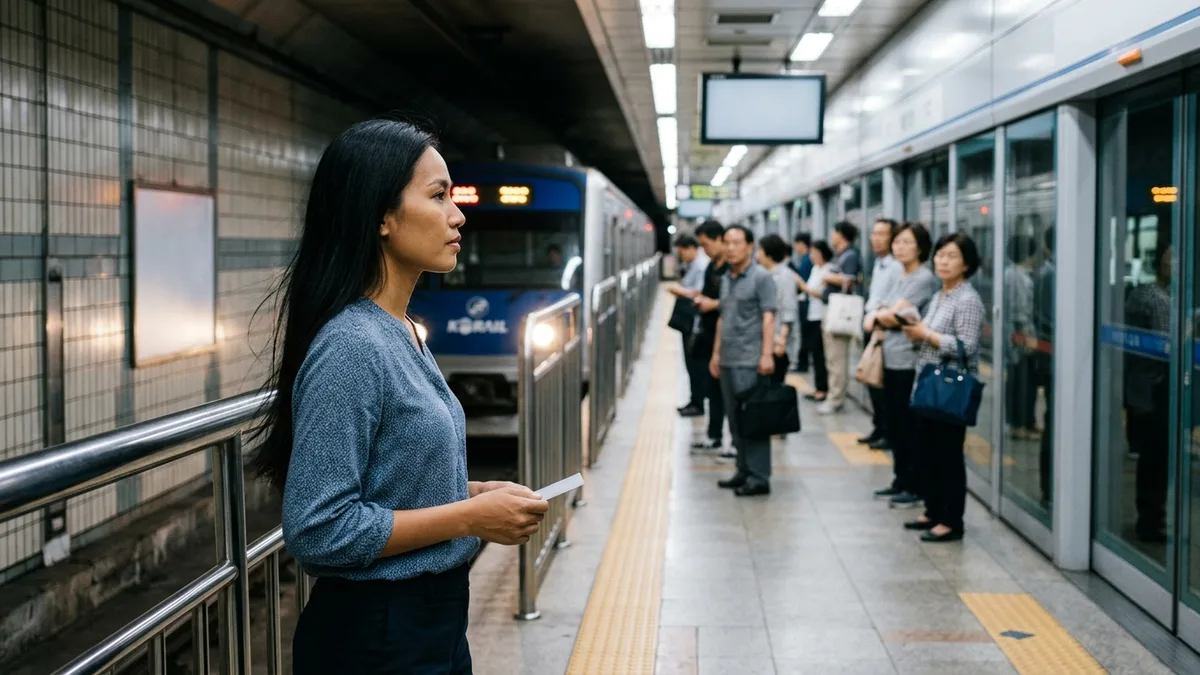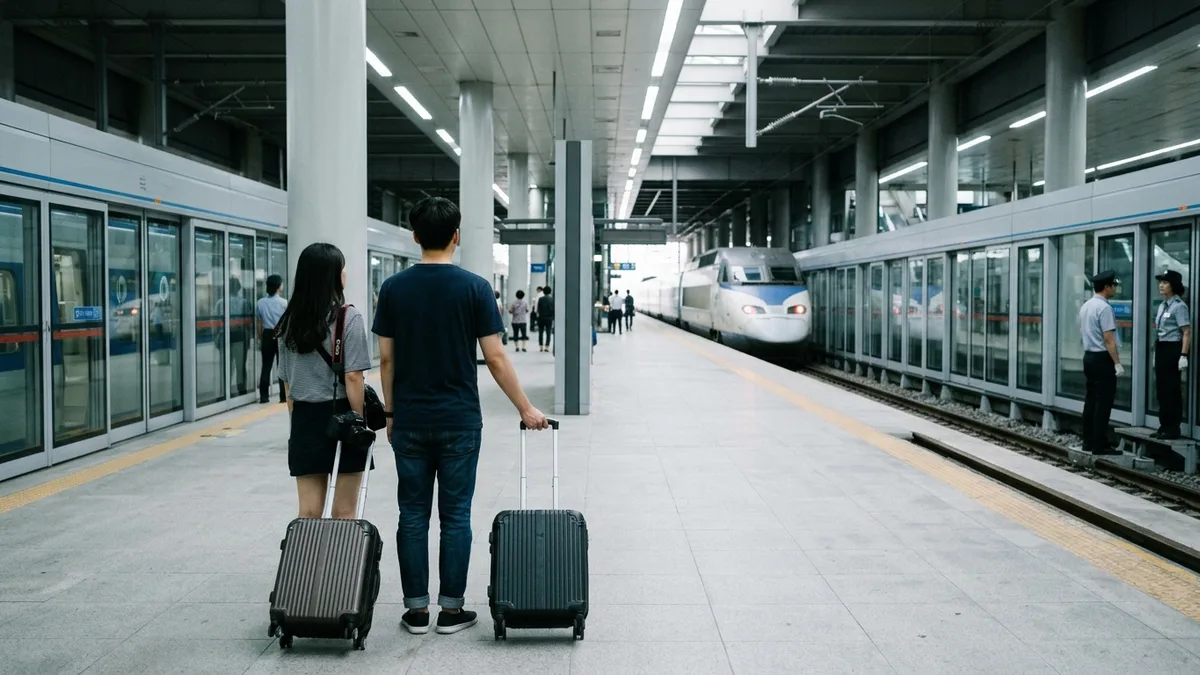
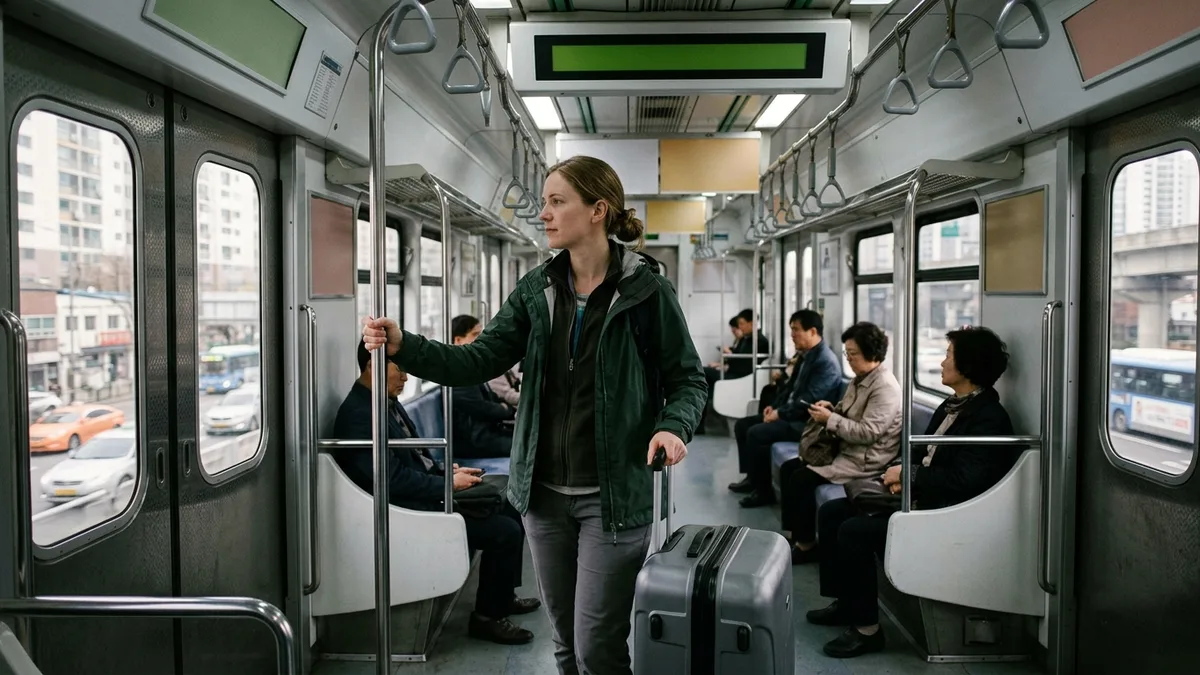
Five of the lines your map app labels as "subway" in the greater Seoul area aren't subway lines at all — they're light rail. Gimpo Goldline, Ui-Sinseol Line, Sillim Line, Yongin EverLine, and Uijeongbu Light Rail, each run by a different company. The trains are short, too: Gimpo Goldline and Ui-Sinseol run 2 cars, Sillim Line runs 3 (we couldn't confirm the actual number of cars per trainset for EverLine and Uijeongbu Light Rail in official sources).
Fares split right away. The first four lines cost 1,550 KRW with an adult transit card, same as the Seoul Subway — but Uijeongbu Light Rail alone charges 1,750 KRW. That extra 200 KRW isn't about distance; it's a "separate fare" item that exists only on this line (Uijeongbu Light Rail Passenger Transport Terms, Article 3, Item 20), so it applies no matter where you board or get off.
If you're traveling with a suitcase, the carry-on rules matter even more. Seoul Metro, Gimpo Goldline, Ui-Sinseol Line, and EverLine allow items where the sum of length, width, and height is under 158cm and the weight is 32kg or less, while Uijeongbu Light Rail alone caps it at 120cm and 20kg. If oversized baggage is found, you may be charged a 5,000 KRW surcharge per item and asked to get off at the next station.
Age-based discounts depend on nationality. Seoul Metro's Passenger Transport Terms Article 10(2) and Uijeongbu Light Rail's Article 10(2) both state that foreign nationals are treated as adults (general fare) except for infants, children, and teenagers. That means even if you're 65 or older, as a foreign national you don't qualify for free senior rides.
All five lines are connecting-service sections under Article 34 of the Urban Railroad Act, so when you transfer from the Seoul Subway, your journey continues without exiting and re-entering the fare gates.
Note: The fares and carry-on rules below were compiled as of 2026-08 from the passenger transport terms and fare information published by Seoul Metro, Gimpo Goldline Co., Ltd., Ui-Sinseol Urban Railway Co., Ltd., Namseoul Light Rail Co., Ltd., Yongin Rapid Transit Co., Ltd., and Uijeongbu Light Rail Transit Co., Ltd. Terms and fares get revised, so please double-check each line's official page before you travel.
Your Map App Says "Subway" — But Here's What These Five Lines Really Are
Article 3 of Seoul Metro's Passenger Transport Terms defines each of these lines as a section operated by a different company. The Uijeongbu Light Rail section is run by Uijeongbu Light Rail Transit Co., Ltd., the Ui-Sinseol light rail section by Ui-Sinseol Urban Railway Co., Ltd., the Gimpo urban railway section by Gimpo Goldline Co., Ltd., the Sillim Line urban railway section by Namseoul Light Rail Co., Ltd., and the Yongin light rail section by Yongin Rapid Transit Co., Ltd.
Different operators means different terms and conditions for each line. That's exactly why the carry-on limits and separate fares we'll cover below vary.
| Line | Operator | Trainset & Capacity | Where it takes you |
|---|---|---|---|
| Gimpo Goldline | Gimpo Goldline Co., Ltd. | 2 cars per trainset, capacity 172 (56 seated, 116 standing) | Gimpo Airport, Gimpo Hangang New Town |
| Ui-Sinseol Line | Ui-Sinseol Urban Railway Co., Ltd. | 2 cars per trainset, capacity 174 (48 seated, 126 standing); 300 when packed | Bukhansan Ui area, Seongbuk district |
| Sillim Line | Namseoul Light Rail Co., Ltd. | 3 cars per trainset, capacity 158; 237 when full | Gwanaksan, Yeouido direction |
| Yongin EverLine | Yongin Rapid Transit Co., Ltd. | 133 passengers per car | Everland, downtown Yongin |
| Uijeongbu Light Rail | Uijeongbu Light Rail Transit Co., Ltd. | We couldn't obtain official rolling stock specs | Downtown Uijeongbu, connects to Hoeryong Station on Line 1 |
Gimpo Goldline runs 23.59km with 10 stations from Yangchon Station to Gimpo Airport Station, and the full route takes 32 minutes. It opened on September 28, 2019 (per Gimpo City's official information).
The cars are also narrower than subway cars. Ui-Sinseol Line cars are 2,650mm wide, and Sillim Line cars are up to 2,400mm. If you show up expecting an eight- or ten-car subway train and meet a two- or three-car train instead, the space one suitcase takes up feels completely different.
We couldn't find consistent official figures for EverLine's actual cars per trainset and route length, or for Ui-Sinseol Line's total length and station count. Please check each line's official page for these details.
Fares — 1,550 KRW on Four Lines, Plus 200 KRW Only on Uijeongbu
| Category | Gimpo Goldline / Ui-Sinseol / Sillim / EverLine | Uijeongbu Light Rail |
|---|---|---|
| Adult, transit card | 1,550 KRW | 1,750 KRW (1,550 connecting fare + 200 separate fare) |
| Adult, single-journey card | 1,650 KRW | 1,850 KRW |
| Teen, transit card | 900 KRW | 1,100 KRW |
| Child, transit card | 550 KRW | 750 KRW |
| Base fare distance | Up to 10km | We couldn't confirm the distance condition (check Uijeongbu Light Rail's fare information) |
The base fares on those four lines match the amounts in Appendix 2 of Seoul Metro's Passenger Transport Terms. In other words, riding out of the Seoul Subway and onto these lines doesn't change the fare structure.
Uijeongbu Light Rail has one extra layer. Article 3, Item 20 of its Passenger Transport Terms defines the separate fare as "a fare applied separately, in addition to the connecting fare, within the Uijeongbu Light Rail section," and Article 11(1) states that when transferring with the Seoul metropolitan urban railway, the base fare is calculated as the sum of the connecting fare and the separate fare. Even with a transfer, the separate fare is only added once.
Heads-up: If your card balance dropped by an extra 200 KRW in Uijeongbu, it's not that the transfer discount failed — it's the line's own fare structure. That said, sources disagree on whether this 200 KRW is waived when you transfer at Hoeryong Station, where the line meets Line 1 (the terms only say it's "added once"), so we couldn't confirm it this time. If you need the exact amount, please check with the Uijeongbu Light Rail customer center.
The full Seoul Subway fare system is laid out in Seoul Subway Complete Guide. The table above shows the actual amounts behind the note there that "some lines add a separate surcharge."
Transfer Discounts Work on All Five Lines — 30 Minutes (60 at Night), Up to 4 Transfers
All five lines are part of the metropolitan integrated transfer discount system, so they're calculated as one journey together with the Seoul Subway and buses. There are three conditions.
- You must tap in on your next ride within 30 minutes of tapping out of the previous one.
- Between 9 p.m. and 7 a.m. the next day, the window extends to 60 minutes.
- The discount applies to up to 4 transfers, for a total of 5 rides.
Skip the tap-out and your discount chain breaks right there. Forgetting to tap your card when getting off is the most common way people lose money. The full rules are in Transfer Discounts Explained.
There's an early-bird discount too. Ride with a prepaid or postpaid transit card from the start of service until 6:30 a.m. and you get 20% off the base fare. It doesn't apply, though, if you got on by transferring from another mode of transport.
Single-journey cards put you at a disadvantage for transfers. Article 14(5) of Gimpo Goldline's Passenger Transport Terms states that single-journey transit cards cannot be used for connecting transfers with buses. Even on a trip of just a few days, buying one transit card ends up cheaper.
The Climate Card is listed as a valid ticket type in Article 12 of Gimpo Goldline's terms and Article 13 of Seoul Metro's. Whether it works on Uijeongbu Light Rail and EverLine, however, we couldn't confirm — so check with the relevant line's information before using it.
Before You Board with a Suitcase — 158cm Total, but Only 120cm on Uijeongbu
If you're the type who drags around a suitcase the size you'd normally check at the airport, this is the most important section here.
| Line | Sum of three sides | Weight | Governing article |
|---|---|---|---|
| Seoul Subway (Seoul Metro) | Under 158cm | 32kg or less | Passenger Transport Terms, Art. 36 |
| Gimpo Goldline | Under 158cm | 32kg or less | Passenger Transport Terms, Art. 39 |
| Ui-Sinseol Line | Under 158cm | 32kg or less | Passenger Transport Terms, Art. 32 |
| Yongin EverLine | Under 158cm | 32kg or less | Passenger Transport Terms, Art. 33 |
| Uijeongbu Light Rail | Within 120cm | Within 20kg | Passenger Transport Terms, Art. 36(1) |
The exact wording is: "Items whose length, width, and height sum to 158cm or more, or whose weight exceeds 32kg, may not be carried on board." Meaning it's off-limits the moment the sum of the three sides hits 158cm.
Uijeongbu Light Rail alone sets a far lower bar. Article 36(1) states that "only items within 20kg in weight and within 120cm in the sum of length, width, and height may be carried on board, and must be kept under the passenger's own responsibility." That's roughly half of what the other lines allow.
Tip: Plenty of people think of their suitcase as a "24-inch" or "28-inch," but actual measurements differ by brand even at the same inch rating, so inches won't tell you. Include the wheels and handle, measure width, depth, and height separately, and add them up to compare against 158cm (120cm for Uijeongbu).
Wheelchairs, strollers, and folding bicycles in folded form are specified as exceptions to these limits. For other bicycles and personal mobility devices, you'll need to check each line's terms individually.
For the Sillim Line, we couldn't locate a carry-on provision in this round of research. If you plan to ride the Sillim Line with large baggage, please double-check with Namseoul Light Rail's official information.
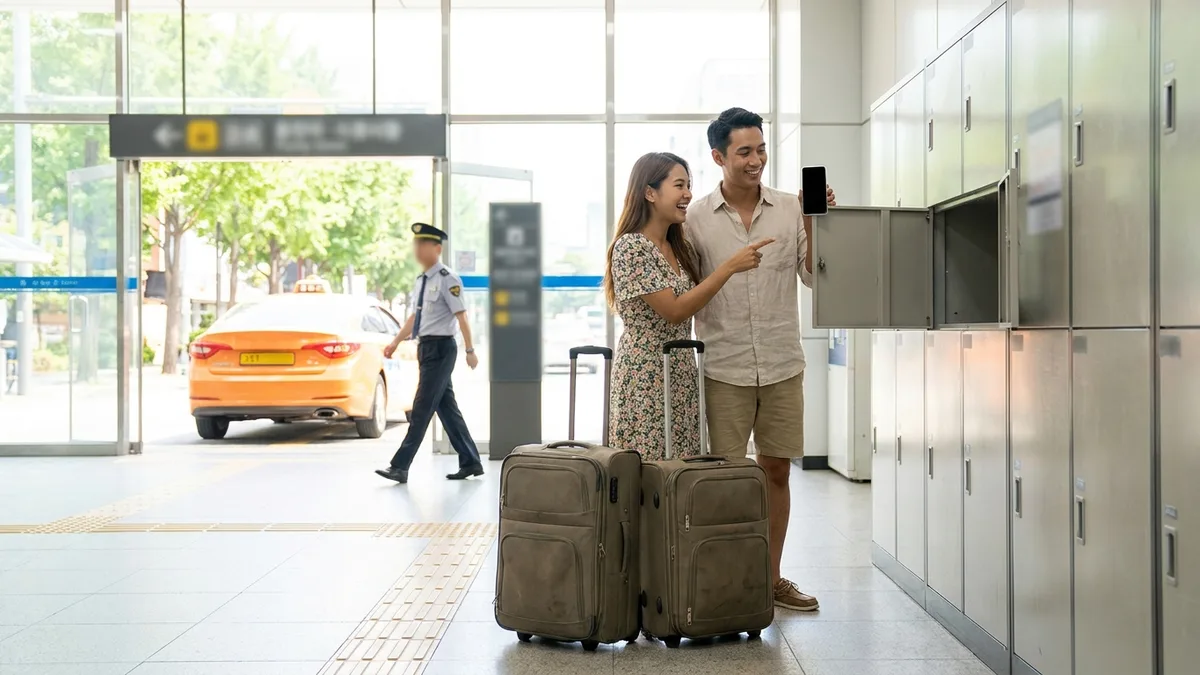
If your bags exceed the limit, it's faster to store them before heading into the station. Locker locations and rates are covered in Luggage Storage & Delivery Services.
There's no separate official guidance from any of these operators on things like platform length or elevator locations — the details that directly affect moving around with a suitcase. The only thing fixed by regulation is the carry-on provisions above; the rest you'll have to judge on the spot.
What Happens if You Exceed the Limit — 5,000 KRW Surcharge and Removal from the Train
| Type | Surcharge | Basis |
|---|---|---|
| Restricted carry-on item (oversized) | 5,000 KRW per item | Seoul Metro App. 5, Gimpo Goldline App. 6, Uijeongbu Light Rail App. 5 |
| Prohibited item (other than hazardous goods) | 10,000 KRW | Appendices of the above terms |
| Hazardous goods | 100,000 KRW | Appendices of the above terms |
| Fare evasion | Single-journey fare + 30 times that amount | Railroad Business Act, Art. 10(1) |
The three operators we checked all list identical appendix amounts. For the remaining lines, please check the appendices of their respective terms.
And it doesn't end with paying money. Uijeongbu Light Rail's Article 37 and Seoul Metro's Article 37 state that if you try to board with a restricted carry-on item, boarding may be refused, and if you're found to already be on board, you'll be made to get off at the next stop or nearest station and pay the surcharge. Ending up at an unfamiliar station holding your bags is a real possibility.
The fare evasion surcharge is steep. Article 10(1) of the Railroad Business Act allows collection of an additional fare of up to 30 times the fare, and all four operators whose terms we checked (Gimpo Goldline, Ui-Sinseol Line, EverLine, Uijeongbu Light Rail) apply the full 30x. On a section where an adult single-journey ticket is 1,650 KRW, that's 1,650 KRW plus 49,500 KRW, for a total of 51,150 KRW.
Heads-up: Following the person ahead of you through the gate because your balance was too low to open it counts as fare evasion. The rules apply just the same at unstaffed stations with no one at the window — so don't slip through; top up first.
Gimpo Goldline Crowding — When Is That "199%" Figure From?
Search for it and the first number you'll see is "199% congestion." You need to look at the date alongside it. That figure is from a Ministry of Land, Infrastructure and Transport announcement dated April 29, 2024, and the same announcement put average congestion during peak hours at 182%.
The government released improvement targets at the same time. The plan is to add 5 trainsets by the end of 2026, bringing peak congestion down to 150% ("moderate") and average congestion to 130% ("moderate"), and cutting headways from 3 minutes to 2 minutes 10 seconds.
The first round of additions is done. According to Gimpo City's official information (updated June 15, 2026), 29 trainsets are in operation with headways in the 2-minute-30-second range. The second round of 5 trainsets is listed for completion in December 2026, and we couldn't confirm the progress as of August 2026.
Still, the fact that the trains are short hasn't changed. With 2 cars per trainset and a capacity of 172, riding during rush hour with a big suitcase is physically difficult.
📌 Note: If you're moving through Gimpo Airport with large bags, avoiding peak hours or choosing another mode is the realistic call. Options for getting from the airport into central Seoul are compared in Gimpo Airport Transport Guide.
Things That Only Trip Up Foreign Travelers — Age Discounts, Single-Journey Tickets, Unstaffed Stations, Early-Bird Fares
Even at 65 or Older, Foreign Nationals Pay Full Fare
Seoul Metro's Passenger Transport Terms Article 10(2) states that "in the case of foreign nationals, they are regarded as adults except for the following," and Uijeongbu Light Rail's Article 10(2) has the same structure with "regarded as general." The only exceptions are infants, children, and teenagers.
So while Korean nationals aged 65 and over ride free with a senior transit card, foreign nationals of the same age pay the full adult fare. Many people arrive having only heard "the subway is free for seniors in Korea," and find out for the first time at the fare gate.
Whether long-term foreign residents such as permanent residents (F-5) can get a senior discount transit card from their local government varies by municipality, so we couldn't confirm it this time. Under the terms, foreign nationals are adults — so if you think you might qualify, please contact your city, county, or district office directly.
Stations Are Unstaffed, So There's No One at the Window
Light rail here runs driverless. Article 38(1) of Uijeongbu Light Rail's terms states that "revenue trains in the light rail section operate in fully automatic unmanned mode," and the official introductions for the Sillim Line and EverLine also describe fully automatic driverless operation.
When something goes wrong, instead of a service window you talk to the central control room via the emergency intercom (Uijeongbu Light Rail terms, Article 40(2)). Responses are primarily in Korean, which is where foreign travelers tend to feel most stuck.
- If the fare gate won't open, don't force your way through — press the emergency intercom button first.
- Writing down the station name in Korean before you call makes explaining the situation much faster.
- If you keep getting card errors, work through the steps in Transit Card Troubleshooting.
The Traps in Single-Journey Tickets and Early-Bird Discounts
- Single-journey transit cards can't be used for bus transfers (Gimpo Goldline terms, Article 14(5)). Get off the light rail and board a bus, and the fare starts over from scratch.
- Single-journey tickets are bought at a ticket machine, inserted into the gate at your destination station, and then you get your deposit back at a deposit refund machine (Article 14(3)). The deposit amount isn't stated in the terms, so check the machine's screen.
- The 20% early-bird discount doesn't apply if you arrived by transfer. Land at dawn, take an airport bus first, then switch to light rail, and you won't get the discount.
Practical Routes by Line — Gimpo Airport, Bukhansan, Gwanaksan, Everland, Uijeongbu
Once you know your destination, picking the line is simple.
- Gimpo Goldline — Its terminus is Gimpo Airport Station, so it plugs straight into airport arrival and departure routes. 10 stations and 23.59km to Yangchon Station, 32 minutes end to end.
- Ui-Sinseol Line — Connects to the trailhead on the Bukhansan Ui side. Routes are in the Bukhansan Hiking Guide.
- Sillim Line — This is the line with Gwanaksan Station. For half-day hikes, see Seoul Half-Day Hiking Courses.
- Yongin EverLine — One of the routes to Everland. Comparisons with other routes are in Everland & Nami Island Transport.
- Uijeongbu Light Rail — Loops around downtown Uijeongbu, with a transfer to Line 1 at Hoeryong Station. Just remember the fare is 200 KRW higher.
Double-check transfer station names and connecting lines on your map app and each line's official route map. First and last train times vary by station, so there's no single number to quote — checking the per-station timetable on each line's official page is the accurate way.
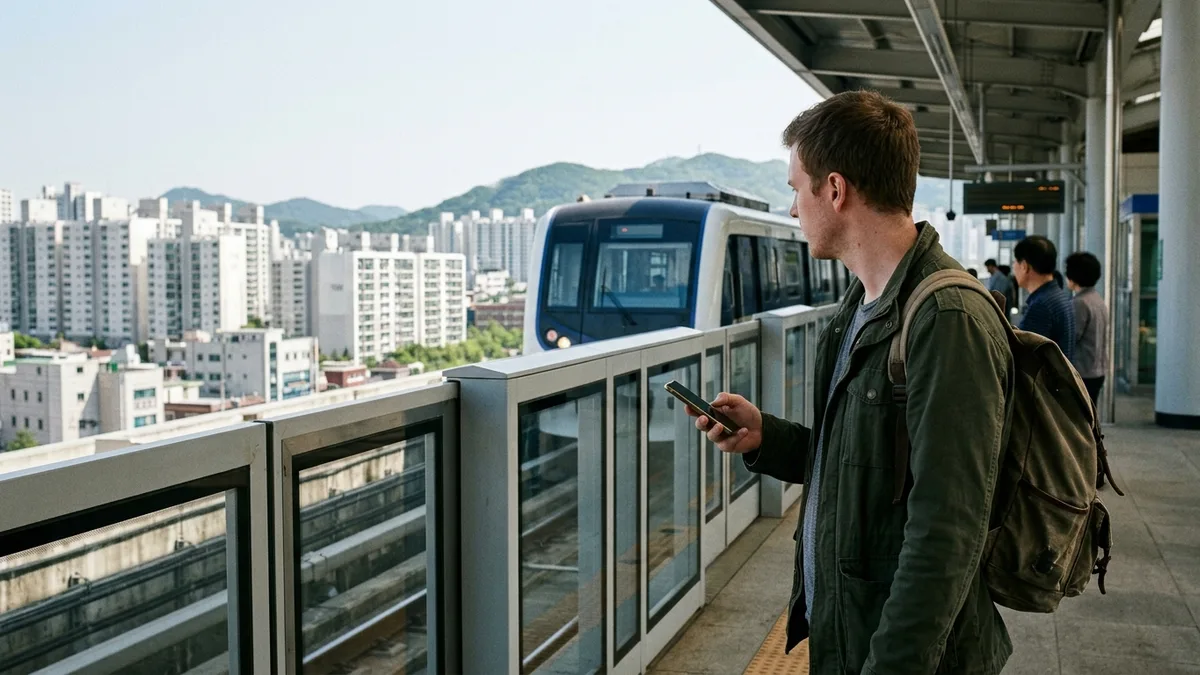
All five lines run on prepaid transit cards like T-money or postpaid transit cards, with no special app needed. Light rail works with transit cards rather than app tickets, so all you need is one card with a balance on it. LACHA is a transport and payment super app for foreign travelers that you can use right away without identity verification, covering taxis, KTX, express buses, the Airport Railroad, and transit cards. It doesn't handle light rail tickets, but if you're facing a rush-hour Gimpo Goldline ride with a big suitcase, taking a taxi instead is the realistic move.
Want to search and book KTX and express buses in one app? Check out LACHA.
Built to work without a Korean phone number or bank account, with overseas payment methods like Alipay, WeChat Pay, and Apple Pay. Taxi hailing plus KTX, express bus, and airport railroad (AREX) booking — all in one app.
Up to 60% off Korea transit with a coupon (max ₩3,000): enter code at sign-up. KTX gets up to 18% off on top
Download now


Frequently Asked Questions (FAQ)
Q1. Why is Uijeongbu Light Rail the only one with a higher fare? It's the 200 KRW "separate fare." Article 3, Item 20 of its Passenger Transport Terms defines the separate fare as "a fare applied separately, in addition to the connecting fare, within the Uijeongbu Light Rail section." So the adult transit card base fare is 1,750 KRW instead of 1,550 KRW, and a single-journey ticket is 1,850 KRW. It's not a failed transfer discount — it's the line's own fare structure. That said, sources conflict on whether this 200 KRW is waived when transferring to Line 1 at Hoeryong Station, so we couldn't confirm it; please check with the customer center.
Q2. Can I bring a large suitcase on light rail? It depends on the line. On the Seoul Subway, Gimpo Goldline, Ui-Sinseol Line, and EverLine, the sum of length, width, and height must be under 158cm and the weight 32kg or less. Uijeongbu Light Rail alone is far lower at within 120cm and 20kg. Inch labels won't tell you, so measure the three sides yourself and compare the total. Exceed the limit and you face a 5,000 KRW surcharge per item and may be made to get off at the next stop.
Q3. Can foreign nationals aged 65 and over ride free? No. Seoul Metro's Passenger Transport Terms Article 10(2) and Uijeongbu Light Rail's Article 10(2) state that foreign nationals are treated as adults (general fare) except for infants, children, and teenagers. You pay the adult fare regardless of age. Whether long-term foreign residents can be issued a senior discount card varies by municipality and we couldn't confirm it this time, so please contact your city, county, or district office.
Q4. Do transfer discounts work when switching from the Seoul Subway? All five lines are covered by the metropolitan integrated transfer discount. Board your next ride within 30 minutes of tapping out (60 minutes between 9 p.m. and 7 a.m. the next day), and it applies for up to 4 transfers and 5 rides total. Skipping the tap-out breaks the discount, so be sure to tap your card when getting off too. On journeys that include Uijeongbu Light Rail, the 200 KRW separate fare is added only once.
Q5. What do I do if the fare gate won't open at an unstaffed station? Light rail is fully automatic and driverless, so there's no staff permanently on site. Problems with fare gates or ticket machines are handled by connecting to the central control room via the emergency intercom (Uijeongbu Light Rail terms, Article 40(2)). Responses are primarily in Korean, so it helps to write down the station name and your situation in Korean. If your balance is short, don't slip through — top up first. Even at unstaffed stations, the fare evasion surcharge (the fare plus 30 times that amount, Railroad Business Act Article 10(1)) applies in full.
Note: The fares, carry-on rules, and surcharges in this article are values confirmed as of 2026-08 from the passenger transport terms of Seoul Metro, Gimpo Goldline Co., Ltd., Ui-Sinseol Urban Railway Co., Ltd., Namseoul Light Rail Co., Ltd., Yongin Rapid Transit Co., Ltd., and Uijeongbu Light Rail Transit Co., Ltd., along with each line's fare information. The Gimpo Goldline congestion figure is from the Ministry of Land, Infrastructure and Transport's April 29, 2024 announcement, and the trainset expansion status is per Gimpo City's information (updated June 15, 2026), so both may differ from the current situation. The Sillim Line's carry-on provision, whether the separate fare is waived for transfers at Hoeryong Station, whether the Climate Card applies on Uijeongbu Light Rail and EverLine, and first/last train times by station could not be confirmed and remain provisional. Terms and fares may be revised, so please double-check each line's official page before you travel. LACHA does not sell light rail tickets or operate any of these lines.