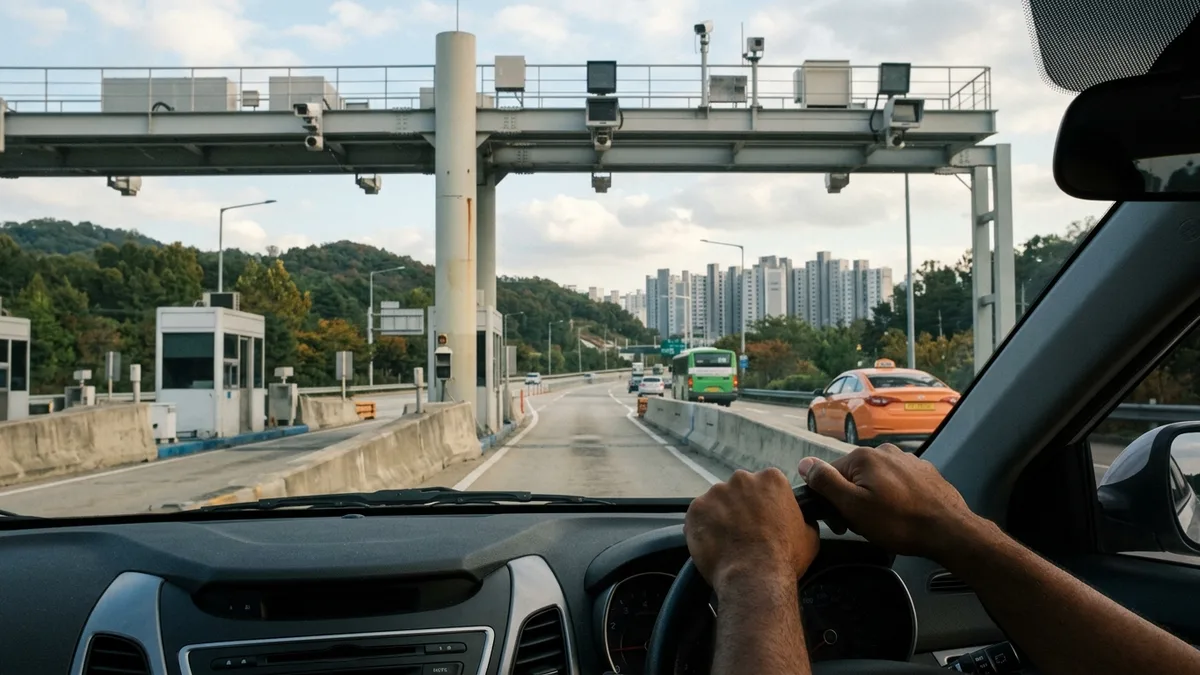
Driving straight past a tollgate doesn't slap a 10x charge on you right there. According to Korea Expressway Corporation guidance, a surcharge on a simple unpaid toll only actually kicks in "after the payment deadline on the final demand notice has passed." Pay before then and you owe nothing but the original toll.
The problem is that a rental car driver never gets to see that demand notice. Unpaid-toll notices are sent based on the vehicle's registered address, and for a rental car the vehicle is registered to the rental company. The first, second, and third notices all go to the company while the person who actually drove has no idea an unpaid toll even exists.
Trying to check it yourself hits another layer. For the unpaid-toll detail lookup and online payment on the Hi-Pass site (excard.co.kr), Korea Expressway Corporation spells out that a "digital certificate of the registered vehicle owner is required." On a rental car, where the registered owner is the company, that's a condition a renter can never satisfy in principle.
There's no English guidance, either. The Korea Expressway Corporation English site (ex.co.kr/eng) covers only corporate introduction, IR, and overseas business — the words "toll," "Hi-Pass," and "unpaid" don't even appear. The toll-specific site hipass.co.kr has no language-switch link at all (verified directly on 2026-08-25).
So the order of operations matters. Settling it on the spot at the tollgate is option one; if you missed that, looking it up yourself by license plate a few days later and paying at a service window is option two.
Note: The laws, multipliers, and procedures in this article were verified as of 2026-08 against the Toll Road Act and its subordinate regulations, Korea Expressway Corporation, the Center for Private Highway Investment Support (CEPHIS), and the official guidance of individual private highway operators. Multipliers and payment methods differ by operating entity and are revised often, so before paying, double-check with the official channel of the operating entity listed on your notice.
If you drove straight past a tollgate — don't stop, finish it at the exit
When you realize too late that you've entered a Hi-Pass lane by mistake or that the terminal is switched off, the most dangerous thing you can do is stop right there. Official guidance says the opposite. Don't stop and don't reverse — just keep driving through. Then, at the exit tollgate at your destination, tell the staff member the name of the tollgate where you entered or your license plate number, and it's settled on the spot.
If you finish it in that one step, no unpaid toll is ever created. No notice, no surcharge, no billing routed through the rental company. For a rental car driver, this is the only truly clean path.
If you also exited through a Hi-Pass lane, it's treated as an unpaid toll from that point on. Korea Expressway Corporation classifies six situations as a "simple unpaid toll."
- No terminal installed / not registered — the car has no Hi-Pass terminal, or it isn't registered
- No card inserted — the terminal is there, but no Hi-Pass card is in it
- Insufficient balance — the prepaid Hi-Pass card doesn't have enough left
- Using a suspended terminal or card anyway
- Passing through a regular lane without paying — going through without a staff member or automated payment machine
- Vehicle class mismatch — the registered vehicle class differs from the actual one
None of these six are the type that triggers a 10x charge immediately. They all go through the three-stage notice process covered below.
This is also where what you check at pickup makes a difference. Whether the car has a terminal at all, and if it does, whether a card is inserted with a balance left on it, is best confirmed together with the staff right at the rental counter. How terminals are provided and what they cost varies by company — there's no standard to speak of.
📌 Note: The discount terminals known as "Hi-Pass discounts" require fingerprint registration at a community service center (a veterans affairs branch office for national merit recipients) and fingerprint authentication before you set off. If authentication fails, the normal toll is charged. It isn't a program foreign visitors can use in the first place, so don't expect a discount just because your rental car has a terminal.
The notice doesn't come to you — the time lag that rentals create
Unpaid-toll notices and mobile alerts go out based on the vehicle's registered address. Who was driving that day is not the sending criterion. Since a rental car is registered to the rental company, the first notice, the second notice, and the demand notice all go to the company's address.
The notification channels also assume a Korean account. The Center for Private Highway Investment Support sends unpaid-toll notices as mobile electronic documents such as KakaoTalk certified messages or Naver electronic notices, and these count as valid notification under Articles 4, 18-4, and 18-5 of the Framework Act on Electronic Documents and Transactions, plus a regulatory sandbox provisional approval from the Ministry of Science and ICT dated February 14, 2019. If you don't have a Kakao or Naver account, this notification effectively never reaches you.
So when does it reach the renter? When the company bills you. But there's no national standard for how that billing works. The Fair Trade Commission's Standard Terms for Vehicle Rental (Standard Terms No. 10064, revised November 4, 2021) contains no clause on tolls or Hi-Pass at all. Article 13 only states that "if additional costs incidental to the rental arise at the renter's request, the renter shall bear those additional costs," and Article 14 that "if the prepaid charge falls short due to exceeding the usage period or similar, the shortfall shall be settled and paid upon return of the rental car."
On top of that, standard terms are recommended guidelines that have passed review — they aren't binding, and an individual company's own terms take precedence. Looking at actual company terms, toll road charges are specified as a separate customer-borne item not included in the rental fee, and payment must be made by the payment method the company designates. But how much the handling fee is, or how many days after return you get billed, is something this article can't put a number on — these are company-by-company terms, so no standard amount and no standard timeframe exist. Your only option is to read the toll clause yourself and ask about it when you sign.
The documents and conditions you need at the rental stage are covered separately in Korean driver's license exchange and renting a car.
Caution: The non-payment rate for traffic-violation administrative fines among foreign rental car users averaged 50.7% over the five years from 2020 to October 2024, versus 25.8% for Korean nationals — roughly double (the foreigner-only figure as of October 2024 was 66.1%). That comes from National Police Agency data submitted to the National Assembly's Public Administration and Security Committee (reported 2025-03); on Jeju the figure was 96.8% in 2024. These are administrative fine statistics, not toll statistics, so you can't map them directly — but it's worth checking before you rent how the company sets payment and settlement conditions for foreign renters.
The 10x surcharge is a "ceiling" — 10x on Korea Expressway Corporation roads, 5x on some Gyeonggi private roads
"Miss a toll and it's 10x" circulates widely in Korean-language communities, but the statute reads a little differently. Article 20 of the Toll Road Act provides that a surcharge "as prescribed by Presidential Decree within a range of 10 times the toll unpaid or exempted" may be imposed and collected. The 10x is a statutory ceiling; the multiplier actually applied is set by the entity operating that road. Detailed criteria are in Article 14 of the Enforcement Decree of the Toll Road Act, and the current decree was revised on July 28, 2026 (Presidential Decree No. 36542).
| Section | Surcharge | Verified basis |
|---|---|---|
| Expressways managed by Korea Expressway Corporation | 10x the original toll | Title of the Corporation's guidance table, "Notice on Imposition of 10x Surcharge" (basis: Enforcement Decree Article 14) |
| Gyeonggi Nambu Road (Seosuwon–Uiwang) | 5x the original toll | Reduced on 2017-09-01 when Gyeonggi Province unified its private highway collection system |
| Ilsan Bridge and Third Gyeongin Expressway | 5x the original toll | Same adjustment; the remarks column of their guidance notes "Korea Expressway Corporation applies 10x" for contrast |
| Other private highway routes | Varies by route | Statutory ceiling is 10x — check the guidance of that route's operator |
The Gyeonggi Nambu Road guidance first acknowledges the ceiling — "an amount within 10 times the original toll may be imposed pursuant to Article 20 of the Toll Road Act and Article 14 of its Enforcement Decree" — and then states that the imposition rate was reduced to 5x. In effect, the operator itself has documented that the ceiling and the multiplier actually applied are different things.
Caution: "In Korea it's always 10x if you don't pay" is wrong, and so is "private highways are cheap." The multiplier is set by whoever operates the route, so before you calculate any amount, first check which entity operates the section you drove through.
When does it apply — three-stage notices, the demand notice, and the immediate-charge exceptions
A simple unpaid toll doesn't jump straight to a surcharge. It goes through the three-stage notice process set out in Article 8-2 of the Enforcement Rules of the Toll Road Act.
| Stage | What the notice contains | If you pay at this point |
|---|---|---|
| 1st notice | Date/time and place of travel, unpaid amount, payment period, payment methods | Just pay the original toll and you're done |
| 2nd notice | Everything in the 1st, plus the grounds for a surcharge and advance notice of the "amount to be imposed" | Still just advance notice, so it's the original toll only |
| 3rd notice (demand notice) | Grounds for the surcharge, amount, payment period, payment methods | On Korea Expressway Corporation sections, the charge applies only after the deadline written here passes |
Guidance on exactly when the charge becomes final differs a bit. The Center for Private Highway Investment Support and Seoul Beltway say "the surcharge is imposed upon the 3rd notice," while Korea Expressway Corporation says "imposed after the demand notice's payment deadline has passed." The Corporation is one beat later, in other words. Pay before the demand notice (3rd notice) arrives and there's no add-on — on Corporation sections your last line is the deadline printed on the demand notice, but on private routes the charge is already imposed at the 3rd-notice stage, so it's safer to clear it before then.
How many days you get between each stage is something I won't pin a number on here. What the Enforcement Rules specify is the items a notice must contain; the actual payment deadlines shown vary by operator's guidance and need checking. The benchmark is always the payment deadline printed on the notice you received.
There are two exceptions. One is the four types of fraudulent conduct that skip the three stages and are charged immediately.
- Forging or altering a toll ticket, toll card, or the machinery
- Exchanging your own toll ticket for someone else's
- Forging or altering an exemption-holder's certificate
- Using an exemption certificate owned by someone else
Accidentally driving through a Hi-Pass lane does not fall under any of these. The other exception is frequency. If 20 or more unpaid tolls, including the current one, have accumulated within the past year from the date of travel, the surcharge is imposed right at the 1st-notice stage without waiting for the three stages. Drive a rental car for several days and pass multiple tollgates without Hi-Pass, and that count adds up faster than you'd think.
You're blocked at the lookup stage — no same-day search, owner's certificate, CI signup
Unpaid tolls can't be looked up on the day they occur. Korea Expressway Corporation says "same-day unpaid-toll lookup unavailable," Gyeonggi Nambu Road says "available the next day," and a Policy Briefing card news piece says "payable after 3 days." Sources differ on whether it's the next day or three days later, so the safe assumption is: it won't show up the same day, and it'll be reflected a few days later.
Three doors open a few days later, and two of them are shut in a foreign renter's face.
First, the unpaid-toll detail lookup and online payment on excard.co.kr require the registered vehicle owner's digital certificate. On a rental car the registered owner is the rental company, so there's no way for a renter to meet that condition. And many foreign visitors don't have a joint certificate at all, so they're blocked twice over.
Second, the "member unpaid-toll lookup" on hipass.co.kr sends you to an "authorization check" page if you enter without logging in (verified 2026-08-25). And if you try to sign up, the mandatory data collection items include CI (Connecting Information). CI is a value that can only be issued through an identity verification agency — Korean mobile phone identity verification or a joint certificate, for instance — so the member route is shut entirely for visitors without a Korean number.
Third is the road that's left. The "Hi-Pass unpaid toll lookup" on ex.co.kr is a screen where you enter only a license plate number, with no login (verified 2026-08-25). The page is in Korean, but since the only value you need to enter is a plate number, you can get through it fine with browser translation on.
Tip: Take a photo of the license plate before you return the car. Surprisingly few people remember the exact plate number after returning a car, and that number is exactly what the no-login lookup needs. Jot down the names of the tollgates you passed and the dates and times of travel too, and things go much faster at the service window.
If your overseas card gets declined at the payment stage, see What to do when your overseas card is declined in Korea. For the full map of what does and doesn't work without a Korean number, see Services that work without a Korean phone number.
Payment routes that reliably work for foreigners — service windows and the rest
Korea Expressway Corporation officially lists more than ten payment methods, in-person and remote combined. But from the standpoint of a foreigner with a rental car, the odds of actually getting through vary a lot.
| Route | Payment methods per official guidance | Where foreign renters get stuck |
|---|---|---|
| Highway business office / tollgate window | Cash, prepaid or postpaid transit cards, credit/debit cards | A person handles it. All you need is the plate number and travel date |
| Rest area information desk / automated payment machine | Prepaid or postpaid transit cards, credit/debit cards | The machine screens are in Korean, so the information desk staff is the safer bet |
| Giro QR code at convenience stores | Cash, debit cards | You need the giro notice — and the notice goes to the rental company |
| Bank giro window / automated utility payment machine | Cash | Same reason: it presupposes a notice |
| ex.co.kr Hi-Pass unpaid toll lookup | Lookup only | Opens with just a plate number, no login. Screen is in Korean |
| excard.co.kr online payment | Online payment | Requires the registered owner's digital certificate — renters can't get through |
| hipass.co.kr member lookup / payment | Online payment | CI is a mandatory signup item. Without login you're blocked at "authorization check" |
| Internet Giro, virtual accounts, toll service app | Bank transfer, card | Presupposes a notice number or member verification, so whether you can get through needs checking |
| Call center 1588-2504 ARS | Credit/debit cards | "Mobile phones only" condition. No official guidance on foreign-language support |
| LACHA | — | Doesn't handle rental cars, tolls, or parking |
The conclusion is simple. Paying a human being directly at a highway business office or tollgate window is the surest route. Cash works, credit and debit cards work, and above all a person handles it rather than a screen, so with just your plate number and travel date you can explain the situation. If your itinerary takes you back onto the expressway, stopping by a business office that day and clearing it in one go is the better move.
Caution: The giro window, automated utility payment machine, and convenience store QR routes all require a giro notice. But a rental car's notice goes to the rental company. For a renter who has to act without a notice in hand, those three routes are effectively not options.

One drive splits into several unpaid tolls — Korea Expressway Corporation and private roads are separate
Clearing it in one place may not be the end of it. The Gyeonggi Nambu Road guidance contains this sentence: "We cannot accept payment for unpaid amounts owed to Korea Expressway Corporation or other private highways." In other words, a private highway operator can only take unpaid tolls for its own route.
So a single day of self-driving splits into as many cases as there are operating entities. One case on Corporation sections, plus one more for each private route you passed through, and each one goes through its own three-stage notice process. If you're unaware of any one of them, that case alone runs all the way to a demand notice.
An integrated lookup has appeared, to be fair. Since December 24, 2024, unpaid private expressway tolls can be looked up and paid together at hipass.co.kr — but at launch the scope was four routes: Seoul–Munsan, Anyang–Seongnam, Incheon–Gimpo, and Incheon Bridge. I couldn't verify whether the scope has expanded since (needs checking), so don't assume "all private routes show up here." On top of that, this integrated lookup is also a hipass.co.kr member route, so you run straight into the CI wall described above.
Practically speaking, do this: keep your navigation route or the names of the tollgates you passed as photos or notes, and if there's a section that doesn't show up in the Corporation lookup, search out that route operator's own site separately. If your trip involves going back and forth between cities several times, mapping your routes out in advance with Transport plans by travel itinerary cuts down on the sections you'll need to check later.
Ignore it and even your bank deposits can be seized — compulsory collection and your foreign registration number
Unpaid tolls and surcharges aren't just an invoice sitting there. Article 21 of the Toll Road Act allows them to be collected by compulsory means, following the precedent for national tax delinquency dispositions or under the Act on the Collection of Local Administrative Sanctions and Charges. Property seizure and public auction disposition are within the scope of what can be served notice of.
The provision that matters most for foreigners is Article 21-3(2)(4). Toll road management authorities, Korea Expressway Corporation, and the Center for Private Highway Investment Support may, for the purpose of imposing and collecting tolls, request and collect — without the individual's consent — resident registration numbers and corporate registration numbers along with foreign registration numbers and information on vehicle seizures. The assumption that being a foreigner makes you untraceable doesn't match the text of the law.
The practical procedure on private highways runs like this.
| Stage | Period | Method |
|---|---|---|
| Advance notice of compulsory collection | 10 days | Mobile electronic notice |
| Dispatch of compulsory collection notice | 20 days | Certified message and registered mail |
| Electronic deposit seizure | — | The portion of deposits and savings exceeding the 1,850,000 KRW seizure-exempt amount, via NICE Information Service |
| Release of seizure | 1–4 days after full payment is confirmed | Released once full payment is confirmed |
Applications for compulsory collection are limited to cases where the five-year commercial statute of limitations still has time left as of the application date. It's notable that the notification channel here, too, is a certified message. Without a Kakao account, registered mail is what's left — and even that registered mail goes to the vehicle's registered address, i.e., the rental company.
Criminal punishment also comes up in the guidance. The provision cited for habitual or fraudulent non-payment isn't the Toll Road Act but Article 348-2 of the Criminal Act (Unlawful Use of Convenience Facilities), with statutory penalties of imprisonment for up to 3 years, a criminal fine of up to 5,000,000 KRW, detention, or a minor fine. It's a provision far removed from accidentally driving past a tollgate once, but it's worth knowing which article actually gets cited in a notice of criminal complaint.
Caution: I couldn't find official guidance anywhere — Korea Expressway Corporation or the Ministry of Land, Infrastructure and Transport — on how unpaid tolls of foreigners who have left the country are actually handled (as of 2026-08, needs checking). You can't state conclusively either that "it disappears once you leave" or that "you'll be blocked on re-entry." That said, for anyone continuing to live in Korea, the procedure above works exactly as written, so it's safer to clear any outstanding cases and move on.
Unpaid tolls aren't the kind of problem an app can clear on your behalf. Both lookup and payment are handled only through the channels of the entity operating that road, and cases left against a rental car's plate number ultimately get settled between the renter and the rental company. LACHA is a transport-and-payments super app for foreigners that you can use right away without identity verification, but it doesn't handle rental cars, tolls, or parking — what it does cover is KTX, express buses, taxis, the Airport Railroad, and transit cards.
Want to search and book KTX and express buses in one app? Check out LACHA.
Built to work without a Korean phone number or bank account, with overseas payment methods like Alipay, WeChat Pay, and Apple Pay. Taxi hailing plus KTX, express bus, and airport railroad (AREX) booking — all in one app.
Up to 60% off Korea transit with a coupon (max ₩3,000): enter code at sign-up. KTX gets up to 18% off on top
Download now


Frequently Asked Questions (FAQ)
Q1. I accidentally entered a Hi-Pass lane. Should I stop right there? No. Stopping or reversing is actually dangerous, and official guidance says to drive straight through. Then, at the exit tollgate at your destination, tell the staff member the name of the tollgate where you entered or your license plate number, and it's settled on the spot. Finish it there and no unpaid toll is created at all — no notice, no surcharge, no billing routed through the rental company.
Q2. How do I check whether my rental car has an unpaid toll? The "Hi-Pass unpaid toll lookup" on ex.co.kr is a screen that opens with just a license plate number and no login (verified 2026-08-25). It won't show up on the same day, though — it's reflected a few days later. The detail lookup on excard.co.kr requires the registered vehicle owner's digital certificate, so renters can't get through, and the hipass.co.kr member lookup has CI as a mandatory signup item, so it's blocked without Korean real-name verification. Private highway sections may not appear in the Corporation's lookup, so check that operator's guidance separately.
Q3. Do I really pay 10 times the amount if I don't pay? The 10x figure is the ceiling set by Article 20 of the Toll Road Act. Sections managed by Korea Expressway Corporation do actually charge 10 times the original toll, but Gyeonggi Nambu Road, Ilsan Bridge, and the Third Gyeongin Expressway have applied 5x since September 1, 2017. On top of that, a simple unpaid toll goes through the three-stage notice process — on Corporation sections it only applies after the demand notice's payment deadline, while on private routes it's imposed at the 3rd notice (demand notice) stage. However, if 20 or more unpaid tolls have accumulated within the past year, the surcharge is imposed right at the 1st-notice stage.
Q4. If I don't have a Korean phone or KakaoTalk, will I miss the notice? Unpaid-toll notices are based on the vehicle's registered address to begin with, so for a rental car they go to the rental company. On top of that, mobile electronic notices (KakaoTalk certified messages, Naver electronic notices) are the default notification channel, so without a Kakao or Naver account that route doesn't reach you either. Rather than waiting for a notification, looking it up yourself by license plate number is the realistic approach.
Q5. Do unpaid tolls disappear once I leave the country? You can't say that conclusively. I couldn't find official guidance on how unpaid tolls of foreigners who have left the country are actually handled (as of 2026-08, needs checking). Conversely, if you live in Korea, the compulsory collection under Article 21 of the Toll Road Act and the foreign registration number lookup under Article 21-3(2)(4) work exactly as written, and can lead to deposit seizure after advance notice. And for a rental car case, the separate process of the rental company billing the renter remains as well.
Note: This article is intended as general information. The statutory provisions, surcharge multipliers, notice procedures, and payment methods in the text were verified as of 2026-08 against the Toll Road Act and its subordinate regulations, Korea Expressway Corporation (ex.co.kr), the Center for Private Highway Investment Support (cephis.koti.re.kr), and the official guidance of operators including Gyeonggi Nambu Road and Seoul Beltway. Multipliers, payment methods, and the routes covered by the integrated lookup vary by operating entity and point in time and are revised often, so double-check with the official channel of the operating entity listed on your notice before paying. The number of days allowed at each stage, the rental company's billing method and fees, and how cases are handled after departure from Korea are not given as figures here because official standards could not be verified. LACHA does not handle rental cars, tolls, or parking.