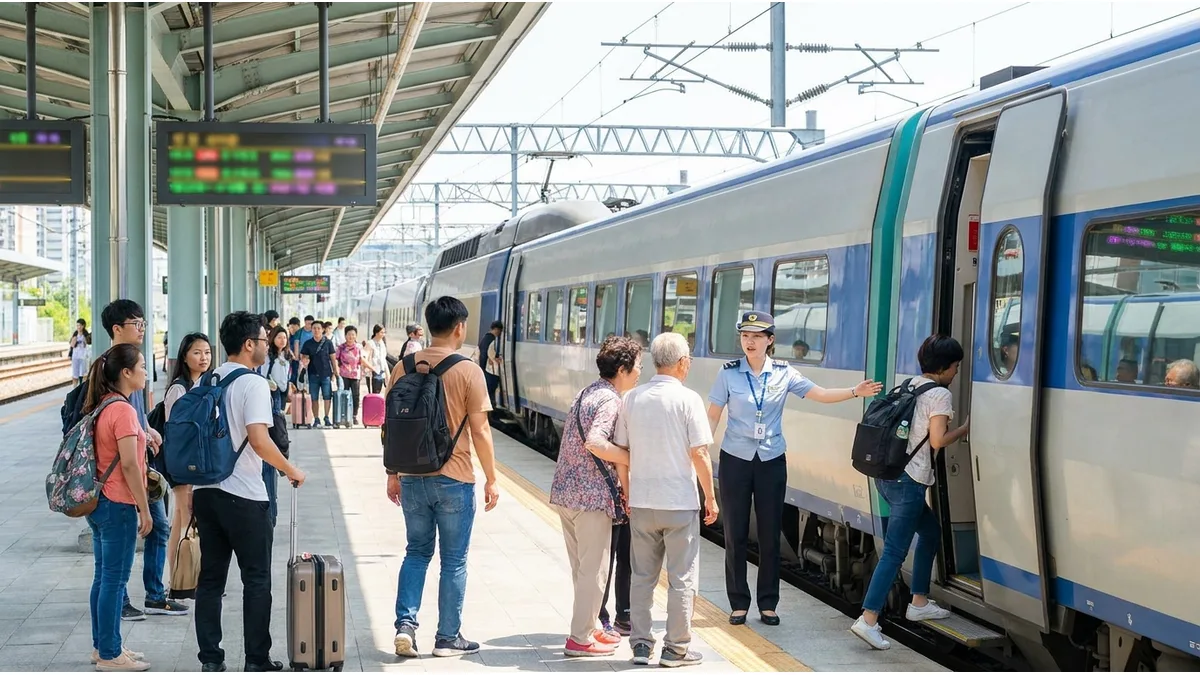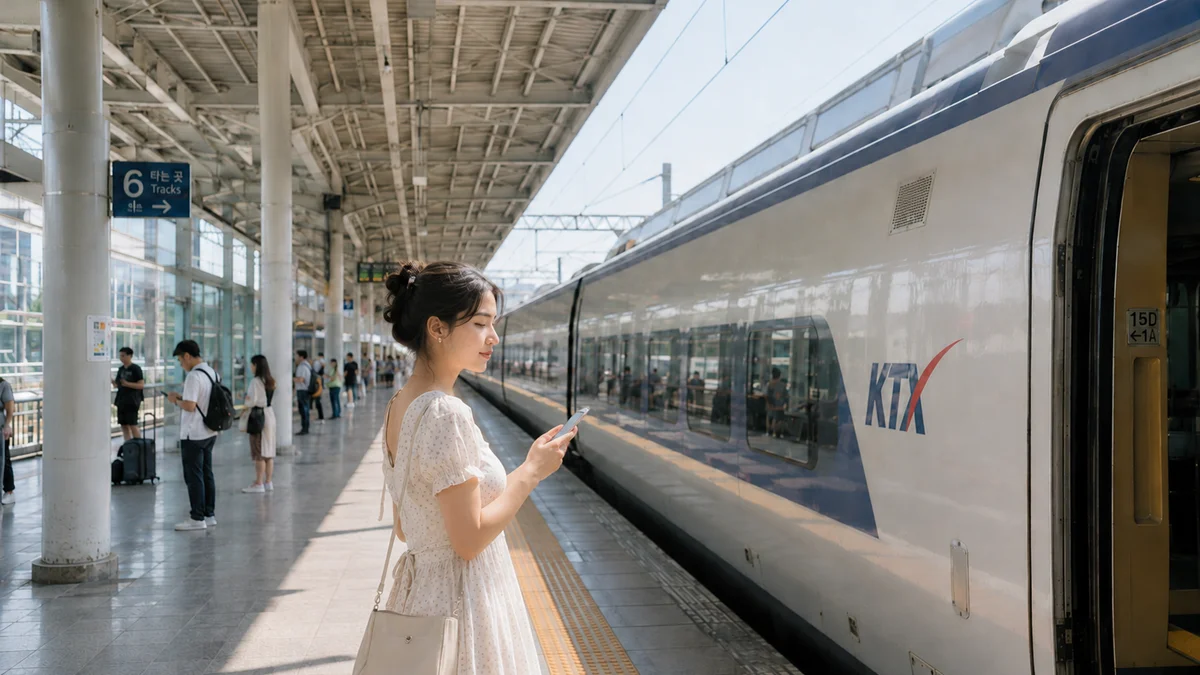

Korea's high-speed rail is becoming one system starting September 1, 2026. Korail and SR, which had operated KTX and SRT separately, are merging, and from the first train on September 1, the SRT name will disappear and all high-speed trains will run as KTX. Trains previously called SRT will be absorbed into KTX-Sancheon.
Fares are dropping too. High-speed KTX fares will be reduced by an average of 10%, bringing Seoul↔Busan economy class one-way down from 59,800 KRW to 54,400 KRW. This fare will be kept for at least three years, a minimum period set during the Korea Fair Trade Commission's merger review.
Booking windows are consolidating into one. Korail Talk changed its name to 'Korail+' on August 3, 2026, and from September 1, you'll book all trains—including those departing from Suseo Station—in this single app. The SRT app and SR website will only operate until August 31.
If you already bought tickets in August, don't worry too much. Tickets for travel on or after September 1 have been sold at the reduced fare since sales opened on August 5, and SRT tickets for travel through August 31 remain fully valid.
Note: The fare, schedule, and app information in this article is based on the Korea Fair Trade Commission's merger approval announcement and official notices from Korail and SR as of August 2026. Additional details may be released before and after the implementation date (September 1, 2026), so please double-check with the Korail+ app and Korail website right before booking.
What Changes from September 1, 2026
Let's look at the big picture first. Four things are changing: operator, brand, booking channels, and fares. Here's a side-by-side comparison of how things look through August 31 versus from September 1 onward.
| Item | Through August 31, 2026 | From September 1, 2026 |
|---|---|---|
| Train name | KTX and SRT as separate brands | All high-speed trains unified as KTX (SRT → KTX-Sancheon) |
| Operation | Korail and SR operate separately | Korail operates integrated system |
| Booking app | Korail Talk / SRT app separately | Korail+ only |
| Seoul↔Busan economy one-way | 59,800 KRW | 54,400 KRW |
| Yongsan↔Gwangju-Songjeong economy one-way | 46,800 KRW | 42,000 KRW |
| High-speed line base fare | 8,400 KRW | 7,500 KRW |
| Mileage | No accrual on Suseo departures | Extended to Suseo departures, 5% of payment |
| Transfer discount | Not applied to Suseo departures | 30% off regular train segment fare |
Here's the background. The Korea Fair Trade Commission gave final merger approval on August 2, 2026, allowing Korail to acquire SR's operations and the government's 58.95% stake in SR. As a result, both high-speed rail systems are operated by one company starting September 1.
Booking for integrated trains already started at 10:00 AM on August 5, 2026. Travel from September 1 onward became available that day on Korail+, the Korail website, and station counters. Only SRT trains running through August were still handled on the legacy SRT app and website.
Important: What's merging is operations, booking, and branding. Stations are NOT merging. Seoul Station, Yongsan Station, and Suseo Station all remain separate, so even if everything shows up in one app, you must always confirm whether your ticket departs from Seoul, Yongsan, or Suseo.
How Much Are Fares Dropping — Route Comparison Before & After
This fare reduction aligns high-speed rail fares with the former SRT level. It eliminates the price gap that used to make KTX more expensive than SRT for the same route, starting September 1.
| Route·Item | Through August 31, 2026 | From September 1, 2026 | Difference |
|---|---|---|---|
| Seoul↔Busan economy one-way | 59,800 KRW | 54,400 KRW | 5,400 KRW reduction |
| Yongsan↔Gwangju-Songjeong economy one-way | 46,800 KRW | 42,000 KRW | 4,800 KRW reduction |
| High-speed line base fare | 8,400 KRW | 7,500 KRW | 900 KRW reduction |
| All high-speed KTX | Current fare | Average 10% reduction | Kept for at least 3 years (minimum period set in FTC merger review) |
A few things worth noting:
- We can't assume fares will automatically go back up after three years. The three years is the minimum mandatory period for keeping fares and services that the Korea Fair Trade Commission set in its merger review, and during that period the Fair Trade Commission and the Ministry of Land, Infrastructure and Transport check how Korail carries out its business plan. The Ministry of Land, Infrastructure and Transport said that restoring fares or reducing mileage after three years "has not been decided." Under the Railroad Business Act, a fare change requires Korail to file it and the Ministry to accept it, so Korail cannot decide it alone, and after the period ends fares will be reviewed again considering financial conditions and inflation.
- The reduction target is high-speed KTX. All announcements only say "high-speed rail (KTX) fares average 10%," so it's not confirmed whether KTX-Eum running on Gangneung and Jungang lines is included (tentative — official confirmation needed).
- First class also dropped on September 1. However, the reduction rate differs from economy class, so you can't estimate first-class prices from the economy amounts in the table above. The Seoul↔Busan first-class amount isn't published in official materials, so confirm the actual amount shown on the booking screen.
- Regular train fares like ITX-Saemaeul and Mugunghwa aren't changing. However, transfer discounts now apply to Suseo Station departures, giving you 30% off the regular train segment when you connect from high-speed rail. Online deals are also newly available for former SRT routes.
- Age discounts still apply. Youth (ages 13–24) get 10–30% off, and young adults (ages 25–33) get 10–40% off.
To compare actual travel costs from Seoul to Busan, check out Seoul to Busan by KTX Guide alongside this article.
Note: First class also dropped, but at a different rate from economy class. The reductions in the table above are based on economy class and the Seoul↔Busan first-class amount isn't published in official materials, so if you're planning to book first class, confirm the actual amount shown on the booking screen.
The SRT Name Becomes KTX-Sancheon
The brand transition timing is clear. SRT ends service with the last train on August 31, 2026, and from the first train on September 1, it runs under the KTX name. The trains themselves aren't disappearing—just the name tag.
- Former SRT rolling stock is absorbed into KTX-Sancheon. From September 1, only one high-speed train brand remains in Korea: KTX.
- Suseo Station isn't disappearing. Suseo Station continues operating as a separate station serving the Suseo–Pyeongtaek high-speed line.
- Starting September 1, train operations are integrated regardless of origin/destination distinctions. So you might catch a former KTX-bound train at Suseo Station or a former SRT-bound train at Seoul Station.
- There's no guidance on when all station signage will be updated. Official timelines for replacing SRT displays on electronic boards, announcements, or train livery have not been confirmed (tentative — official confirmation needed).
What really matters for foreign travelers is the search term you use when booking. If you saved instructions on "how to book SRT," just remember that from September 1, there won't be any tickets sold under that name. If you're curious how the two trains differed, check SRT vs KTX Comparison first to understand the pre-merger structure, then come back to this article for faster comprehension.
Where to Book — Korail Talk Becomes 'Korail+'
Korail Talk changed its name to 'Korail+' on August 3, 2026. You don't need to install a new app, but you do need to update to search for integrated trains.
- Book travel from September 1 onward on Korail+. The Korail website and station counters remain available.
- The SRT app and SR website only operate through August 31. Not just high-speed rail bookings, but also commuter and multi-ride passes, new member registration, travel packages, partner services, customer inquiries, and chatbots all shut down.
- Third-party platforms like Naver and Kakao T remain usable. You can purchase high-speed trains departing from Suseo through these channels starting September 1 (foreign language support on these platforms needs separate confirmation).
- Booking steps reduced from 7 to 4. PIN/biometric quick login, large text mode, dark mode, widgets, Samsung Wallet integration, and paperless tickets were also added.
| Booking Channel | From September 1, 2026 | Languages |
|---|---|---|
| Korail+ app | All high-speed trains including Suseo departures | Multilingual support (7 languages per App Store listing) |
| Korail website | Bookings available | English page available |
| SRT app·SR website | Service ends August 31 | — |
| Naver·Kakao T etc. external platforms | Suseo departures available for purchase | Confirmation needed (tentative) |
| Station counters | Available (except during Chuseok booking period) | Varies by station |
| LACHA | Book KTX·express buses in one app, use foreign payment methods without identity verification | English·Vietnamese·Russian·Thai·Traditional Chinese |

What Happens to Tickets Purchased in August
This is the most common concern. Bottom line: you don't need to cancel and rebook.
Tickets for travel from September 1 onward have been sold at the reduced fare since sales opened on August 5. The usual one-month advance booking was bypassed by setting the opening date for September 1 departures to August 5. So there's no such thing as 'September tickets bought at the old price.' Trains running through August 31 use pre-reduction fares, and there's no announced retroactive refund for those (tentative — official confirmation needed).
SRT tickets purchased in August are the same. They're valid through August 31 as-is. However, from September 1, booking and refund rules shift to Korea Railroad Corporation passenger transport terms.
| What You Bought in August | From September 1, 2026 |
|---|---|
| September travel ticket | Valid as-is. Sold at reduced fare from the start, no need to rebook |
| August SRT ticket | Use normally through August 31. No need to refund or rebook |
| SRT commuter/multi-ride pass | Usage ends August 31, unused portions auto-refunded |
| SR member coupons | Unused coupons migrated to Korail+ integrated members as of August 25 (already past) |
| SR-only member account | You must convert to integrated membership yourself |
If you use passes, there's a bit more to handle. SRT commuter and multi-ride passes end both sales and usage on August 31, and any pass whose validity runs into September is automatically refunded. Commuter passes refund the unused days (excluding weekends and holidays); multi-ride passes refund the unused rides. To keep using a pass after September, you'll need to buy a Korail commuter pass (sales started August 27, valid from September 1) or an N-Card (sales started August 5) — but N-Cards are for railroad members only, so convert to integrated membership first.
Important: SR announced on August 21, 2026 that the SRT app and SR website will only operate through August 31. From September 1, all SRT app functions—including non-member bookings—shut down, so plan around this timeline.
What Foreign Visitors Should Prepare in Advance
Whether you live in Korea or are coming to visit, here's what to sort out before September.
- Check membership conversion first. Korail-only members convert automatically, but dual members with both Korail and SR accounts must manually consent to SR activity migration via the 'Integrated Member Conversion' menu on the web. The conversion process opened on July 14, 2026.
- SR-only members must convert. Without conversion, you can't book Chuseok tickets using your existing SR member number.
- App languages are supported but not perfect. The Korail+ app on the App Store lists Korean, English, Japanese, Chinese (simplified·traditional), Thai, and Vietnamese as supported languages. However, post-launch reviews noted some popup buttons only displayed in Korean. "Multilingual support" and "seamless checkout" are two different things.
- Foreign card·passport non-member booking guidance post-merger hasn't been released yet. Pre-merger, Korail stated on its foreign-language website that it accepts foreign-issued credit cards. Post-September procedures for foreign member registration or 3D Secure authentication support on the Korail+ app are not confirmed (tentative — official confirmation needed).
- Advance booking period is extending. Per a Korail notice, booking that used to open one month before departure opens two months before, at 7:00 AM, from October 1, 2026 (holiday trains are announced separately). This is a significant change for travelers booking flights first.
- Multilingual AI chatbots and global platform integration without membership are at the 'planning' stage. Korail and the Ministry of Land, Infrastructure and Transport announced the direction but no implementation date.
Specific pain points where foreign visitors hit walls on the Korail app are covered separately in Where Foreigners Get Blocked on the Korail App.
More Seats, More Trains, and New Routes to Suseo Station
The merger's benefits go beyond fares. Supply is increasing too.
- 116,000 seats added per week. That's about 16,000 seats per day: 15,679 on weekdays and 17,655 on weekends.
- Service frequency increases from 379 to 402 runs on weekdays, 431 to 457 on weekends. Daily increase is 23 runs weekdays (Seoul 13·Suseo 10) and 26 runs weekends (Seoul 14·Suseo 12).
- Suseo Station gets 955-seat KTX trains. These are the highest-capacity trains, noticeably boosting Suseo seat supply (specific increase rate needs official confirmation).
- New Suseo~Gupo~Busan service launches. Starting September 1, 2026: one run daily on weekdays, two runs on Fridays/Saturdays/Sundays.
- Seodaejeon~Suseo KTX also adds two round trips. Departures from Seodaejeon at 12:03 and 14:39, from Suseo at 09:39 and 16:11.
Travel time and intermediate stops for new routes haven't been disclosed yet (tentative — official confirmation needed). If you're planning trips to regional cities, check Regional Cities Train·Bus Access Guide alongside this for route planning.
2026 Chuseok Booking: App·Website Only
Chuseok booking comes right after implementation. Here's the schedule Korail announced on August 14, 2026:
- Pre-booking for passengers with reduced mobility runs September 3–4, 09:00–15:00.
- General booking runs September 7–11, 07:00–13:00.
- Station counters will not operate. 100% non-face-to-face booking via Korail+ app and website.
- SR-only members must complete integrated membership conversion in advance. Booking is blocked without conversion.
How holiday ticket competition usually plays out is covered in Chuseok·Seollal Train Booking Guide.
When Booking Gets Blocked at Payment
While the merger cleans up booking channels into one starting September 1, the actual pain points for foreigners remain the same: Korean-style identity verification and foreign card payment. You might be asked for a Korean phone number during sign-up, or face 3D Secure rejections without explanation. This is especially true since post-September 1 procedures for foreign sign-up and payment on Korail+ haven't been officially announced yet.
LACHA is a transportation and payment app designed for foreigners to use without Korean-style identity verification. You can book immediately without a Korean bank account or Korean phone number. You can search and book KTX and express buses in one app, and pay with 17 e-wallets including Alipay and WeChat Pay, plus VISA, Mastercard, JCB, AMEX, and UnionPay foreign cards. Instant taxi calls, Airport Railroad Express (AREX), and transit cards all flow through the same app. Korail's official channels do sometimes work with passports and foreign cards, so keeping both routes open makes you safer.
Want to search and book KTX and express buses in one app? Check out LACHA.
Built to work without a Korean phone number or bank account, with overseas payment methods like Alipay, WeChat Pay, and Apple Pay. Taxi hailing plus KTX, express bus, and airport railroad (AREX) booking — all in one app.
Up to 60% off Korea transit with a coupon (max ₩3,000): enter code at sign-up. KTX gets up to 18% off on top
Download now


Frequently Asked Questions (FAQ)
Q1. Do I need to cancel and rebook tickets I bought in August? A. No. Tickets for travel from September 1 onward have been sold at the reduced fare since sales opened on August 5, so 'September tickets at the old price' don't exist. Trains running through August 31 use pre-reduction fares, and there's no announced retroactive refund (tentative — official confirmation needed). SRT tickets purchased in August are valid through August 31 as-is.
Q2. Can I still use the SRT app in September? A. No. SR announced on August 21, 2026 that the SRT app and SR website will only operate through August 31. Not just bookings, but also sign-ups, travel packages, and chatbots all shut down. From September 1, book Suseo-departing trains on the Korail+ app, Korail website, station counters, or third-party platforms like Naver and Kakao T.
Q3. If SRT disappears, can I still catch trains at Suseo Station? A. Yes. What's merging is the operator, brand, and booking channels—not the station. Suseo Station continues operating, and 955-seat KTX trains are being added, actually increasing seats. However, since Seoul, Yongsan, and Suseo all show up in one app, always confirm your departure station when booking. If you're staying in Gangnam or Jamsil, Suseo is more convenient.
Q4. How much are fares dropping, and will they go back up after three years? A. Seoul↔Busan economy one-way drops from 59,800 KRW to 54,400 KRW, Yongsan↔Gwangju-Songjeong economy from 46,800 KRW to 42,000 KRW. For all high-speed KTX, it's an average 10% reduction kept for at least three years, the minimum period set during the Korea Fair Trade Commission's merger review. The Ministry of Land, Infrastructure and Transport said restoration after three years "has not been decided," and a fare change requires Korail to file it and the Ministry to accept it, so we can't assume automatic increases. First class also dropped, but at a different rate from economy, and the Seoul↔Busan first-class amount hasn't been published, so check the booking screen.
Q5. As a foreigner, can I use the Korail+ app in English? A. According to App Store listing, it supports Korean, English, Japanese, Chinese (simplified·traditional), Thai, and Vietnamese. However, post-launch reviews noted some popup buttons only appeared in Korean, and there's no official confirmation on foreign member registration procedures or foreign card 3D Secure support post-merger. If payment gets blocked, check station counters or the alternatives outlined in How to Book KTX with Foreign Cards.
Reference: This article's fare, schedule, and app information is current as of August 2026, with the merger implementation date of September 1, 2026. Additional or revised details may be released before and after implementation, so items not yet announced—such as KTX-Eum coverage and foreign payment procedures—and first-class fares, whose amounts aren't given in official materials, are not stated definitively. Always verify actual fares, timetables, and payment availability on the Korail+ app and Korail website immediately before booking.